

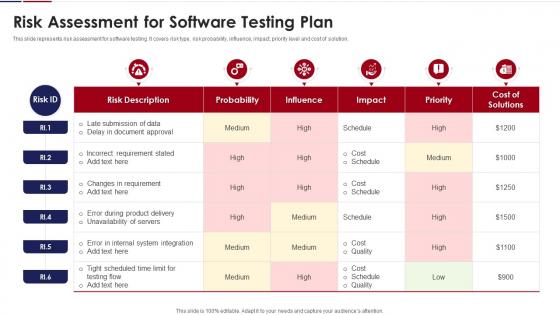
Risk Assessment For Software Testing Plan




Try Before you Buy Download Free Sample Product
 Impress Your
 Audience
 100%
100% Editable
 Save Hours
 of Time


This slide represents risk assessment for software testing. It covers risk type, risk probability, influence, impact, priority level and cost of solution.
People who downloaded this PowerPoint presentation also viewed the following :
Risk Assessment For Software Testing Plan with all 6 slides:
Use our Risk Assessment For Software Testing Plan to effectively help you save your valuable time. They are readymade to fit into any presentation structure.





FAQs for Risk Assessment For
You've got four main pieces to work with: spotting risks, analyzing them, deciding what matters, and actually doing something about it. Start by figuring out what could go sideways in your situation. Then look at how likely each thing is and how bad it'd be if it happened. Here's where most people mess up though - they don't have those awkward conversations about what level of risk they can actually live with. Once you know your priorities, pick your strategy: avoid it, reduce it, pass it off to someone else, or just accept it. Don't forget to check back regularly since everything changes.
Honestly, just look at everything that could go wrong across your whole operation. Get people from different teams together for brainstorming - they'll catch stuff you'd never think of. Check your processes, systems, supply chain, all that. Past incidents are goldmines for this, even the minor headaches that seemed trivial at the time. Don't skip the boring stuff like regulatory changes and cyber threats either. I'd set up a basic risk register to track what you find and rank them by how likely they are vs. how much damage they'd cause. The biggest mistake? Treating this like an annual thing instead of staying on top of it year-round.
Honestly, data analysis is what turns your hunches into actual proof when you're assessing risks. You'll be digging into historical trends and spotting patterns instead of just winging it. Numbers don't lie - they show you the real probability and impact of different scenarios. I've seen too many people try to skip this step and then scramble when leadership asks for backup. Good analysis catches risks you'd totally miss otherwise and helps you figure out what's actually worth stressing about. Just make sure your data's solid first though - crappy data equals crappy conclusions.
Risk assessments? At minimum once a year, but honestly that's cutting it close. Any major changes - new systems, processes, whatever - should trigger an immediate review. Don't just wait around. High-risk stuff like finance or healthcare probably needs quarterly check-ins since everything moves so fast there. I always think of it like car maintenance - regular schedule plus before big trips, you know? Set up calendar reminders and make sure someone actually owns this process. Otherwise it'll just get forgotten in the chaos. Map out which areas need more frequent reviews based on how risky they actually are.
So basically quantitative risk assessment uses actual numbers - like calculating exact percentages and dollar amounts for potential losses. Qualitative just uses ratings like "high, medium, low" based on what experts think will happen. Most teams I've seen go with qualitative because it's so much faster. You don't need a bunch of historical data either. But executives love seeing concrete numbers when you're asking for budget money, so quantitative works better for financial stuff. My approach? Do a quick qualitative sweep first to spot your biggest problems, then get into the math on those major risks.
Honestly, just grab a risk matrix - it's the easiest way to sort this mess out. Plot everything by how likely it is vs how badly it'd hurt your business. High probability + high impact = deal with it now, obviously. Most people I know totally skip this part though and just guess, which is kinda insane when you think about it. Oh, and don't forget some risks might be legally required to fix regardless of where they land on your chart. Check what resources you actually have too. Start with whatever's in the danger zone and work from there.
Depends what you're assessing and how much you can spend, really. GRC platforms like ServiceNow or MetricStream are solid if you need the full package - threat modeling, compliance tracking, all that stuff. For cybersecurity, I'd go with Nessus or Qualys for vulnerability scans. OpenVAS works too if you're on a tight budget. Honestly though? Sometimes a good Excel template does exactly what you need without the fancy bells and whistles. Risk matrices are pretty standard, and there's Monte Carlo simulation software if you want to get statistical about it. Oh, and bow-tie analysis tools are great for certain industries. Just figure out your risk type first, then match it to something that won't drain your wallet.
Honestly, compliance basically runs the whole show when it comes to risk assessment. You can't just wing it based on what feels right - everything has to match what regulators want to see. So you're stuck using their methodologies, their reporting formats, all of it. Pretty annoying but whatever. I'd start by figuring out which regulations actually apply to you first. Then map your current risks against those rules. Build your whole process around meeting those requirements, whether it's banking stuff, healthcare regs, environmental standards. Trust me, it'll save you headaches later when auditors show up asking questions.
Honestly, don't wait until you're already in trouble to think about what could go wrong. From the start, figure out what risks could mess up your main goals - market changes, new regulations, operational stuff breaking down. Rate each one by how likely it is and how bad it'd be if it happened. That way you can focus on the scary ones first. Build backup plans for those big risks now, not later when you're scrambling. I'd say review everything quarterly since things change fast. Oh, and make risk evaluation part of every big decision you make - it'll save you headaches down the road.
Honestly? Getting clean data is a nightmare - there's always something missing. Stakeholder alignment is even worse though. Everyone thinks their pet project is "critical" while ignoring actual risks. Quantifying the subjective stuff gets messy fast, especially with different risk tolerances on your team. Oh, and management will give you like two weeks for what should take two months. Risks change constantly too, so you're basically chasing a moving target. I'd focus on your most important assets first and get people to agree on risk criteria upfront - saves you so much headache later.
Honestly, good training is like having your own early warning system. Your people become way better at catching problems before they blow up - safety stuff, compliance issues, you name it. I've watched untrained employees mess up things that cost thousands to fix, so yeah, it's worth the investment. You want both general awareness training and the specific dangers for each role. Oh, and definitely figure out where your training gaps are first - that's probably where you're most exposed right now. Makes the whole thing way more targeted.
Honestly, company culture makes or breaks whether risk assessments actually matter. People in super cautious places will report every tiny thing but stay quiet about the real disasters - they're scared of getting blamed. Then you've got those "fail fast" environments where everyone just ignores obvious red flags because, you know, innovation or whatever. What really matters is whether folks feel safe speaking up. I've seen this play out so many times. Watch how the bosses react when someone raises a concern. That'll tell you everything about whether your risk process is legit or just theater.
Each industry has totally different regulations and risks you've gotta watch for. Healthcare? You're dealing with patient safety stuff, HIPAA rules, and medical equipment that could fail. Finance is more about SOX compliance, hackers going after financial data, and making sure trading systems don't crash. The basic framework approach is pretty much the same, but everything else changes. A data breach hits finance with regulatory fines - healthcare though? That's actual patient harm we're talking about. I'd start by listing your industry's top 5 regulatory requirements first. Then build your risk categories around those. Way easier than trying to force a generic template to fit.
You really can't spot every risk on your own - different people see different problems based on what they deal with day-to-day. Getting various stakeholders involved early means you'll catch way more potential issues. Plus (and this is huge) people actually follow through on plans they helped create. When someone feels like their input mattered, they're not gonna fight you later on implementation. Each person brings their own experience with threats and solutions you might never think of. Oh, and the data quality is just better when multiple perspectives are feeding in. Start involving people from the beginning, not as an afterthought.
Look, past incidents are honestly your best learning tool. They show you what actually happened vs what you *thought* might happen. You can spot the blind spots you totally missed and update your risk ratings with real data instead of guesswork. Plus you'll find new risk categories you never even considered - there's always something that catches you off guard. The trick is going back through incidents systematically and asking "okay, what would we do differently now?" Then actually update your templates with those lessons. I know it sounds obvious but most people skip that last step.
-
It's always a delight to see new templates from you! I am extremely pleased with the fact that they are easy to modify and fit any presentation layout in seconds!
-
Happy to incorporate such stunning templates in my presentation. Made my presentation look professional and engaging.