


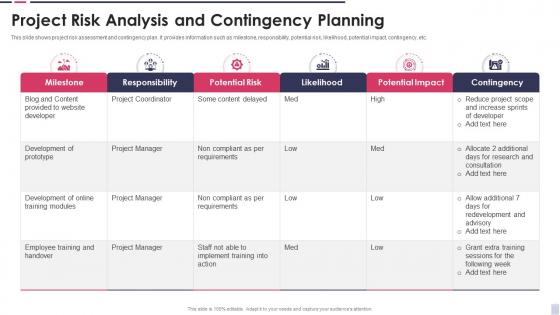
Project Risk Analysis And Contingency Planning




Try Before you Buy Download Free Sample Product
 Impress Your
 Audience
 100%
100% Editable
 Save Hours
 of Time


This slide shows project risk assessment and contingency plan. It provides information such as milestone, responsibility, potential risk, likelihood, potential impact, contingency, etc.
People who downloaded this PowerPoint presentation also viewed the following :
Project Risk Analysis And Contingency Planning with all 6 slides:
Use our Project Risk Analysis And Contingency Planning to effectively help you save your valuable time. They are readymade to fit into any presentation structure.





FAQs for Project Risk Analysis
Okay so you'll want to cover four main things: identifying risks, figuring out how bad they could be, planning responses, and keeping tabs on everything. Get your team together and brainstorm every possible thing that could go wrong - seriously, the random stuff people think of often ends up happening. Rate each risk on probability and impact with a basic matrix. For responses, you've got four options: avoid it, reduce it, pass it off to someone else, or just accept it. Oh, and assign someone to own each risk because otherwise nobody watches them. The biggest mistake? Creating this whole plan then never looking at it again.
Start looking for risks during planning - seriously, the earlier the better. Check out what went sideways on similar projects first (there's always drama). Get everyone together for brainstorming sessions. SWOT analysis works, or just make a simple risk list. Dependencies are usually where things get messy, plus resource issues and tech problems. Oh, and question your assumptions - that's where the sneaky risks hide. I'd set up monthly check-ins to catch new stuff as it pops up. Projects are basically just controlled chaos anyway.
Start with a basic probability/impact matrix - plot risks on a grid using 1-5 scores for likelihood and impact, then multiply for your risk score. Super visual and stakeholders actually get it during meetings. Monte Carlo simulations are solid for complex stuff where you're modeling different scenarios. Historical data analysis works too, though it gets subjective real quick depending on your team. Expert judgment's the same way - kinda hit or miss. Oh, and there's the Delphi technique if you want structured expert input, but honestly? I'd just stick with the matrix approach first. Way easier to explain.
Yeah, external stuff will mess up your project faster than you think. New regulations drop out of nowhere, interest rates jump, supply chains break - suddenly your whole plan is screwed. I've seen it happen with tech projects where a competitor launches something game-changing mid-stream. Your budget assumptions? Gone. Timeline? Forget it. What really helps is watching the outside world while you're working. Set up some basic alerts for market changes that actually matter to your project. Have backup plans ready because honestly, something always comes up that you didn't see coming.
Honestly, good stakeholder communication is like having extra eyes on your risks. They'll catch stuff you miss and help brainstorm fixes before things get messy. Trust me on this - when something does go wrong, people who were already in the loop won't panic nearly as much. They're way more likely to have your back during damage control. Quick weekly check-ins work great, doesn't have to be fancy. Even just shooting them an email with the highlights builds so much trust over time. It's basically your safety net and early warning system combined.
Start broad with qualitative stuff first - way faster and you won't get lost in spreadsheets right away. Just categorize risks and figure out which ones are actually worth worrying about. The high-priority ones? That's where you bust out the fancy quantitative methods like Monte Carlo sims. Honestly, most people jump straight to the complex analysis and waste tons of time. This two-step approach gives you the full picture plus the detailed numbers your boss will want to see. You'll have solid data to back up whatever risk plan you pitch.
So there's four main ways to handle project risks. You can avoid them completely by changing your approach. Mitigation is about reducing either the chance it happens or how bad it'll be - like building in extra time or resources. Transfer means making it someone else's problem, usually through insurance or dumping it on vendors (they hate that but whatever). Then there's just accepting it exists and rolling with it. Honestly, I'd group your risks into these categories first. Focus your energy on action plans for the ones that could really mess things up.
So definitely start with a risk matrix - plot everything by how likely it is vs how bad it'd be if it happens. The scary high-probability, high-impact stuff gets your attention first, obviously. Get your whole team involved though, seriously - they always spot things I completely miss. Medium risks? Just keep an eye on them without going crazy. Low risks can sit there and get a monthly check-in. Oh, and don't lie to yourself about probabilities just because dealing with something sucks. I've been guilty of that before. Keep updating the matrix as things shift around.
Honestly, I'd start with whatever project management tool you're already using - most have decent risk tracking built in. Monday.com and Asana are solid for this stuff. If you need something more specialized, check out RiskWatch or LogicGate. They handle the whole process from spotting risks to monitoring them. Excel can work too, but ugh, it gets super messy once things get complicated. For bigger companies, Resolver and ServiceNow are worth looking at. My advice? Don't overcomplicate it by adding yet another platform if your current PM tool can handle the basics.
Oh totally, stakeholder risk tolerance is all over the map. Executives? They'll gamble on big strategic moves but freak out the second you go over budget. End users are usually the most scared of change - makes sense since they're stuck with whatever mess you create. Project sponsors sit somewhere between those two camps. Finance people hate scope creep with a passion, which honestly I get. The trick is figuring out each person's comfort level upfront. Then you can't just blast the same risk report to everyone - your CEO wants different info than the actual users do. It's like speaking different languages sometimes.
So you want to know if your risk management is actually working? Start by tracking how many risks you catch before they blow up - that's the golden metric right there. Also check if your mitigation plans actually work by comparing what you expected vs what really happened when things went sideways. Budget variance is huge too, especially timeline impacts. Honestly, most people overthink this stuff. Pick maybe 3-4 metrics that matter to your specific project and don't get lost in the weeds with fancy dashboards.
Okay so when surprise risks hit, don't panic but move quickly. Figure out if it's urgent or can wait a few days. Document everything right away - future you will thank you for this. Then decide: avoid it, fix it, pass it off to someone else, or just deal with it. Get your team involved because honestly, when you're stressed you miss obvious solutions. Tell everyone affected immediately (nobody wants to find out about problems through gossip). Update your risk log and maybe do a quick "what went wrong" chat later. I've learned the hard way that skipping that last part just means you'll repeat the same mistakes.
Look, documenting what went wrong (and right) with project risks is like keeping notes for an open-book test. You're building this knowledge bank that future teams can actually use instead of stumbling into the same traps. I can't tell you how many projects I've watched repeat the exact same risk screwups because nobody wrote anything down. Those insights help you spot risks earlier, guess probabilities better, and plan smarter fixes. Honestly, even a basic bullet-point log helps tons. Start one now - your future self will thank you.
Yeah, cultural stuff really throws off global risk management. Some teams won't speak up about problems because challenging leadership feels rude in their culture. Others see risks everywhere while some just roll with whatever happens - honestly drives me crazy sometimes. What looks urgent to your US team might seem totally manageable to colleagues in other countries. Different communication styles make it worse too. I'd set up various ways for people to flag issues, maybe anonymous channels? Also figure out early how each culture usually deals with uncertainty so you're not blindsided later.
Honestly, AI risk prediction is everywhere now - way better than those crusty Excel sheets we used to rely on. Real-time dashboards that actually auto-update are game changers. Risk management isn't this weird separate thing anymore either, it's built right into agile workflows and sprint planning. Predictive analytics helps catch issues before they explode in your face, which is nice. Teams are way more chill about "fail fast, learn faster" these days. My advice? Start with whatever plugs into your current project management setup - trust me, adoption is so much smoother that way.
-
I am really satisfied with their XYZ products. Used their slides for my business presentations and now I am taking their help for my son's high-school assignments. Super satisfied!!
-
SlideTeam’s readymade presentations have landed my unique images with my bosses in the past and it continues to reward me.