


Operational Risk Management Strategic Plan Powerpoint Presentation Slides




Try Before you Buy Download Free Sample Product
 Impress Your
 Audience
 100%
100% Editable
 Save Hours
 of Time


Operational Risk Management attempts to reduce risks and deals with monitoring and managing operational risks. Grab our insightfully crafted Operational risk management strategic plan. It is a top down strategy to identify, assess, and prepare for potential hazards and damages that could disrupt an organizations operations. Our Operational risk management deck incorporates the mitigation plan to assist managers in shaping the enterprises overall risk positioning. This template illustrates the difficulties businesses face due to a lack of proper operational, strategic, and financial risk management. It also discusses the different types, benefits, strategies, and operating, strategic, and financial risk management frameworks. It also covers how to identify, assess, mitigate, and monitor various types of organizational risks. Our ERM module further includes effective risk management and risk mitigation strategies for various enterprise risks. Finally, the presentation emphasizes the costs associated with implementing enterprise risk management, the impact of ERM on the overall operational performance of the organization, and the reduction of potential hazards that may harm business operations. To learn more, download our 100percentage editable and customizable risk management ppt now.
People who downloaded this PowerPoint presentation also viewed the following :
Content of this Powerpoint Presentation
Slide 1: This slide introduces Operation Risk Management Strategic Plan. Commence by stating Your company Name.
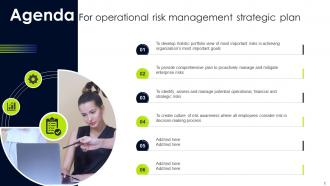
Slide 2: This slide depicts the Agenda of the presentation.
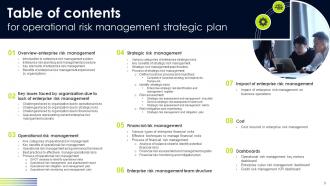
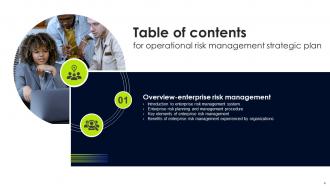
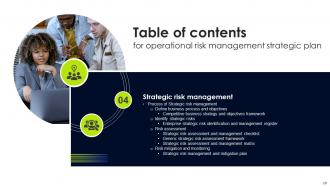
Slide 3: This slide incorporates the Table of contents.
Slide 4: This slide showcases the Title for the Topics to be discussed further.
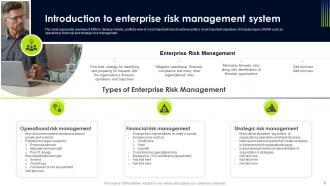
Slide 5: This slide presents the Introduction to enterprise risk management system.
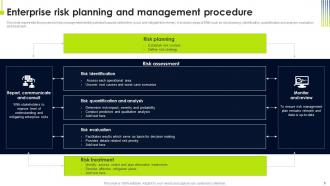
Slide 6: This slide showcases the process to help management identify potential hazards before they occur and mitigate them timely.
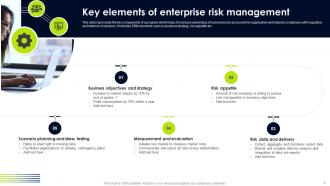
Slide 7: This slide elucidates the key components of a program which helps to increase awareness of business risks across entire organization and improve compliance with regulatory and internal compliance.
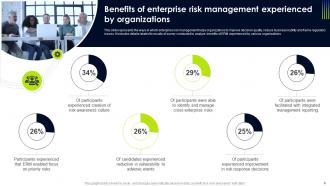
Slide 8: This slide lists the ways in which enterprise risk management helps organizations to improve decision quality, reduce business liability and frame regulatory issues.
Slide 9: This slide incorporates the Heading for the Ideas to be discussed next.
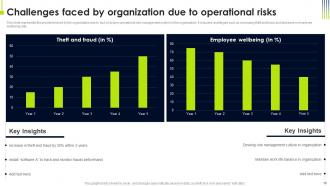
Slide 10: This slide showcases the problems faced by the organization due to lack of proper operational risk management system in the organization.
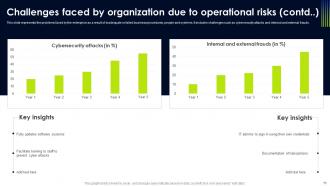
Slide 11: This slide continues the problems faced by the enterprise.
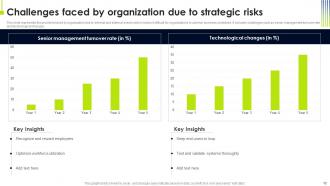
Slide 12: This slide exhibits the problems faced by organization due to internal and external events which makes it difficult for organizations to achieve business objectives.
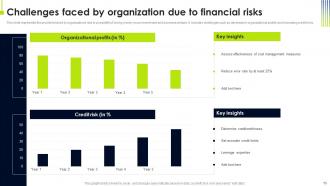
Slide 13: This slide represents the problems faced by organizations due to possibility of losing money on an investment and business venture.
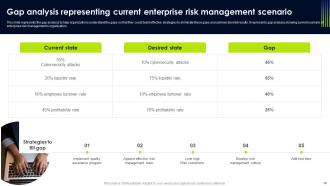
Slide 14: This slide talks about the Gap analysis representing current enterprise risk management scenario.
Slide 15: This slide incorporates the Title for the Ideas to be covered in the upcoming template.
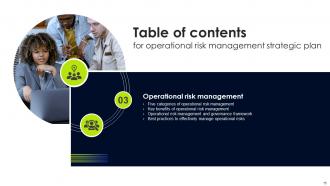
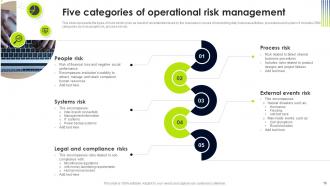
Slide 16: This slide reveals the Five categories of operational risk management.
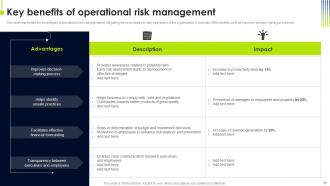
Slide 17: This slide shows the advantages of operational risk management in mitigating the risks related to daily operations of the organization.
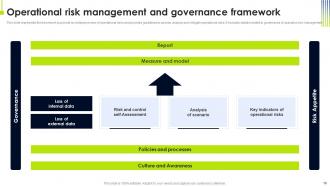
Slide 18: This slide highlights the framework to provide an enterprise view of operational risks and provides guidelines to assess, analyze and mitigate operational risks.
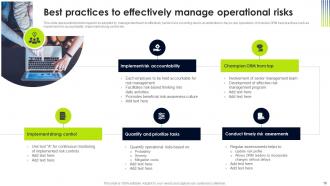
Slide 19: This slide talks about the Best practices to effectively manage operational risks.
Slide 20: This slide mentions the Heading for the Topics to be discussed further.
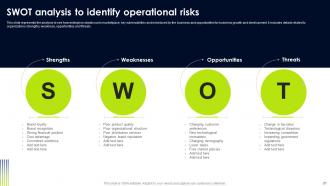
Slide 21: This slide elucidates the SWOT analysis to identify operational risks.
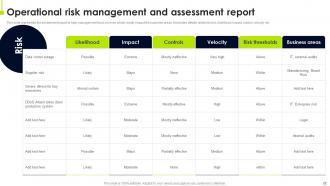
Slide 22: This slide represents the assessment report to help management focus on risks which mostly impact the business areas.
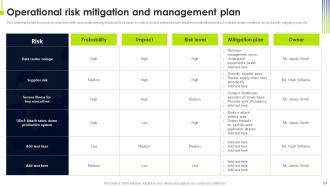
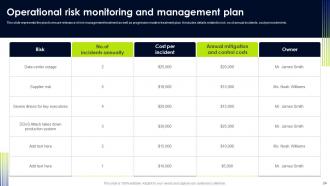
Slide 23: This slide deals with the Operational risk mitigation and management plan.
Slide 24: This slide portrays the plan to ensure relevance of risk management treatment as well as progresses made in treatment plan.
Slide 25: This slide incorporates the Title for the Components to be covered in the upcoming template.
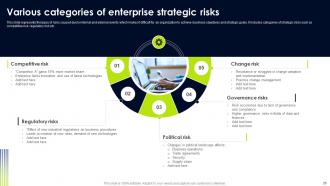
Slide 26: This slide provides information about the types of risks caused due to internal and external events which makes it difficult for an organization to achieve business objectives and strategic goals.
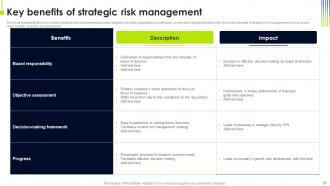
Slide 27: This slide exhibits the Key benefits of strategic risk management.
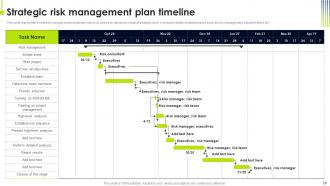
Slide 28: This slide focuses on the Strategic risk management plan timeline.
Slide 29: This slide reveals the Title for the Topics to be discussed next.
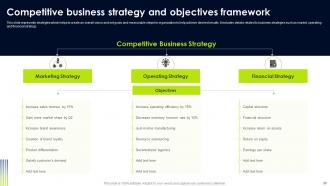
Slide 30: This slide presents the strategies which helps to create an overall vision and set goals and measurable steps for organization to help achieve desired results.
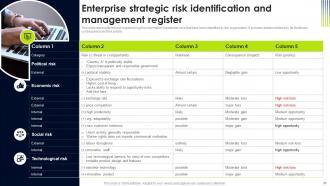
Slide 31: This slide highlights the Enterprise strategic risk identification and management register.
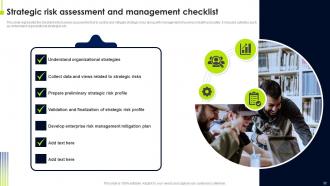
Slide 32: This slide shows the checklist which serves as powerful tool to control and mitigate strategic risks along with management of business health and safety.
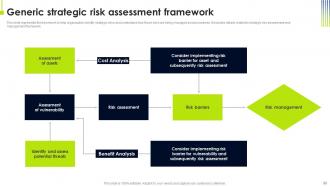
Slide 33: This slide deals with the Generic strategic risk assessment framework.
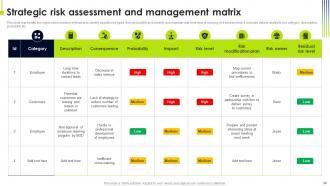
Slide 34: This slide represents the matrix which enables enterprise to identify specific risk types, their probability and severity and maintain real-time view of evolving risk environment.
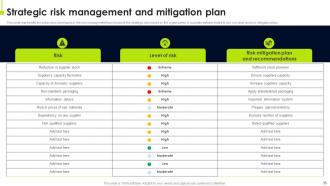
Slide 35: This slide contains the Strategic risk management and mitigation plan.
Slide 36: This slide reveals the Heading for the Components to be covered in the forth-coming slide.
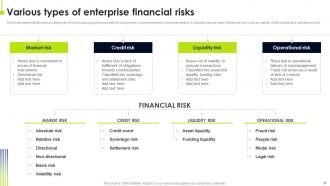
Slide 37: This slide lists the Various types of enterprise financial risks.
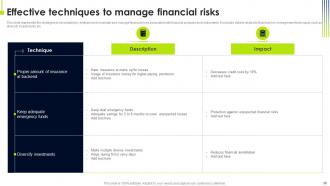
Slide 38: This slide exhibits the Effective techniques to manage financial risks.
Slide 39: This slide presents the Title for the Topics to be discussed next.
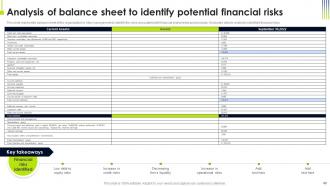
Slide 40: This sldie elucidates the Analysis of balance sheet to identify potential financial risks.
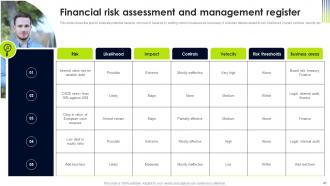
Slide 41: This slide shows the plan to evaluate potential hazards, removal of hazards by adding control measures as necessary.
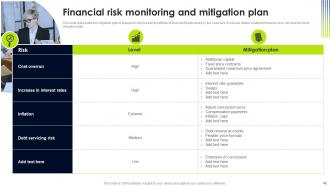
Slide 42: This slide represents the mitigation plan to prepare for and lessen the effects of financial threats faced by the business.
Slide 43: This slide contains the Heading for the Contents to be discussed further.
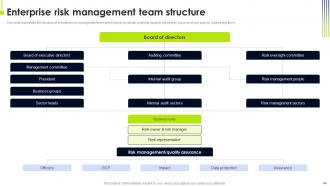
Slide 44: This slide illustrates the structure of enterprise risk management team which strives to identify potential hazards before they occur and have plan for addressing them.
Slide 45: This slide highlights the Heading for the Ideas to be covered in the next template.
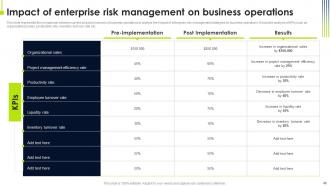
Slide 46: This slide deals with the Impact of enterprise risk management on business operations.
Slide 47: This slide shows the Title for the Contents to be discussed in the forth-coming template.
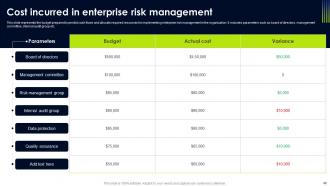
Slide 48: This slide reveals the Cost incurred in enterprise risk management.
Slide 49: This slide incorporates the Heading for the Topics to be discussed further.
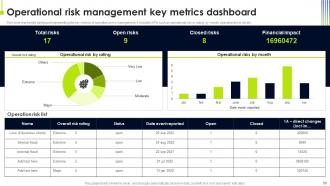
Slide 50: This slide represents dashboard representing the key metrics of operational risk management.
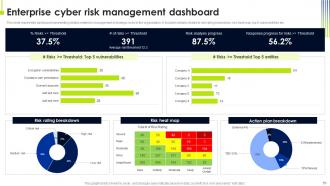
Slide 51: This slide focuses on the Enterprise cyber risk management dashboard.
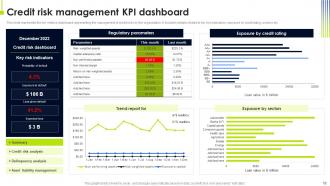
Slide 52: This slide illustrates the key metrics dashboard representing the management of credit risks by the organization.
Slide 53: This is the Icons slide containing all the Icons used in the plan.
Slide 54: This slide is used for the purpose of depicting Additional information.
Slide 55: This is the About us slide. State your Company related information here.
Slide 56: This is Our team slide for showcasing the information related to your team members.
Slide 57: This is the Puzzle slide with related imagery.
Slide 58: This slide contains the Post it notes for reminders and deadlines.
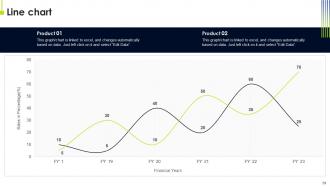
Slide 59: This slide elucidates the Line chart.
Slide 60: This is the Venn Diagram slide.
Slide 61: This is Our goal slide. List your Organization goals here.
Slide 62: This is the Thank you slide for acknowledgement.
Operational Risk Management Strategic Plan Powerpoint Presentation Slides with all 67 slides:
Use our Operational Risk Management Strategic Plan Powerpoint Presentation Slides to effectively help you save your valuable time. They are readymade to fit into any presentation structure.








FAQs for Operational Risk Management Strategic Plan
You'll need risk identification processes first, then assessment frameworks and controls to handle what you find. Monitoring systems are huge - risks change constantly so this can't just sit in a drawer somewhere. Set up clear reporting lines and governance stuff so everyone knows who's responsible when shit hits the fan. Map out your key processes and see where things usually break down - that's honestly the best starting point. Don't forget escalation paths and regular testing of controls. The whole thing needs to stay flexible because what works today might not work next month.
First thing - dig into what usually breaks in your industry. Check out regulatory stuff and honestly, see what disasters your competitors have dealt with (their pain, your gain lol). Get different departments together for risk workshops because they'll catch things you'd never think of from your level. Map out your main processes and find those scary single points of failure. Industry associations are gold for this - people love sharing their horror stories at conferences. Oh, and document everything in a risk register as you go. Sounds boring but you'll thank yourself later when things get messy.
Honestly, tech is probably your best bet for catching operational stuff before it goes sideways. Automated monitoring catches problems early. Real-time dashboards actually show you what's happening instead of guessing. AI's gotten surprisingly decent at spotting weird patterns too - better than most people anyway. The trick is making sure your systems actually talk to each other instead of having like 15 different tools that don't connect. I'd start by figuring out where you're most vulnerable, then see where automation could save you the biggest headaches day-to-day.
Start by mapping out all your processes and spotting where things could go wrong. Use a basic risk matrix - probability vs impact - to see what's actually worth worrying about. Honestly, the "big scary" risks everyone talks about usually aren't the ones that'll get you. Get real data instead of just guessing, and remember to factor in whatever controls you already have when you're scoring impact. Oh, and tackle the high-probability, high-impact stuff first obviously. Work your way down from there.
Honestly, skip the boring PowerPoint training - use real stories from your industry instead. People actually remember those. Set up ways for employees to report sketchy stuff without getting blamed for it. Your front-line workers usually spot problems first anyway, so listen to them. Maybe create some kind of system where people can easily speak up? And definitely celebrate the ones who do flag issues. The whole vibe should be "let's fix this together" not "who screwed up?" You know what I mean? When people aren't scared of getting in trouble, they'll actually help you catch problems early.
Look at your incident rates first - are they going up or down, and how bad are they? Near-miss reports tell you a lot too. Response time matters when stuff actually happens. Your KRIs should catch problems early (if they're not, they're useless honestly). Money talks - check operational losses, insurance claims, compliance costs month to month. Here's what most people miss though: employee buy-in is everything. If your team isn't reporting issues or following the process, you're basically flying blind no matter how good your system looks on paper. Pick 3-5 metrics tied to your biggest risks and review monthly. That's really all you need to start.
Don't treat risk management like some separate thing you tack on later - weave it right into how you already work. Map out your main processes first, then spot where things usually go sideways. Build your safeguards directly into those moments. Honestly, I've watched so many teams try to add this stuff afterwards and it just becomes another ignored checklist. Your people need to get that they're your real defense here, not just box-checkers. Keep your risk tracking dead simple so folks will actually use it. Maybe tie some risk stuff into regular reviews? The whole point is making this feel natural instead of like extra homework.
Think of scenario analysis as running disaster drills for your business - but on paper. Pick your worst nightmares (system crashes, supplier bailouts, cyberattacks) and map out what would actually happen. The cool part? You'll spot weak spots you never thought about. Plus you see how one problem snowballs into others across your whole operation. I'd start with maybe 3-4 scenarios that genuinely keep you up at night, then work backwards from there. It's honestly way more useful than those generic risk assessments everyone does.
Honestly, most companies just don't get how much the culture needs to change - they slap risk management on top of whatever they're already doing and wonder why it doesn't stick. Then you've got these crazy complicated frameworks that look great in presentations but are totally useless in real life. Leadership pays lip service but doesn't actually commit, which kills everything. Oh, and treating it like just another compliance thing to check off? Recipe for disaster. My advice? Keep it stupid simple at first. Get your executives actually invested, not just nodding along. Focus on stuff that could genuinely mess up your day-to-day work.
Honestly, your risk framework can't be some static document collecting dust. Map new regulations against what you already have first - that's where you'll find the gaps. I've watched so many teams assume they're covered when they're really not. Update your risk assessments and get people retrained on the new stuff. The smart move? Build in flexibility from day one so you're not panicking every time rules change. Oh, and those quarterly reviews actually help you catch trends before they bite you. Way better than playing catch-up later.
Track the basics first - loss frequency, severity, near-miss incidents. Don't get caught up in overcomplicated metrics. Staff turnover and system downtime are solid KRIs that actually tell you something useful. Your incident reporting rates? Pure gold for catching trends before they blow up. Control testing results by business unit matter too, plus audit findings. Oh, and set up auto-updating dashboards - sounds obvious but you'll actually check the data when it's not a pain to access. Time-to-resolution metrics are another winner most people sleep on.
Data analytics can catch patterns you'd never spot manually in risk assessments. Predictive models help forecast where things might fail, while statistical analysis shows how different risk factors connect. Machine learning gets better at predictions over time using your historical data - pretty cool actually. Real-time dashboards are huge game-changers since you're monitoring key indicators live instead of waiting weeks for reports. Just make sure you start with clean, reliable data sources first. Build models that fit your actual operations, not some cookie-cutter approach from another company.
Dude, communication literally makes or breaks risk management. People need to feel safe reporting problems - otherwise stuff just gets buried and you're screwed. Set up clear ways for teams to escalate issues and share what they've learned from mistakes. Oh, and make sure everyone knows your risk limits so they don't accidentally cross lines they shouldn't. Info has to flow both directions too - can't just be top-down corporate speak. Regular reporting helps, but honestly? The "flying blind" thing is so real if people won't speak up about issues.
Look, every failure teaches you something if you actually pay attention to it. Document what broke, why it broke, and how you'll catch it next time. Then actually use that info in your risk plans and training. I can't tell you how many places just keep making the same dumb mistakes because nobody writes anything down or follows up. Here's what works: after something goes sideways, do a real review and feed those lessons straight into how you assess risks going forward. Quick test - think about your last three big screw-ups. Did you actually change anything concrete to stop them from happening again?
So feedback loops are everything here - you can't improve what you don't measure. Do post-incident reviews religiously and compare yourself to what other companies are doing. I've watched teams just repeat the same tired assessments for years (such a waste). Build a lessons-learned database that people actually reference when updating stuff. Monthly check-ins work better than quarterly ones honestly - things move too fast these days. Your team needs to feel safe calling out broken processes without getting blamed. Oh, and dedicate specific time to just improving your tools and methods, not just using them.
-
Love the template collection they have! I have prepared for my meetings much faster without worrying about designing a whole presentation from scratch.
-
SlideTeam is the way to go when you are in a time crunch. Their templates have saved me many times in the past three months.