


Operational risk assessment powerpoint presentation slides




Try Before you Buy Download Free Sample Product
 Impress Your
 Audience
 100%
100% Editable
 Save Hours
 of Time


Monitor and control unfavorable business events with the aid of our Operational Risk assessment PowerPoint Presentation Slides. You can increase customer satisfaction and overall economy of your business with the help of a risk management PPT theme. Use a business risk PowerPoint graphic to outline the different attributes of internal and external risks. Take the assistance of an operational risk assessment presentation template to operate controls over business issues. Employ the financial risk management PowerPoint layout to improve customer retention and demand shortfall. You can concentrate on business performance and its quality by using this professionally designed disaster management PPT visual. There are various slides like a risk assessment plan, and risk tolerance present in the operational risk management presentation with which you can make your presentation more engaging and informative. Hence, you can download our ready-to-use risk management PowerPoint deck and develop business strategies.
People who downloaded this PowerPoint presentation also viewed the following :
Content of this Powerpoint Presentation
Slide 1: This slide introduces Operational Risk Assessment. State your Company Name and begin.
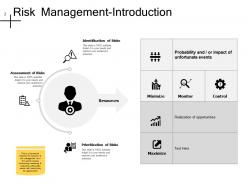
Slide 2: This slide shows Risk Management- Introduction describing- Identification of Risks, Assessment of Risks, Prioritization of Risks.
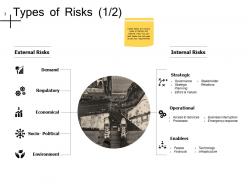
Slide 3: This slide shows Types of Risks describing External, Strategic, operational and enables risks.
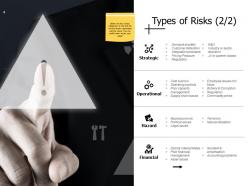
Slide 4: This is another slide on Types of Risks describing- Strategic, Operational, Hazard and Financial risks.
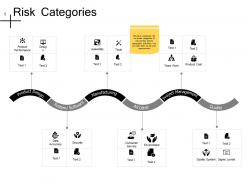
Slide 5: This slide showcases Risk Categories which includes- Product Design, System/ Software, Manufacturing, Project Management, Quality and all other.
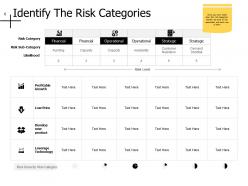
Slide 6: This slide represents Identify the Risk Categories with risk level and other sub categories.
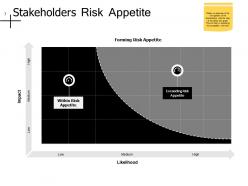
Slide 7: This slide shows Stakeholders Risk Appetite in graphical form.
Slide 8: This slide shows Risk Tolerance on a scale describing risk impact from very low to very high.
Slide 9: This is another slide on Risk Tolerance showing the risk tolerance limit of the stakeholders.
Slide 10: This slide presents Risk Assessment Plan in tabular form.
Slide 11: This slide displays Operational Risk Assessment Icons.
Slide 12: This slide reminds about 15 minutes Coffee Break.
Slide 13: This slide is titled as Additional Slides for moving forward.
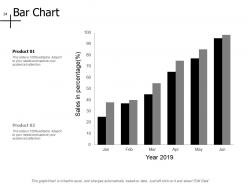
Slide 14: This slide presents Bar Chart with two products comparison.
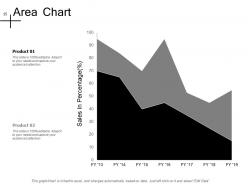
Slide 15: This slide displays Area Chart with two products comparison.
Slide 16: This is Our Mission slide with related imagery and text.
Slide 17: This is Our Team slide with names and designation.
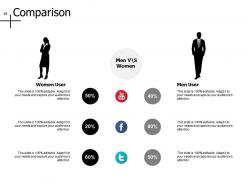
Slide 18: This is a Comparison slide to state comparison between commodities, entities etc.
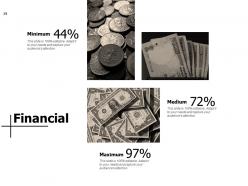
Slide 19: This is a Financial slide. Show your finance related stuff here.
Slide 20: This is a Timeline slide to show information related with time period.
Slide 21: This is a Target slide. State your targets here.
Slide 22: This slide shows Magnifying Glass to highlight information.
Slide 23: This is an Idea Generation slide to state a new idea or highlight information, specifications etc.
Slide 24: This is a Thank You slide with Address# street number, city, state, Contact Number, Email Address.
Operational risk assessment powerpoint presentation slides with all 24 slides:
Use our Operational Risk Assessment Powerpoint Presentation Slides to effectively help you save your valuable time. They are readymade to fit into any presentation structure.
-
Operational Risk Assessment
-
Risk Management Introduction
-
Types of Risks 1 2
-
Operational Risk Assessment
-
Risk Categories
-
Identify The Risk Categories
-
Stakeholders Risk Appetite
-
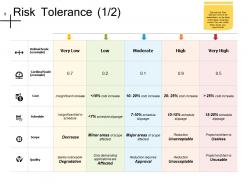
Risk Tolerance 1 2
-
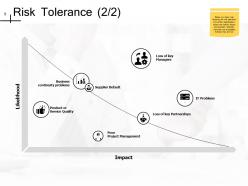
Risk Tolerance 2 2
-
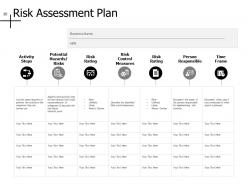
Risk Assessment Plan
-
Operational Risk Assessment Icons Slide
-

Coffee Break
-

Additional Slides
-
Bar Chart
-
Area Chart
-

Our Mission
-

Our Team
-
Comparison
-
Financial
-
Timeline
-
Target
-
Magnifying Glass
-

Idea Generation
-

Thank You
FAQs for Operational risk assessment
You'll need four main pieces: risk identification, assessment methods, monitoring systems, and governance structure. Map out all your processes first to find where things could go wrong - honestly such a pain but you can't skip it. Set clear criteria for measuring probability and impact, then build dashboards for regular monitoring. Make sure everyone knows who owns which risks. Oh, and don't forget incident reporting procedures. My advice? Start with just one business unit first. Test everything there before you roll it out everywhere else - saves you tons of headaches later.
Check out what's tripped up other companies in your space first - regulatory reports and trade publications are goldmines for this stuff. Your frontline people usually spot problems way before the C-suite does, so definitely pick their brains. Manufacturing risks are completely different from fintech ones, obviously. Map your critical processes and think "what sector-specific thing could screw us here?" I'd honestly start with whatever could actually shut you down, then work backwards from there. Prioritize by how likely something is vs how badly it'd hurt. Don't waste time on theoretical disasters that'll never happen.
Analytics tools are honestly a lifesaver for risk stuff - they'll catch weird patterns way faster than you ever could. Real-time monitoring flags sketchy transactions before they become disasters. AI learns from past screw-ups, so it gets smarter about spotting trouble. Dashboards give you the full picture of what's going down across everything. Just make sure whatever you pick plays nice with your current setup, or you'll end up with a bigger mess than you started with. Machine learning is where it really shines though.
Honestly, data analytics is a game changer - it turns risk management from pure guesswork into actual science. You'll spot patterns in old incidents and catch warning signs way before they blow up into real problems. Machine learning is crazy good at finding those weird outlier risks that you'd never notice otherwise. Instead of waiting months for reviews, you get alerts right when stuff starts going sideways. Here's the thing though - most teams mess up the basics. Get your data collection sorted first, then build those automated dashboards. Trust me, clean data upfront saves you tons of headaches later.
Honestly, templates are your best friend here - standardized ones that grab risk descriptions, likelihood, impact, controls, and who owns what. Makes comparing stuff so much easier later. Write down your methodology first so people actually get how you scored things. Both inherent and residual risk need to be in there. Timelines and review dates are crucial because this stuff goes stale ridiculously fast. I learned that the hard way. Keep it simple enough that if you got hit by a bus tomorrow, someone else could jump in and understand everything. Regular review cycles will save you from scrambling later when everything's outdated.
Start with a risk matrix - plot probability vs impact. Hit the high-probability, high-impact stuff first since those are your real threats. After that, go for the high-impact but unlikely scenarios (the "black swan" disasters). Honestly, the frequent but minor stuff can wait unless you're swimming in resources. Score everything on whatever scale makes sense to you - I usually keep it simple at first. Factor in your company's risk tolerance and any regulatory headaches you need to avoid. Oh, and be realistic about what you can actually tackle with your current team and budget.
Dude, training your people is seriously underrated for risk management. When everyone knows what they're doing, you'll see way fewer expensive screw-ups and compliance headaches. Your staff becomes way better at catching problems early too - fraud, sketchy equipment, whatever. Security gets tighter because people actually follow protocols instead of taking shortcuts. Here's the thing though - it can't be those mind-numbing annual sessions everyone sleeps through. Make it relevant to real situations they deal with daily. Keep it fresh and ongoing. Trust me, the upfront investment pays off big time when you're not dealing with constant fires.
Honestly, start with the basics - how often stuff goes wrong and how much damage it causes when it does. Those two metrics alone will tell you where to focus your energy. Near-miss tracking is huge too, way more valuable than people think. Recovery time matters, especially if customers get hit. I'd throw in some forward-looking stuff like checking if your controls actually work, not just looking backward at losses. Don't go crazy with dashboards though - pick maybe 3-5 things that'll actually change what you do. Otherwise you're just drowning in data for no reason.
New regulations totally mess with your risk assessments - you're basically starting over half the time. All your risk registers need updates, control frameworks get revised, and sometimes you're completely re-categorizing operational risks. It's such a headache, especially when stuff drops out of nowhere (which happens more than it should, honestly). Building in flexibility from day one saves your sanity later. Monitor what's coming down the pipeline so you're not scrambling. Having a solid process for folding new requirements into existing assessments makes the whole thing way less painful when changes hit.
Think of scenario analysis as your business fire drill - but for disasters that haven't hit yet. You pick your worst nightmares (cyber attacks, losing key people, supply chain meltdowns) and game out how you'd actually respond. Way better than just looking at what went wrong before, since tomorrow's crisis will probably blindside you anyway. Honestly, most companies are terrible at this stuff until something breaks. Work backwards from 3-4 scenarios that would really mess you up. You'll spot holes in your plans pretty quick. The whole point is figuring out where your controls would fall apart before they actually do.
Figure out what risks you can actually live with based on what your business needs to accomplish. I'd start by mapping out your most critical stuff, then rank risks by how likely they are and how much damage they'd do. Most companies get way too paranoid and slow everything to a crawl - honestly drives me crazy. You can speed things up by automating the boring risk checks and only having humans review the big scary scenarios. Set clear boundaries for different areas so people know what's acceptable. Monitor regularly and tweak as you go. Half the stuff we worry about never actually happens anyway.
Honestly, the worst thing companies do is treat risk assessment like some bureaucratic box to check. Teams rush through it focusing only on the obvious stuff while completely missing how different risks connect. IT handles their risks, operations does theirs - but nobody talks to each other, which is insane if you think about it. Then there's the scoring systems... oh man, these overly complicated matrices that look impressive in presentations but tell you nothing about what actually needs fixing first. My take? Keep it straightforward, get different departments in the same room, and actually use what you find to make real decisions.
Working with third-party vendors is like handing over pieces of your business to someone else - which honestly makes me a bit nervous. Their problems quickly become your problems. System crashes, data breaches, compliance issues? You'll still get blamed even though it wasn't your fault. The reputation hit and regulatory headaches land on you regardless. I've seen companies get burned by this more than once. You really need to stay on top of checking their security practices and financial stability. Also make sure they have solid backup plans. Don't just assume they've got it handled.
There's a bunch of solid options for automating risk assessments. ServiceNow, MetricStream, and RSA Archer are the big names - they cover everything from spotting risks to generating reports. Smaller teams might want to check out Riskturn or SimpleRisk since they won't break the bank. Hell, even a decent SharePoint setup can work if you're just getting started. The trick is finding something that matches how your team already works instead of making everyone learn some crazy complicated system. I'd say figure out what you actually need first, then try demos of maybe 2-3 platforms.
Honestly, your company culture makes a huge difference here. When people are scared of getting blamed, they'll just hide problems instead of reporting them - which means you're missing half the picture. Teams with better psychological safety actually give you real data to work with. Risk tolerance varies wildly too. Some groups are super cautious, others will push limits all day. Communication styles matter for escalation as well. I'd say look at your culture first before you even start the assessment process. Otherwise you might be basing decisions on incomplete info, which... yeah, not ideal.
-
Easily Editable.