


Operational risk management kpi dashboard approach to mitigate operational risk ppt topics




Try Before you Buy Download Free Sample Product
 Impress Your
 Audience
 100%
100% Editable
 Save Hours
 of Time


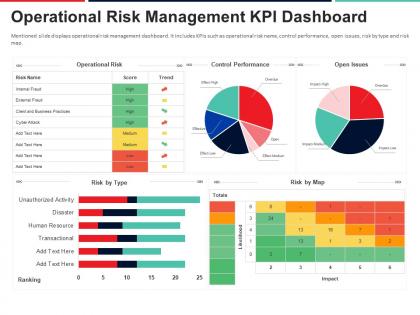
Mentioned slide displays operational risk management dashboard. It includes KPIs such as operational risk name, control performance, open issues, risk by type and risk map.
People who downloaded this PowerPoint presentation also viewed the following :
Operational risk management kpi dashboard approach to mitigate operational risk ppt topics with all 2 slides:
Use our Operational Risk Management Kpi Dashboard Approach To Mitigate Operational Risk Ppt Topics to effectively help you save your valuable time. They are readymade to fit into any presentation structure.
FAQs for Operational risk management kpi dashboard approach to mitigate operational
So you're gonna want to nail down risk identification, assessment, mitigation, and monitoring first. Clear governance helps - like who's actually responsible when stuff breaks? Map out your critical processes and figure out where things usually go sideways. That's honestly your best starting point. Build solid internal controls and incident management processes. Business continuity planning too, obviously. Don't forget regular risk assessments and indicators that catch problems early. Oh, and make sure your reporting systems actually get used - I've seen too many companies with beautiful dashboards nobody looks at.
Honestly, just map out your main processes and ask "what could break here?" at every step. Risk workshops with your team work great - they get heated sometimes but you'll uncover stuff you'd never think of alone. Check your old incidents and complaints too, there's usually patterns. Dependencies are huge - third parties, tech systems, that one person who knows everything (we all have one). Don't wing it though, be methodical about finding these risks. Oh and set up regular reviews because new risks pop up as you grow.
Honestly, tech is a game-changer for risk management. Real-time alerts catch stuff before it blows up. Dashboards let you see everything at once instead of digging through endless spreadsheets (thank god those days are over). AI can actually predict problems - sounds fancy but it works. Automated controls stop issues from happening in the first place, which is way better than fixing them later. The trick is finding tools that play nice with what you already have. Nobody needs another system that doesn't talk to anything else. I'd start with whatever manual process annoys you most and automate that first.
Here's how I'd tackle operational risk measurement: Start with Key Risk Indicators - they're basically your early warning system when things might go sideways. Historical loss data gives you the real numbers on what actually happened before. Scenario modeling helps you estimate potential damage from different situations. I'm a big fan of probability/impact matrices too - they let you score risks with actual numbers instead of just gut feelings. Regular risk assessments with your team are clutch since they know the day-to-day stuff better than anyone. Mix the hard data with insights from people on the ground. Map out your biggest 10 risks first and put dollar amounts on them.
So for risk assessment tools, I'd start with risk registers - they're basically your home base for tracking everything. Bow-tie analysis is really helpful too since it visually maps out causes and consequences (honestly way easier to understand than just reading lists). FMEA breaks down where your processes might fail and what happens when they do. Most people also use root cause analysis when something actually goes wrong, plus risk heat maps to figure out what to tackle first. Oh and scenario analysis for testing worst-case situations. You don't need all of these right away though - pick 2-3 that make sense for your situation.
Look, regulatory stuff is basically your baseline - like Basel III or SOX depending on your industry. They make you document everything, set aside capital, report incidents. Pain in the ass but honestly makes you more organized. Don't just do the bare minimum though. Most companies I've seen that actually succeed? They use those frameworks as a starting point then build something way better. Capital buffers are required anyway, so might as well make them work for you. The documentation requirements suck but they force you to think systematically about risk. Just don't treat it like a checkbox exercise.
Think of risk-aware culture like having good instincts - everyone naturally spots problems before they explode. Your people actually speak up about sketchy stuff instead of hoping someone else handles it. Near-misses get shared without anyone freaking out about blame. Honestly, the best part is when it stops feeling like paperwork and just becomes how you operate. Decision-making gets way better because issues surface early. Short version: create psychological safety first, then watch your team start flagging risks before they bite you.
So data analytics basically lets you catch problems before they blow up. Look at past incidents and operational stuff to see patterns - way better than just crossing your fingers and hoping for the best. I'd focus on leading indicators first, like when processes go off track or key people start leaving. System performance metrics are huge too. Honestly, dashboards make this so much easier to track. Don't overthink it though - just pick 3-5 major risk areas you actually care about and start there. You can always add more later once you've got the basics down.
Honestly, getting people to actually care is your biggest headache. Everyone assumes operational risk is the other guy's problem until shit hits the fan. Data's a nightmare too - good luck getting clean, consistent info from different teams. Oh, and don't even get me started on finding that sweet spot between being thorough and not burying people in red tape. My advice? Pick one department first. Get some quick wins under your belt, then slowly branch out. Way better than trying to fix everything at once and pissing everyone off.
Honestly, just do a basic risk matrix - plot how bad something could be versus how likely it'll happen. Hit the high-impact, high-probability stuff first (duh). But here's the thing - don't overthink it or you'll never actually get started. Sometimes I'll tackle medium risks if they're super quick wins, you know? Focus your money and time on those top-right corner risks. Keep your scoring simple enough that everyone on your team will actually use it without getting confused. The perfect system doesn't exist anyway.
Honestly, the biggest thing is making it dead simple for people to actually report stuff - like mobile-friendly forms that don't suck. Train everyone upfront so they know what's worth reporting vs. what isn't. Set up those automated workflows to route everything to the right people with clear deadlines. But here's the key part: you've gotta kill the blame game completely. People will hide problems if they think they'll get in trouble. I'd also do regular review meetings to spot patterns - you'll be surprised what trends pop up. Oh, and definitely use standardized templates. Makes everything way easier to track later.
Honestly, scenario analysis is just a fancy way of playing "what if" with your business risks. Think about your worst operational nightmares - maybe your main system crashes, half your team quits, or you get hit with ransomware. Then actually run the numbers on how screwed you'd be. Way more useful than crossing your fingers and hoping past data predicts the future (spoiler: it doesn't). You'll spot your weak points before they bite you. I'd start with your top 3-5 disaster scenarios and figure out the damage from there. Beats learning the hard way.
Honestly, generic training is useless - people just zone out. Go role-specific instead, based on what your team actually does. Interactive stuff works way better: real case studies, tabletop exercises from your industry. Don't do the one-and-done thing either, you need regular refreshers. Mix up who's running the sessions too so it doesn't get stale. The whole point is making risk stuff feel normal, not like some annoying compliance box to check. Oh, and definitely figure out what gaps you've got first before diving in.
Okay so basically external stuff like market crashes or new regulations can make your operational risks way worse. Your team starts screwing up under pressure. Vendors bail on you. Cash flow gets tight and suddenly your whole process is falling apart. Growth spurts are weirdly just as dangerous - I've seen companies completely overwhelmed when they scaled too fast. The worst part? These shocks don't hit one thing at a time. Everything breaks simultaneously and creates this chain reaction you never saw coming. You'll want to run stress tests regularly and keep your systems flexible enough to adapt.
You're gonna want to nail the communication piece first - that's what keeps everything from falling apart. Set up those weekly check-ins between teams so people actually know what risks are floating around. I've watched companies crash and burn just because marketing had no clue what IT was worried about. Shared dashboards work great for the visual people (which is most of us, let's be honest). Quick escalation paths matter too. When something sketchy happens, you need people talking to each other fast. Otherwise you're just guessing what other departments are dealing with.
-
Thanks a lot
-
Great designs, really helpful.
-
Unique research projects to present in meeting.
-
It saves your time and decrease your efforts in half.