


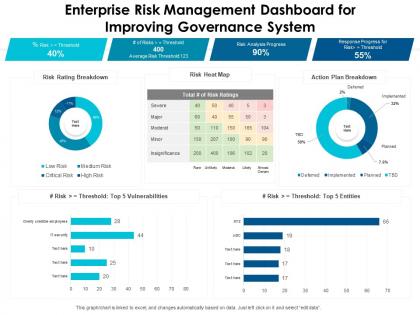
Enterprise risk management dashboard for improving governance system




Try Before you Buy Download Free Sample Product
 Impress Your
Audience
 100%
Editable
 Save Hours
of Time


Our Enterprise Risk Management Dashboard For Improving Governance System are topically designed to provide an attractive backdrop to any subject. Use them to look like a presentation pro.
People who downloaded this PowerPoint presentation also viewed the following :
Enterprise risk management dashboard for improving governance system with all 2 slides:
Use our Enterprise Risk Management Dashboard For Improving Governance System to effectively help you save your valuable time. They are readymade to fit into any presentation structure.

FAQs for Enterprise risk management dashboard for
You'll need four main things: governance (who's responsible for what), ways to spot and assess risks, clear statements on how much risk you're okay with, and systems to track everything. Start by figuring out who owns which risks in your company - that's honestly the hardest part. Set up regular check-ins because this stuff changes constantly. Don't forget response plans for different risk types. Oh, and make sure info flows up and down the chain properly. Think of governance as your foundation - without it, everything else falls apart.
Start with workshops where everyone brainstorms what could go wrong - operational stuff, money issues, strategy fails, compliance headaches. Rate each risk 1-5 for how likely and how bad. Don't go crazy detailed or you'll burn out the team (learned that one the hard way). Heat maps work great for showing which risks need fixing now vs just watching. Getting people from different departments is clutch because they'll catch things you totally missed. We actually found our biggest blindspot came from someone in accounting, weirdly enough. Document it all and review regularly since everything changes constantly.
Honestly, leadership makes or breaks risk management. They set the whole vibe for whether people actually care about potential problems. Your leaders need to bring up risks in regular meetings and reward folks who spot issues early - kinda like encouraging kids to fess up when they break something, you know? No penalties for raising red flags, ever. The whole "do as I say, not as I do" thing never works here. Leaders have to walk the walk by openly discussing risks themselves. Actually, here's a simple start: have your leadership team mention one risk they're watching at the next company meeting. Sets the tone immediately.
Honestly, tech makes the whole ERM thing way less of a nightmare. Instead of doing everything manually, you get these platforms that pull all your risk data into one place. Real-time dashboards show you what's actually going on - no more guessing. The predictive stuff is where it gets interesting though, spotting problems before they blow up in your face. Everyone can finally see the same info instead of working blind. I'd map out whatever manual processes are driving you crazy right now and automate those first. Trust me, you'll wonder why you waited so long.
Track both the numbers and the fuzzy stuff - risk incident frequency, how fast you spot problems, and whether your risk assessments actually predict real issues (this is honestly where most programs fall apart). Board reporting quality and stakeholder satisfaction surveys matter too. Oh, and don't sleep on risk culture maturity - sounds cheesy but it's huge. I'd start with maybe 3-5 metrics tied to your biggest business goals. Once you've got decent data flowing, you can always add more. Time to identify and respond to risks is clutch too.
So compliance is basically your baseline - the bare minimum you've gotta hit before building out your real risk strategy. Healthcare, finance, those industries have crazy strict rules that'll dictate how you handle everything. But honestly? Don't stop there. Most companies I've seen treat compliance like it's the finish line when it should just be your starting point. You'll want to map out what you're already required to do, then figure out where those rules leave gaps in your actual business risks. Short version - compliance gives you the foundation, but you still need to build the house on top of it.
Look, you've gotta weave ethics directly into how you spot and measure risks from the start. Don't just think shareholders - consider your employees, customers, the whole community really. Traditional frameworks totally miss this, which is honestly pretty stupid when you think about it. Check for conflicts of interest and whether you're being transparent enough. Does your response actually match what your company claims to value? The trick is baking this into your risk appetite and decision criteria. Not some afterthought checklist thing you do later.
You'll want to speak differently to each group - execs care about big-picture risks that mess with business goals, but your ops teams need the actual "how do we fix this" details. Skip the jargon and use visuals when you can. Don't just do yearly updates either, people forget. Honestly, most risk presentations are boring as hell with all those dense charts. Tell a story instead - what breaks, how likely is it, what's our plan? Get them involved by asking what risks they're actually worried about. Oh, and always connect it back to protecting whatever keeps them up at night.
Don't make it just another compliance thing you check off - that's the kiss of death. People create these huge, complicated risk registers that sit there gathering digital dust because they're impossible to use. Get your leadership actually bought in from day one or you're toast. Here's what's weird - most teams only think about bad stuff happening, but risks can be opportunities too. Start small and simple. Build some wins first, then add the fancy stuff later. I learned this the hard way when we went too complex too fast and everyone just ignored it.
So here's the thing - different industries have totally different comfort levels with risk. Tech startups? They'll bet everything on crazy ideas. Banks and hospitals? Super conservative because regulators are breathing down their necks and people's safety is on the line. Energy companies are weird - they'll drill in the middle of nowhere but obsess over safety stuff. Makes sense I guess. Check what your competitors are doing though, because that'll show you if your board's being reasonable or just paranoid when they shut down your ideas.
Honestly, start with monitoring - set up Google alerts and watch your socials religiously. Finding out about problems from your boss is the worst. Get your crisis plan sorted now while things are calm: who talks to media, what messaging you'll use, all that stuff. Oh and build relationships with journalists and community people before you actually need them (learned that one the hard way). Make sure other departments think about reputation impact when they're making decisions - marketing can't be the only ones caring about this. Do a quick audit of what's online about you right now and figure out where you're most vulnerable.
At minimum, do it yearly. But honestly? That's cutting it close. When big stuff happens - new regulations, cyber attacks, your industry gets shaken up - update immediately. Don't wait around. Quarterly reviews work better if you're in something unpredictable. I've seen too many companies with outdated plans that don't match their current situation at all. Set those calendar reminders now and make someone actually responsible for it. Otherwise you'll keep saying "we'll get to it next month" forever. Your plans need to reflect today's reality, not last year's.
Honestly, strategic planning without risk management is like building a house without checking if it's on a flood plain. You've got to weave risk considerations right into your strategic conversations from the start. When leadership sits down to map out big goals, that's exactly when you need someone asking "okay, but what could torpedo this whole thing?" Most companies do this backwards - they plan first, then panic about risks later. Smart organizations? They put their risk folks in those early strategy meetings, not just the boring quarterly check-ins afterward. It's way more effective than playing catch-up.
Think of scenario analysis like plotting out different movie storylines for your business. You create 3-5 versions of what could happen - the good, the bad, and the weird stuff nobody sees coming. Honestly, the weirdest scenarios sometimes end up being the most useful ones. Get people from different teams involved because they'll catch things you'd never think of. Start with your biggest unknowns and build detailed stories around them. Then test your current plans against each scenario. It's basically strategic storytelling with numbers - sounds nerdy but it actually works pretty well.
Honestly, just weave it into stuff you're already doing instead of making it this big separate thing. Drop risk questions into your regular meetings - like during project planning or budget reviews. I've watched companies turn this into total theater (waste of time). Better approach? Get people asking "what could break here?" during decisions. Document it in whatever project tools you use. Even quick risk chats during standups help. You want it to feel automatic, not forced. The whole point is catching problems before they actually become problems. Try adding one risk question to a meeting agenda this week and see how it goes.
-
Attractive design and informative presentation.
-
Easily Editable.