


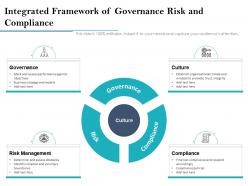
Integrated framework of governance risk and compliance





Try Before you Buy Download Free Sample Product
 Impress Your
 Audience
 100%
100% Editable
 Save Hours
 of Time


Our Integrated Framework Of Governance Risk And Compliance are topically designed to provide an attractive backdrop to any subject. Use them to look like a presentation pro.
People who downloaded this PowerPoint presentation also viewed the following :
Integrated framework of governance risk and compliance with all 2 slides:
Use our Integrated Framework Of Governance Risk And Compliance to effectively help you save your valuable time. They are readymade to fit into any presentation structure.
FAQs for Integrated framework of governance
Look, you need three main things: governance, risk management, and compliance monitoring. Governance is your board oversight and decision-making stuff. Risk management sounds scary but it's just spotting problems before they bite you (honestly took me forever to wrap my head around this part). Compliance keeps you on the right side of regulations. Here's what I'd do - figure out what you've already got in each area first. Then see where the holes are. The real trick is getting all three to actually talk to each other instead of working in silos.
Start by connecting your GRC stuff directly to what the business actually wants to achieve. Expanding into new markets? Your compliance framework should help that happen, not bog it down. Getting leadership on board is the real trick though - they need to see GRC as something that drives growth, not just burns money. Risk appetite has to match your strategic goals, and honestly, governance should speed up decisions rather than create more red tape. Oh, and don't treat GRC like an add-on. Build it right into your strategic planning from the start.
Honestly, technology is what makes GRC actually doable these days. Manual tracking is a nightmare - I mean, who wants to babysit thousands of controls in spreadsheets? You can automate risk assessments now and get real-time dashboards instead of waiting forever for reports. The cool part is AI can spot compliance gaps before they bite you. Modern platforms pull everything together so nothing slips through the cracks. My advice? Figure out what's eating up most of your time manually and tackle those areas first with tech solutions.
Honestly, the worst part is people will fight you on every new process - they see GRC as bureaucratic nonsense. Your data's gonna be a nightmare too, way messier than expected with stuff scattered everywhere or just flat-out wrong. Don't make the classic mistake of buying a bunch of tools that can't even talk to each other. Nobody will know who actually owns what risk either. Oh, and resist the urge to tackle everything at once - I've seen that kill projects fast. Pick one business unit first and prove it works there before expanding.
Honestly, you need both the hard numbers and the fuzzy stuff to know if your GRC program's actually working. Start with the obvious metrics - audit findings, compliance violations, how fast you respond to incidents. Those matter most to leadership anyway. But don't ignore employee awareness surveys and whether stakeholders trust you more now. The trick is watching trends over months, not just random snapshots. Pick maybe 4 key metrics tied to your biggest headaches and review them quarterly. Oh, and the boring spreadsheets? They actually tell the best story when you're trying to prove ROI.
Honestly, I'd kick things off with some company-wide workshops to get everyone's take on what could go wrong. Then nail down your risk appetite - like, what's actually okay to live with vs. what'll keep you up at night? Get everything into one central register because trust me, hunting through random spreadsheets later is pure hell. Mix hard numbers with gut-check assessments since some stuff just can't be quantified. Don't wait for yearly audits to revisit things. The real trick is getting business folks involved from the start - otherwise it's just another compliance box to check. Pick a couple high-impact areas first.
Ugh, multi-country compliance is such a pain. You're basically stuck managing GDPR, SOX, plus whatever random local rules each market decides to throw at you. Your risk assessments get way more complicated because regulations vary everywhere. Governance structures? They have to bend to fit local requirements, which is annoying but necessary. The monitoring side becomes this huge layered mess - honestly surprised more companies don't just give up. My advice? Build flexibility into your GRC setup right from the start. That way you won't have to rebuild the whole thing every time you expand somewhere new.
Honestly, the worst part is everyone sees GRC as just more paperwork. Teams are already swamped, so they push back hard when you roll out new processes. Legacy systems are a nightmare too - nothing connects properly. Each department has their own thing going on, which makes getting buy-in super tough. People think it's all "compliance theater" instead of something that actually helps. Start with just one area though. Show some quick wins first, then explain how it cuts down on risk and saves time later. Way better than making it feel like another box to check off.
Honestly, getting people involved in your GRC stuff is a game changer. Instead of fighting you every step of the way, they'll actually get why certain controls exist. Your frontline people see risks that C-suite folks completely miss - they're dealing with the messy reality every day. When stakeholders help build the frameworks, they become your biggest supporters instead of looking for ways around everything. Don't just blast out policies and call it a day though. Ask each department what's driving them crazy operationally, then build your approach from there. Makes everything way smoother.
Look, you need both leading and lagging indicators - don't just focus on one. Track your audit findings, control effectiveness rates, incident response times, and policy compliance percentages. Training completion rates matter too, plus how fast you close gaps. That stuff actually shows if your program works vs just ticking boxes. For risk metrics, cover threat exposure levels, mitigation timelines, and business impact assessments. Honestly, the hardest part is balancing quantity with quality data - you don't want to drown in numbers. Start with maybe 5-7 core metrics that tie directly to your business goals, then expand later.
Build monitoring right into your GRC setup instead of scrambling after changes drop. Get regulatory alerts from key agencies and join industry groups that track new legislation. Your legal team is honestly amazing for this stuff - use them more. The trick is creating flexible policies that won't need complete rewrites every time. Invest in GRC software that's easily configurable for new rules. Oh, and schedule quarterly "horizon scanning" sessions where you look 12-18 months ahead rather than just firefighting current issues. Way less stressful than playing catch-up constantly.
Dude, AI automation is totally taking over GRC right now. Companies are finally ditching those nightmare spreadsheets for platforms that actually work together. Real-time monitoring is becoming standard too. ESG isn't optional anymore - it's straight-up regulatory stuff now. Cloud solutions make everything way easier to access, and honestly, predictive analytics beats the hell out of just reacting to problems after they happen. You should probably start looking at integrated GRC platforms with AI features. Manual processes are dying fast, so getting ahead of this now would be smart.
You can't build good GRC culture without solid training - it's just impossible. Once people actually get *why* compliance exists and how risks mess with the business, they stop going through the motions. Confidence goes up too when they know their stuff. Don't make it a one-and-done training session though, that never works. I'd start by figuring out where your team's knowledge is weakest and hit those areas hard first. The cultural shift kind of happens on its own after that - it's pretty cool to watch actually.
Think of data analytics as your crystal ball for catching problems early. It spots patterns in your historical data that show where trouble usually starts brewing. Real-time monitoring means you're not flying blind anymore - you can actually see risks building instead of just hoping for the best. Plus it turns all that boring compliance stuff into something useful (finally!). You'll know which fires to put out first based on what'll actually hurt vs just look scary. Honestly, just pick your 3 biggest headaches and check what data you've got sitting around already.
Honestly, just be super open about how you handle governance stuff. Share your risk assessments publicly and actually talk about your compliance numbers - don't hide that work in some back office where nobody sees it. People trust you way more when they can see the whole process, kinda like showing your work in math. When problems come up (and they will), be straight about what happened and how you're fixing it. The whole point is making stakeholders feel like you're genuinely protecting their interests, not just going through the motions to check boxes.
-
The content is very helpful from business point of view.
-
Unique and attractive product design.
-
Qualitative and comprehensive slides.
-
Attractive design and informative presentation.