


Operational Risk Management Key Metrics Dashboard Risk Management And Mitigation Strategy




Try Before you Buy Download Free Sample Product
 Impress Your
 Audience
 100%
100% Editable
 Save Hours
 of Time


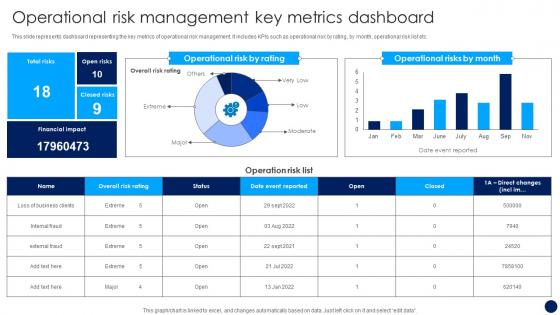
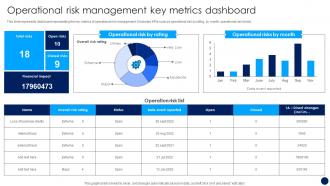
This slide represents dashboard representing the key metrics of operational risk management. It includes KPIs such as operational risk by rating, by month, operational risk list etc.
People who downloaded this PowerPoint presentation also viewed the following :
Operational Risk Management Key Metrics Dashboard Risk Management And Mitigation Strategy with all 7 slides:
Use our Operational Risk Management Key Metrics Dashboard Risk Management And Mitigation Strategy to effectively help you save your valuable time. They are readymade to fit into any presentation structure.






FAQs for Operational Risk Management Key Metrics Dashboard Risk Management
Okay so you need four main things for your ORM framework to actually work. Start by identifying all the risks - figure out what could go sideways in your processes. Assessment comes next where you measure and rank those risks by priority. Put controls in place to prevent or minimize the damage when stuff happens. Oh, and monitoring is huge - seriously, most people totally drop the ball here. You've got to keep watching for early warning signs and check if your controls are doing their job. Run scenario tests regularly too. It's the only real way to know you're ready when everything goes to hell.
So I'd start with mapping out your main processes - just write down every step and think about what could screw up at each one. Impact vs likelihood is how I assess each risk. Honestly, a basic spreadsheet matrix works great for this stuff. Get your team together and walk through different scenarios, plus look back at what's gone wrong before. Oh, and don't forget outside stuff like supplier problems or new regulations that could mess things up. The whole point is being methodical instead of just winging it. Set up regular check-ins to catch new risks as things change.
So for operational risk monitoring, automated systems that track stuff in real-time are huge. Data analytics platforms catch weird patterns you'd totally miss otherwise. Machine learning gets smarter over time at predicting problems - honestly that's probably the biggest game changer. Dashboard tools give you that visual snapshot everyone wants. Oh and workflow automation standardizes how you handle responses, which sounds boring but actually saves tons of headaches. These catch issues way earlier than old-school methods. I'd start with whatever meshes with your current setup and budget though.
Dude, cultural stuff is massive for risk management. What's totally normal in one country can be sketchy or illegal somewhere else. We got burned in Asia because nobody understood how their business relationships actually work - completely missed some major red flags. Different places have wild variations in how they handle hierarchy, being upfront about problems, even basic communication styles. Some cultures are way more risk-averse than others too. I'd start by getting your local teams involved in spotting risks since they know the ground truth. Also map out the cultural landmines for each region you're in - trust me, it saves headaches later.
Think of data analytics as your risk radar - it catches weird patterns way before you would. You can track transaction flows, how employees are acting, system glitches, customer complaints, all that stuff. Honestly, the predictive side is where it gets interesting - tells you what needs fixing NOW vs what can chill for a bit. Plus it shows if your current safety measures actually work or if they're just there for show. I'd pick your 3 biggest problem areas first and see what info you're already sitting on.
Look at your historical loss data first - what went wrong before and how much it cost you. That's your starting point. Teams can do self-assessments where they rate how likely stuff is to happen and how bad it'd be. Key risk indicators are clutch for day-to-day monitoring, like tracking system downtime or how often people quit. Monte Carlo simulations sound impressive but honestly? Start basic. The trick is staying consistent with whatever method you pick so you can actually compare different risks. Otherwise you're just throwing money at random problems instead of the ones that'll actually hurt you.
You'll spot trouble brewing through a few telltale signs. High turnover and employee complaints usually mean something's breaking down internally. Watch for error rates going up, more customer complaints, or stuff getting delayed. System crashes are obvious red flags, but honestly the subtle stuff matters more - missed deadlines, sloppy documentation, that kind of thing. Those tell you your controls are falling apart. Compliance violations are huge warning signs too. I'd set up some basic monthly tracking for these metrics. Nothing fancy, just something that lets you catch patterns before they turn into real problems.
Look, bare minimum is once a year, but that's kinda setting yourself up for trouble. Big changes should trigger immediate reviews - new products, regulation updates, economic weirdness. Quarterly makes sense for your riskiest stuff. Honestly, most companies are way too slow to catch up with how fast risks actually change. Set those annual calendar reminders for the deep dive, but also build in automatic triggers when major operational shifts happen. Being proactive beats scrambling to catch up every single time.
Ugh, operational risk modeling is brutal. You're basically trying to predict rare but catastrophic events - fraud, system crashes, that one guy who accidentally deletes everything. Credit risk has decades of data, but this stuff? It's all over the map. Each incident is totally different, so building reliable models feels impossible sometimes. Plus you're stuck relying on people to actually report near-misses (spoiler: they don't always). Start with getting a decent incident database going. Then add scenario analysis to cover what you're probably missing.
So basically, regulations are like your foundation - they tell you what to monitor, reporting schedules, required controls, all that stuff. Basel III, SOX requirements, you know the drill. Regulators have been pretty intense since 2008 honestly, so you'll end up doing risk appetite statements, assessments, tons of documentation because that's what they're looking for during exams. Here's the thing though - don't just meet the bare minimum. Build your program above what they require and you won't scramble when new rules drop. It's way less stressful that way.
Honestly, you've got to bake this stuff into how people actually work every day. Skip the boring policy docs - nobody reads those anyway. Run training with real stories from your field because that's what sticks. Set up ways for people to flag problems without getting thrown under the bus (seriously, this makes or breaks everything). When someone spots a risk early? Reward them even if disaster never struck. Your executives need to walk the walk too - if they roll their eyes at risk talks, game over. Oh, and build risk checks right into project planning from the start.
Good communication stops those awful "wait, I thought YOU were doing that" moments. Set up regular check-ins and make sure everyone actually talks when something's wrong - nobody should be sitting there hoping someone else noticed the problem (we've all done this though, let's be honest). Quick escalation paths help too. People need to know exactly who to bug when things go sideways. Honestly, half the battle is just getting your team comfortable with speaking up instead of staying quiet. Clear protocols aren't sexy but they'll save your butt when everything hits the fan.
Look at SVB and FTX - both got cocky and forgot the fundamentals. SVB grew so fast their risk systems couldn't keep up, honestly pretty embarrassing for a bank that size. These days you can't just worry about traditional risks either. Crypto, cyber attacks, ESG stuff - it's all fair game now. What's scary is how fast everything unravels once things go south. One day you're flying high, next day you're toast. You really need to stress-test your operations for the worst-case scenarios, not just regular market hiccups. I'd start by figuring out what you're not seeing - those blind spots will bite you.
Look, working with third parties basically means you're gambling with parts of your business you can't directly watch. You inherit all their problems - data breaches, system crashes, whatever mess they create becomes your headache too. The worst part? You're still the one who gets blamed when things go sideways. Regulators don't care if it was your vendor's fault. That's why you gotta do your homework before partnering up and keep tabs on them constantly. I learned this the hard way honestly - never assume they've got their act together just because they talk a good game.
Honestly, just pick one process that scares you most and start there. Map out what could go wrong - you know, those 3am worry scenarios. Write down all the stuff only one person knows how to do (RIP if they quit tomorrow). Train other people on key tasks because being dependent on one employee sucks. Do quick risk check-ins every few months, nothing fancy. Oh and make sure people actually know who to call when shit hits the fan - sounds basic but you'd be surprised. Build simple backup plans for your worst-case stuff. Start small though, don't overwhelm yourself trying to fix everything at once.
-
Attractive design and informative presentation.
-
Great designs, Easily Editable.