


IT Risk Management Strategies Powerpoint Presentation Slides





Try Before you Buy Download Free Sample Product
 Impress Your
 Audience
 100%
100% Editable
 Save Hours
 of Time


Risk management is the identification, analysis, and control of threats to an organizations capital and earnings. IT risk management is the application of risk management methods to control IT threats. Check out our professionally designed IT Risk Management Strategies PowerPoint presentation. At first, It covers the current IT problems that the company is facing, which includes risks reported by the company and their impacts. It also mentions the financial burden to the company. Additionally, it covers the need for IT risk management, IT risk classification, and threat management approach with framework and process. It also describes how to evaluate IT risks. Moreover, it mentions the security criteria and control measures for IT system vulnerabilities, which include the detection and prevention of operational controls, and management security controls, and also covers detailed control measures for technical security risks. Furthermore, It covers IT security residual risk, IT risk management software, and cost estimation for system audit with risk mitigation plan with control measures. At last, it highlights the damage control assessment and IT risk management dashboards. Download this template now.
People who downloaded this PowerPoint presentation also viewed the following :
Content of this Powerpoint Presentation
Slide 1: This slide displays the title IT Risk Management Strategies.
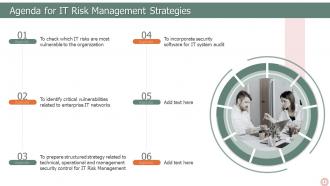
Slide 2: This slide displays the title Agenda for Information Technology Risk Management.
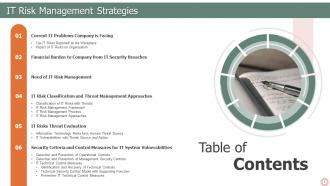
Slide 3: This slide exhibit table of content.
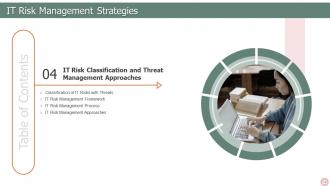
Slide 4: This slide exhibit table of content.
Slide 5: This slide exhibit table of content- Current IT Problems Company is Facing.
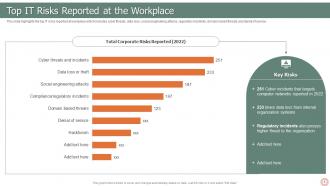
Slide 6: This slide highlights the top IT risks reported at workplace.
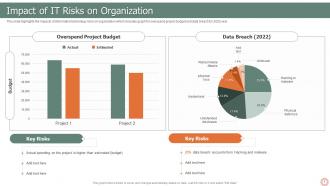
Slide 7: This slide highlights the impacts of information technology risks on organization.
Slide 8: This slide exhibit table of content- Financial Burden to Company from IT Security Breaches.
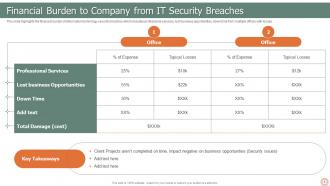
Slide 9: This slide highlights the financial burden of information technology security breaches.
Slide 10: This slide exhibit table of content- Need of IT Risk Management.
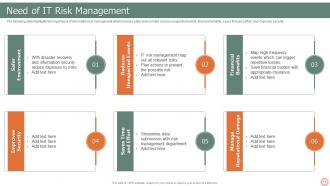
Slide 11: The following slide highlights the importance of information risk management.
Slide 12: This slide exhibit table of content- IT Risk Classification and Threat Management Approaches.
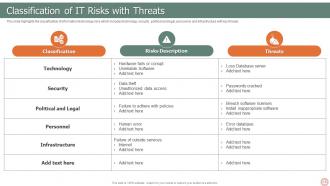
Slide 13: This slide highlights the classification of information technology risks.
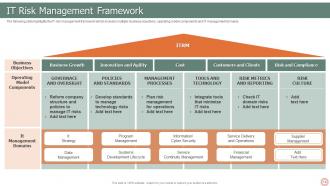
Slide 14: The following slide highlights the IT risk management framework which includes multiple business objectives, operating model components and IT management domains.
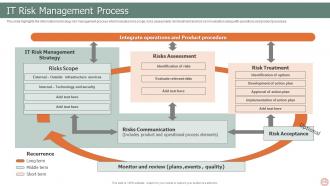
Slide 15: This slide highlights the information technology risk management process.
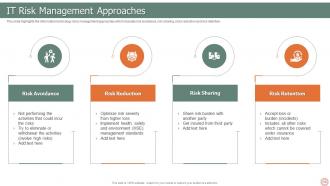
Slide 16: This slide highlights the information technology risks management approaches.
Slide 17: This slide exhibit table of content- IT Risks Threat Evaluation.
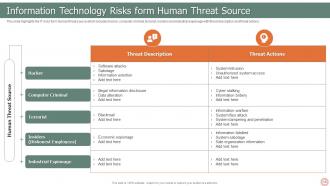
Slide 18: This slide highlights the IT risks form human threat source.
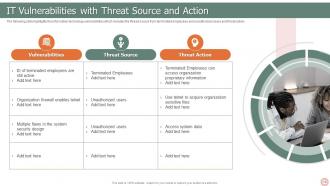
Slide 19: The following slide highlights the information technology vulnerabilities.
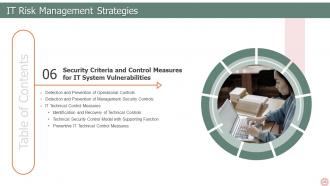
Slide 20: This slide exhibit table of content- Security Criteria and Control Measures for IT System Vulnerabilities.
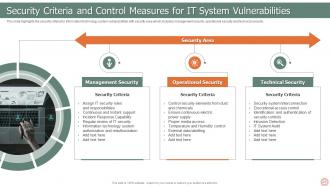
Slide 21: This slide highlights the security criteria for information technology system vulnerabilities with security area.
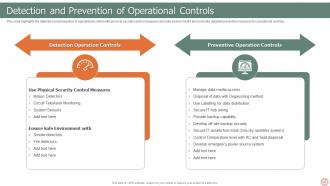
Slide 22: This slide highlights the detection and prevention of operational control with physical security control measures and safe environment.
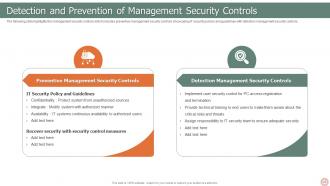
Slide 23: The following slide highlights the management security controls.
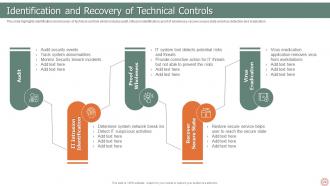
Slide 24: This slide highlights identification and recovery of technical controls.
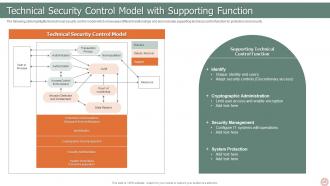
Slide 25: The following slide highlights the technical security control model with Supporting Function.
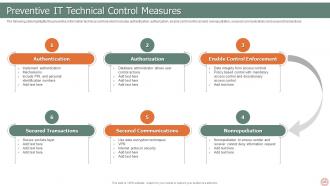
Slide 26: The following slide highlights the preventive information technical controls.
Slide 27: This slide exhibit table of content- IT Security Residual Risk.
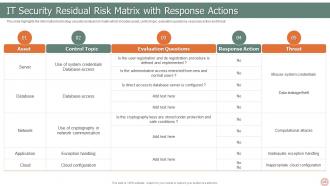
Slide 28: This slide highlights the information technology security residual risk matrix.
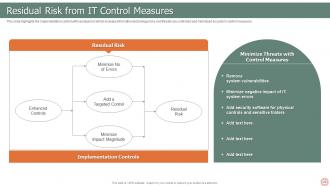
Slide 29: This slide highlights the implementation control with residual risk.
Slide 30: This slide exhibit table of content- IT Risk Management Software and Cost Estimation for System Audit.
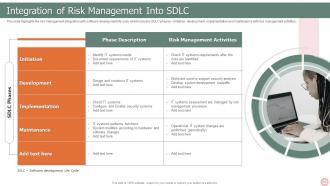
Slide 31: This slide highlights the risk management integration with software development life cycle.
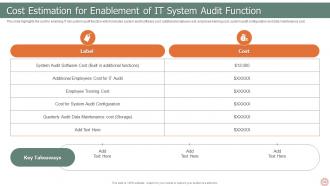
Slide 32: This slide highlights the cost for enabling IT risk system audit function.
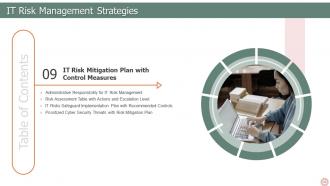
Slide 33: This slide exhibit table of content- IT Risk Mitigation Plan with Control Measures.
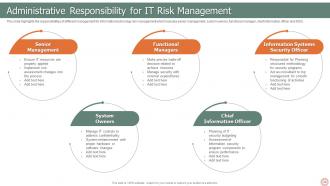
Slide 34: This slide highlights the responsibilities of different management for information technology risk management.
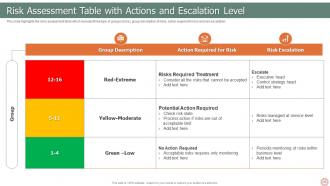
Slide 35: This slide highlights the risks assessment table.
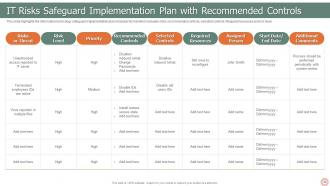
Slide 36: This slide highlights the information technology safeguard implementation plan in tabular format.
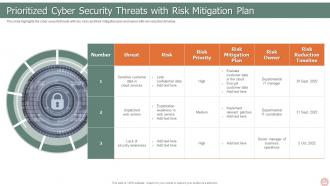
Slide 37: This slide highlights the cyber security threats with key risks and their mitigation plan and owner with risk reduction timeline.
Slide 38: This slide exhibit table of content- Damage Control Assessment from IT Risk Management.
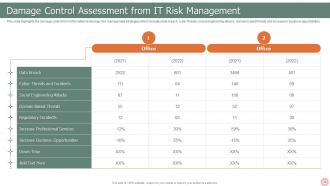
Slide 39: This slide highlights the damage control form information technology risk management strategies.
Slide 40: This slide exhibit table of content- IT Risk Management Dashboards.
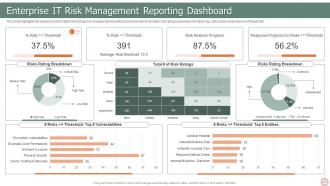
Slide 41: This slide highlights the enterprise information technology risk management reporting dashboard.
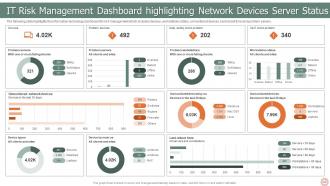
Slide 42: The following slide highlights the information technology dashboard for risk management.
Slide 43: This is the icons slide.
Slide 44: This slide presents title for additional slides.
Slide 45: This slide presents title for About Us.
Slide 46: This slide presents your company's vision, mission and goals.
Slide 47: This slide shows details of team members like name, designation, etc.
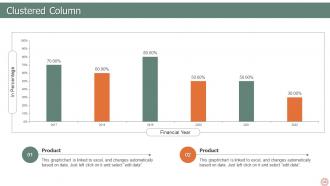
Slide 48: This slide exhibits clustered coloumn charts for different products.
Slide 49: This slide presents title for Important Notes.
Slide 50: This slide exhibits ideas generated.
Slide 51: This slide displays Venn.
Slide 52: This is thank you slide & contains contact details of company like office address, phone no., etc.
IT Risk Management Strategies Powerpoint Presentation Slides with all 57 slides:
Use our IT Risk Management Strategies Powerpoint Presentation Slides to effectively help you save your valuable time. They are readymade to fit into any presentation structure.







FAQs for IT Risk Management Strategies
So basically you need five things. Start with governance - someone's gotta be in charge of this mess, so assign clear owners. Risk identification comes next, where you hunt down all the threats. Then figure out how to handle each one - accept it, fix it, or pass it off to someone else. Monitoring is huge because risks shift constantly (learned that one the hard way). Regular reviews keep everything current since tech moves so fast. Oh, and definitely map out what you're dealing with first - can't fix what you don't see. The whole thing falls apart without clear ownership though.
Look, new tech is basically like opening Pandora's box for risk managers. You've got AI making questionable decisions, cloud systems creating fresh attack points, and don't get me started on IoT devices – they're security disasters waiting to happen. The real problem? This stuff changes faster than anyone can write proper guidelines for it. Honestly feels like whack-a-mole sometimes. What works is staying flexible with your risk processes instead of trying to plan for everything upfront. You'll go crazy otherwise.
So threat intelligence is basically your heads-up about what hackers are actually doing right now. You get real data on current attack methods instead of just guessing what might happen. Pretty much like checking the weather before you leave the house, but for cyber attacks. This stuff helps you figure out which risks to tackle first and beef up defenses against threats that are actually hitting companies like yours. Honestly, there's so much threat data out there it can be overwhelming at first. Start by finding threat feeds that match your industry, then work that intel into how you assess risks.
Honestly, you've got to track how your risk stuff actually plays out in real life. Monitor incident rates, response times, whether your controls are stopping what they're supposed to. Tabletop exercises are gold - they'll show you blind spots fast. Compare what you say your risk appetite is versus what's really happening day-to-day. Ask different teams if your processes make sense or if they're just going through the motions. Don't make it some annual thing either - keep tweaking as you learn. Oh, and people hate admitting when something's just paperwork theater, but their feedback matters most.
Honestly, most people mess up by making their risk categories way too vague. Those "high/medium/low" ratings are basically useless when you need to actually decide something. Plus everyone assesses risks like they exist in a vacuum - but that's not how real life works, right? A tiny security issue suddenly becomes massive if your backup system sucks too. Oh, and stop using the same three people for every assessment! Get different teams involved. You'll want specific scenarios that people can actually act on, then set up regular check-ins with fresh perspectives. Trust me on this one.
Look, regulations basically force you to get your IT risk stuff together whether you like it or not. GDPR, SOX, HIPAA - they all push you toward actually documenting your processes and doing regular check-ups. Yeah, it's annoying at first, but honestly? It makes everything way more organized and you can actually defend your decisions later. These frameworks are like having a GPS instead of just wandering around hoping for the best. I'd start by matching your current risks against whatever regs hit your industry. That'll show you exactly where you're screwed and need to fix things.
Risk can't just be the security team's problem anymore - everyone needs skin in the game. Ditch those soul-crushing compliance videos nobody watches. Run actual tabletop exercises instead. Show people how risks mess with their daily work specifically. Leadership has to walk the walk here, not just talk about it in all-hands meetings. Reward people when they flag problems rather than making them feel like snitches. Build risk tools that don't require a cybersecurity degree to understand. Honestly, most risk frameworks are way overcomplicated. Connect everything back to business impact so your teams get why this matters for their particular role.
Dude, quantitative risk analysis is a game changer - you get actual numbers instead of those useless "medium risk" labels. Calculate real financial losses and probability percentages. Way more convincing when you're begging for budget money! Pick one critical system and slap dollar amounts on breach scenarios. Trust me, it's wild seeing the numbers. You can finally prioritize which fires to put out first and track if your fixes actually work. Those heat maps everyone complains about? Yeah, this blows them out of the water.
Start with the same threats for both your risk assessments and BCP scenarios - saves you from having two different realities. Map your critical IT stuff to actual business processes so you're thinking about tech risks that'll mess with operations. Honestly, joint tabletop exercises are where the magic happens because that's when you realize IT's "critical" systems aren't always what keeps the business alive. Your recovery time goals need to match what you can actually handle risk-wise. Don't just pick numbers that look professional but aren't realistic for your situation.
Yeah so third-party vendors basically give hackers more ways to get to your stuff. You're trusting their security now, which honestly might suck compared to yours. They could mess up data handling or just have terrible access controls. What I'd do first is make a list of all your vendors and figure out which ones are the biggest risks. Then get aggressive about checking their security upfront - like actually ask for audit reports and compliance certs, don't just believe whatever they tell you. Set up monitoring too because things change. Oh and your contracts need to spell out security requirements clearly - learned that one the hard way.
Look, your IT setup changes constantly - new threats drop daily, systems get patched, vulnerabilities appear out of nowhere. Skip regular assessments and you're basically gambling with your security. We learned this lesson when my old team got lazy about quarterly reviews and almost got wrecked by something we totally should've spotted. Quarterly checks are the bare minimum, but monthly is way better if you're dealing with anything critical. Set up those automated scans and just make risk reviews a regular thing in meetings. Trust me on this one.
Honestly, NIST and ISO frameworks are lifesavers for getting your cybersecurity risks under control. NIST has these five functions - Identify, Protect, Detect, Respond, Recover - that basically walk you through building a solid risk program. ISO 27001's another good option, especially if your company cares about getting certified (some do, some don't). Here's the thing though - don't try mixing frameworks. Pick one and actually stick with it. Both help you figure out which risks matter most to your business and set up processes your team won't hate. I'd start with a gap analysis to see where you're at now.
Pick 5-7 metrics that actually matter to your execs - otherwise you'll drown in data nobody cares about. I'd start with incident response times (detection and resolution), plus compliance audit scores since those hit the bottom line. Track how many risks you're finding versus actually fixing - that gap tells you everything. Employee training completion rates are boring but critical since people mess up constantly. RTO/RPO metrics during real incidents (not drills) show if your continuity planning works. Oh, and percentage of critical systems with current risk assessments. Start simple with what's easy to measure, then expand once you've got buy-in.
Stop talking tech to business people - they don't care about your server specs. Ask each group what actually worries them first, then connect your IT risks to those fears. CFOs want dollar impacts. Department heads need to see how outages mess with their teams. Honestly, skip the 20-page reports nobody opens. Dashboards and quick visual summaries work way better. Monthly check-ins beat yearly presentations since everything changes so fast anyway. The trick is translating your technical headaches into their language. Make it about their problems, not yours.
Honestly, the AI threat stuff is getting wild - these attacks adapt way faster than old-school defenses can keep up. Cloud security's becoming a nightmare with all these hybrid setups everywhere. Supply chain attacks are through the roof too, which makes sense since you can't count on every vendor having their act together. Oh, and quantum computing's gonna wreck current encryption eventually, so might as well start planning those crypto transitions now. The biggest shift though? Risk management needs to be predictive instead of just reacting after stuff hits the fan. Get some AI risk tools and start running scenarios before things go sideways.
-
“Thanks to SlideTeam. Now I can make smart presentations in a fraction of time without any hassle.”
-
Easily Editable.