

Prevention And Mitigation In Disaster Management Powerpoint Presentation Slides




Try Before you Buy Download Free Sample Product
 Impress Your
 Audience
 100%
100% Editable
 Save Hours
 of Time


The need for proactive measures before any emergency occurs is very important. Learn the prevention and ways to avoid such emergency situations by using our prevention and mitigation in disaster management PowerPoint presentation. This visually appealing disaster prevention and mitigation PowerPoint complete deck comprising of 33 content ready slides & covers various topics like disaster recovery plan introduction, disaster recovery management team, disaster recovery team roles and responsibilities, disaster categories and its impacts on revenue, disaster assessment by category, disaster assessment likelihood, It operational impact analysis and many other slides. All the slides are completely editable and can be used as per your requirement. You can use this business emergency management PPT slides to present various other topics like disaster management, mitigation methods, hazard assessment, prevention of natural disasters and many more. Download corporate disaster prevention and preparedness presentation deck to showcase steps to prevent disasters. Extract the best of every discipline with our disaster management ppt Slides. They assist in embracing diversity.
People who downloaded this PowerPoint presentation also viewed the following :
Content of this Powerpoint Presentation
Slide 1: This slide introduces Prevention & Mitigation in Disaster Management. State Your Company Name and begi.
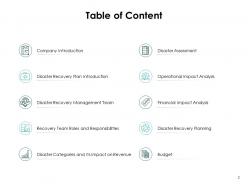
Slide 2: This slide shows Table of Content of the presentation.
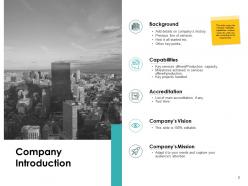
Slide 3: This slide presents Company Introduction with Company’s Mission, Company’s Vision, Capabilities, Background, Accreditation.
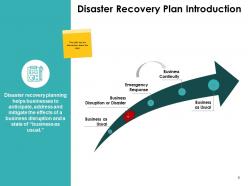
Slide 4: This slide displays Disaster Recovery Plan Introduction.
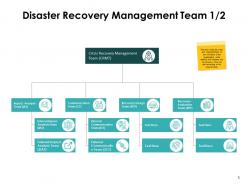
Slide 5: This slide represents Disaster Recovery Management Team with list of roles and responsibilities of the members of the organisation while dealing with disaster and its recovery.
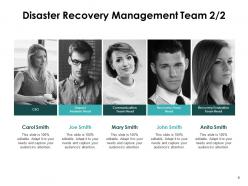
Slide 6: This slide showcases Disaster Recovery Management Team with names and designation.
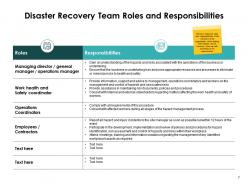
Slide 7: This slide shows Disaster Recovery Team Roles and Responsibilities.
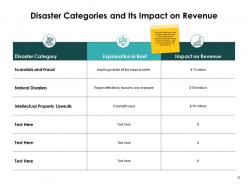
Slide 8: This slide presents Disaster Categories and Its Impact on Revenue.
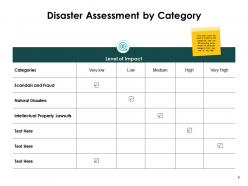
Slide 9: This slide displays Disaster Assessment by Category like scandals and fraud, natural disasters, intellectual property lawsuits etc.
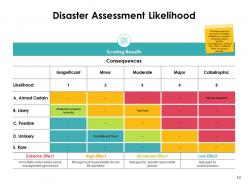
Slide 10: This slide represents Disaster Assessment Likelihood covering the occurrence of disaster possibilities.
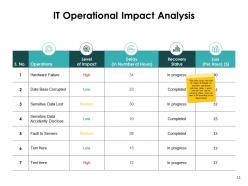
Slide 11: This slide showcases IT Operational Impact Analysis covering the level of impact of disaster on business operational activities, delay in work, loss per hour and its recovery status.
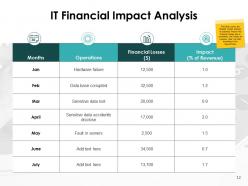
Slide 12: This slide shows IT Financial Impact Analysis covering the disaster impact analysis on business finance like financial losses due to uncertainty and impact on revenue.
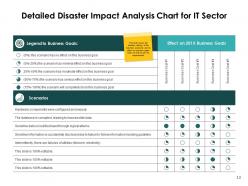
Slide 13: This slide presents Detailed Disaster Impact Analysis Chart for IT Sector covering the disaster ranking of the business scenarios and its effect on business goals.
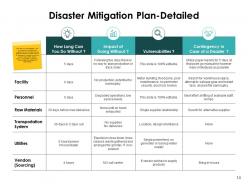
Slide 14: This slide displays Disaster Mitigation Plan-Detailed covering the mitigation plan for company in respect to how company can survive without having particular things.
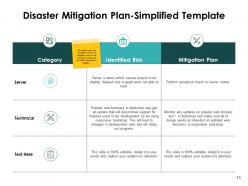
Slide 15: This slide represents Disaster Mitigation Plan-Simplified Template.
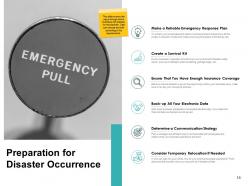
Slide 16: This slide showcases Preparation for Disaster Occurrence describing- Create a Survival Kit, Back-up All Your Electronic Data, Make a Reliable Emergency Response Plan, Ensure that You Have Enough Insurance Coverage, Determine a Communication Strategy, Make Consider Temporary Relocation If Needed.
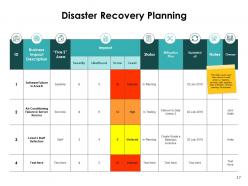
Slide 17: This slide shows Disaster Recovery Planning covering each item into five crucial areas i.e. Systems, services, staff, suppliers, sites of disaster recovery planning for business.
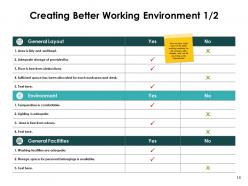
Slide 18: This slide presents Creating Better Working Environment by listing some of the better working conditions for the company after disaster.
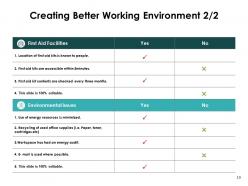
Slide 19: This is another slide for Creating Better Working Environment.
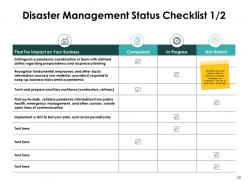
Slide 20: This slide displays Disaster Management Status Checklist covering the recovery status for disaster on business, employees and customers.
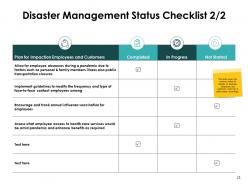
Slide 21: This is an optional slide for Disaster Management Status Checklist.
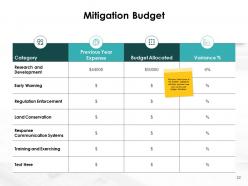
Slide 22: This slide represents Mitigation Budget listing some of the disaster categories with their previous year and current year budget allocation.
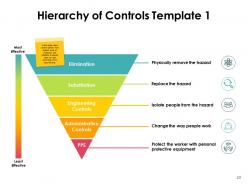
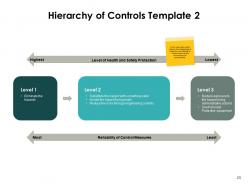
Slide 23: This slide showcases Hierarchy of Controls Template 1 ranking the control options from highest level of protection and reliability to lowest.
Slide 24: This slide shows Hierarchy of Controls Template 2 describing- Eliminate the hazards, Substitute the hazard with something safer, Isolate the hazard from people, Reduce the risks through engineering controls, Reduce exposure to the hazard using administrative actions, Use Personal Protective equipment.
Slide 25: This is Our Company slide to show company specifications etc.
Slide 26: This is Our Mission slide with related imagery and text.
Slide 27: This slide is titled as Important Notes. Post your important notes here.
Slide 28: This is a Financial slide. Show your finance related stuff here.
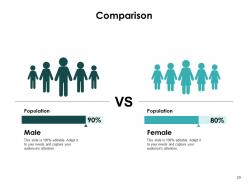
Slide 29: This is a Comparison slide to state comparison between commodities, entities etc.
Slide 30: This is a Puzzle slide with text boxes to show information.
Slide 31: This is a Venn slide with text boxes.
Slide 32: This is a Thank you slide with address, contact numbers and email address.
Prevention And Mitigation In Disaster Management Powerpoint Presentation Slides with all 32 slides:
Our Prevention And Mitigation In Disaster Management Powerpoint Presentation Slides ensure you don't turn a hair. You will display abundant confidence.
FAQs for Prevention And Mitigation In Disaster Management
So there are four phases that kind of blend together: mitigation, preparedness, response, and recovery. Mitigation is reducing risks before stuff goes wrong. Then preparedness - that's your planning and training phase. Response happens when disaster actually hits (total chaos mode, everyone scrambling). Recovery comes after to get things back to normal. But here's what's cool - they all connect. What you figure out during recovery helps you get better at the first two phases next time around. I always think of it more like a circle than steps you check off, you know? Each disaster teaches you something for the next one.
Honestly, tech is a game-changer for disaster response. Early warning systems and GPS tracking help emergency teams get where they need to go fast. Drones can assess damage way quicker than sending people in. There's also apps for coordinating volunteers and social media monitoring to find people who need help. AI's gotten scary good at predicting disaster patterns too - though that still feels weird to say out loud. Once the dust settles, digital platforms make insurance claims less of a nightmare and help coordinate aid distribution. Just don't wait until after disaster hits to set this stuff up.
Community prep is honestly your best bet before disaster strikes. People panic less when they actually know what to do - it's wild how much basic training helps. You want neighbors who can do first aid, know where to evacuate, have their emergency kits sorted. Those first 72 hours are rough since responders get swamped, so communities end up helping each other anyway. Figure out what specific risks your area faces first - floods, earthquakes, whatever - then build education around that stuff. Prepared people make way better decisions than scared ones.
So here's the thing - natural vs man-made disasters are like apples and oranges. Natural ones? You're tracking hurricanes, setting up earthquake drills, building early warning systems. Pretty straightforward stuff. Man-made disasters are trickier though - you've got to prevent cyberattacks, stop industrial accidents, deal with human stupidity basically. Recovery's different too. Hurricane hits? Rebuild the roads and bridges. Data breach happens? Now you're dealing with lawyers and overhauling your entire security system. Figure out what you're actually preparing for first, then you can build the right plan.
Honestly, coordination between agencies is a nightmare - everyone's stepping on each other's toes. Then your comms go down right when you need them most. Resources? Good luck, they'll run out at the absolute worst moment. The info overload is insane too, like half the updates you get are already outdated. Teams burn out fast making huge decisions under crazy pressure, especially when nothing goes according to your protocols anyway. Speed vs accuracy is always this brutal tradeoff. Oh and definitely set up your communication systems beforehand, not while everything's falling apart.
Dude, it's all about avoiding that clusterfuck where everyone's stepping on each other's toes during a crisis. Local teams know the area inside and out, but feds have the big guns and resources. When they actually coordinate beforehand - sharing info, doing joint training, setting up communication lines - response times get cut way down. You won't have three different agencies showing up to the same spot doing duplicate work. Honestly, most disasters turn into shitshows because nobody talked to each other until it was too late. The magic happens when street smarts meets federal muscle, but only if they've practiced together first.
You'll want to track response times - how fast teams deploy, evacuations happen, that stuff. But honestly? Speed means nothing if people still get hurt. Focus on casualty rates and property damage too. Community recovery time is huge - some places bounce back in weeks, others take years. Definitely get feedback from residents and first responders since they see what actually works. Oh, and run those tabletop exercises every few months to test everything before chaos hits. Better to find problems during practice than during the real deal.
Honestly, social media is a game-changer when disasters hit. You can blast out evacuation routes and safety updates instantly - Twitter's perfect for quick alerts, Facebook handles longer posts with photos, and Instagram works great for visual damage reports. People will actually report emergencies and ask for help through these channels too, so you've got to stay on top of monitoring them. NextDoor is weirdly effective for neighborhood-level stuff. Oh, and set up your hashtags ahead of time because scrambling to create protocols mid-disaster is not fun. Two-way communication is everything.
Start with figuring out who's most at risk - older folks, people with disabilities, families without much money, anyone who doesn't speak English well. Those accessible evacuation routes? Super important because not everyone can just drive away. You'll want registries tracking who needs extra help and their addresses. Shelters need space for wheelchairs and medical stuff - oh, and service animals too. Communication gets tricky fast. Multiple languages, visual alerts, the whole deal. Honestly, this stuff has to be planned way ahead of time. Mid-disaster is the worst time to realize you forgot someone.
Dude, climate disasters are getting way more intense and happening constantly now. Hurricanes are stronger, droughts drag on forever, flooding is nuts. Honestly the data is pretty depressing when you dive into it. You can't just respond after stuff happens anymore - communities need to get ahead of it. Like, stop rebuilding the exact same infrastructure in flood zones? Building codes need updates, early warning systems, flexible plans for when multiple disasters hit at once (which they do now, apparently). My cousin's town dealt with a hurricane AND wildfire in the same month last year. Resilience has to be built in from day one.
When disasters hit, people get messed up psychologically - PTSD, anxiety, depression become really common. Kids especially struggle and might start acting younger or have nightmares. Substance abuse goes up too, which honestly isn't surprising given how traumatic everything is. The key is getting mental health support out there fast. Psychological first aid right away, then accessible counseling services. Training community leaders in basic crisis stuff helps a ton since there's never enough professionals. But here's what really works - letting people help plan their own recovery. Giving them some control back makes a huge difference when everything feels so helpless.
Start with your own business continuity plan - that's just basic stuff you need anyway. Then hit up your local emergency management office to see where you fit in. Manufacturing companies are actually perfect for this since they've got tons of useful materials sitting around. Your facilities could become emergency shelters, or maybe you provide supplies and equipment. Train your employees on basic emergency response too. Honestly, most cities are desperate for business partners in disaster planning. Just call your city's emergency coordinator - they'll be thrilled to hear from you and can tell you exactly how to help. Also look into local business continuity groups if they exist.
Look, your community's infrastructure is literally what keeps you alive during disasters. Roads, bridges, hospitals, power grids - when they're built right, people can actually evacuate and get help. But crappy infrastructure? You're screwed. Power stays out forever, roads get blocked, way more people get hurt. I learned this the hard way during that ice storm a few years back - our whole grid went down because they cheaped out on upgrades. Smart communities invest in disaster-resistant stuff upfront instead of rebuilding the same weak systems over and over. It's honestly just common sense, but apparently not that common.
Look, don't wait until after you've rebuilt everything to think about sustainability - that's backwards. Do environmental assessments first, then focus on local materials and green building standards like LEED. I know it's tempting to rebuild fast, but trust me, that usually backfires. Your new infrastructure needs to handle whatever disaster might hit next - elevated foundations for floods, earthquake-resistant stuff, you know? Oh, and get the community involved early or they'll fight you on everything. Set up systems to actually track if your green initiatives work long-term. Otherwise what's the point?
Look, put the most vulnerable people first - elderly folks, disabled communities, anyone without means to just pack up and leave. Those Tesla-driving types will figure it out themselves, honestly. Be upfront about your limitations even when it sucks to admit. Yeah, respect cultural stuff when you can, but safety trumps everything when lives hang in the balance. Write down why you made each call as you go. You'll definitely need those notes later when people start asking questions. Would you want your own mom treated this way? That's your litmus test right there.
No Reviews