


Disaster management process and signifiance powerpoint presentation slides




Try Before you Buy Download Free Sample Product
 Impress Your
 Audience
 100%
100% Editable
 Save Hours
 of Time


Counter great challenges with our content-ready disaster management process and significance PowerPoint presentation slides. The emergency management PPT templates ensure necessary strategies to provide prevention, preparedness, response, and recovery. These disaster preparedness plan presentation illustrations help communities mitigate the potential adverse effects of a natural disaster. Our mitigation strategy PowerPoint slides cover all the necessary preventive measures such as risk mapping, calamity factors, catastrophe risk formula, disaster cycle, flood preparedness, and earthquake scale. Additionally, our disaster recovery plan PPT show focus on creating a plan to lessen the occurrences of disaster. This emergency management cycle PowerPoint illustration can be used for the other same subjects such as, cyclic disturbances prevention, hazard control, ecosystem stability, stochastic events, disaster recovery planning, climate resilience, sustainable development, business continuity, disaster risk reduction, mass fatality incident and natural catastrophe insurance program. Download our disaster management ppt visuals which are customizable. Get access to facilities beyond imagination with our Disaster Management Process And Signifiance Powerpoint Presentation Slides. You will have everything to gain.
People who downloaded this PowerPoint presentation also viewed the following :
Content of this Powerpoint Presentation
Slide 1: This slide introduces Disaster Management Process And Significance. State Your company name and begins.
Slide 2: This slide shows Agenda. You can put your company agenda and make the best use of it.
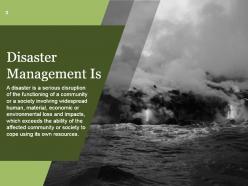
Slide 3: This slide shows disaster management is. You can add your description in this.
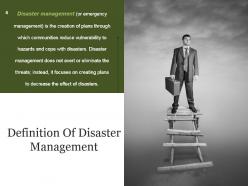
Slide 4: This slide presents Definition Of Disaster Management. Disaster management (or emergency management) is the creation of plans through which communities reduce vulnerability to hazards and cope with disasters. Disaster management does not avert or eliminate the threats; instead, it focuses on creating plans to decrease the effect of disasters.
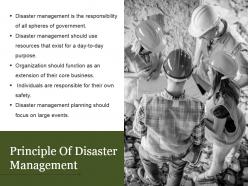
Slide 5: This slide showcases Principle Of Disaster Management. We have listed some them. You can either add as per your need.
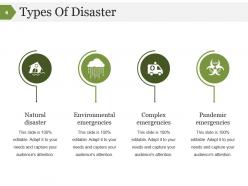
Slide 6: This slide shows Types Of Disaster. we have mentioned few as follows- Natural disaster, Environmental emergencies, Complex emergencies, Pandemic emergencies.
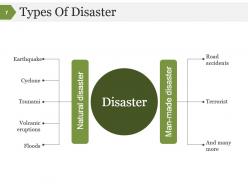
Slide 7: This slide presensts Types Of Disaster with these components we have listed some of them- Disaster, Earthquake, Tsunami, Cyclone, Volcanic eruptions, Floods, Natural disaster, Road accidents, Terrorist.
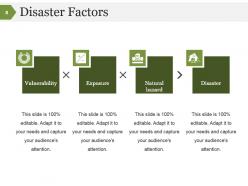
Slide 8: This slide displays Disaster Factors with these - Vulnerability, Exposure, Natural hazard, Disaster.
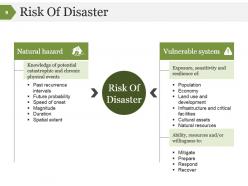
Slide 9: This slide showcases Risk Of Disaster with the two most common parameters that are Natural hazard, vulnerable systems.
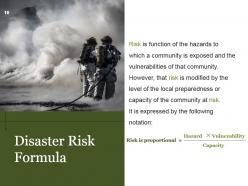
Slide 10: This slide presents Disaster Risk Formula. You can use the formula to analyse the value of disaster risk.
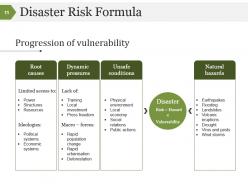
Slide 11: This slide showcases Disaster Risk Formula with this parameters- Root causes, Dynamic pressures, Unsafe conditions, Natural hazards.
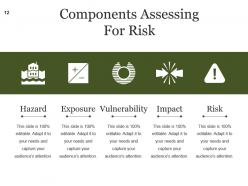
Slide 12: This slide displays Components Assessing For Risk with these five components- Hazard, Exposure, Vulnerability, Impact, Risk.
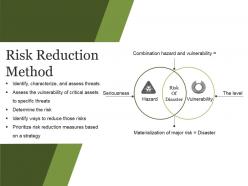
Slide 13: This slide showcases the Risk Reduction Method. You can use it to analyse the risk level through this.
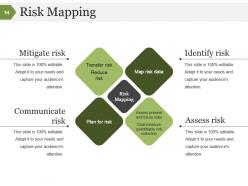
Slide 14: This slide presents Risk Mapping with these important parameters- Map risk data, Transfer risk, Reduce risk, Plan for risk, Assess present and future risks.
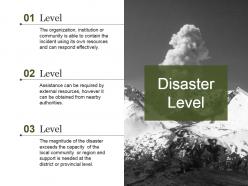
Slide 15: This slide showcases Disaster Level with these levels, we have mentioned three of them. You can put your own as required.
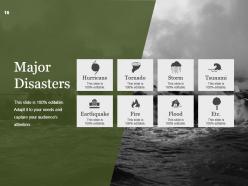
Slide 16: This slide presents various kind of disasters such as- Hurricane, Tornado, Storm, Tsunami, Flood, Fire, Earthquake.
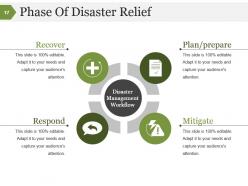
Slide 17: This slide showcases Phase Of Disaster Relief further showing Disaster Management Workflow with these points- Recover, Respond, Plan/prepare, Mitigate.
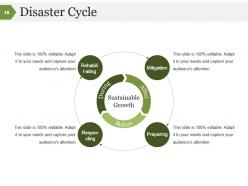
Slide 18: This slide presents Disaster Cycle which further includes Sustainable growth- Rehabilit-ating, Respon-ding, Mitigation, Preparing.
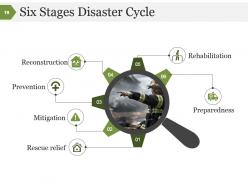
Slide 19: This slide shows Six Stages Disaster Cycle with these six points we have considered- Rehabilitation, Reconstruction, Mitigation, Preparedness, Prevention, Rescue relief.
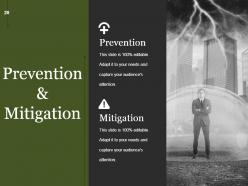
Slide 20: This slide presents Prevention & Mitigation. You can add your data in these two categories- Prevention, Mitigation.
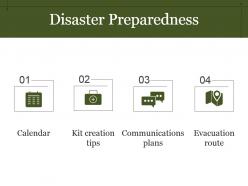
Slide 21: This slide showing Disaster Preparedness which further showing- Calendar, Kit creation tips, Communications plans, Evacuation route.
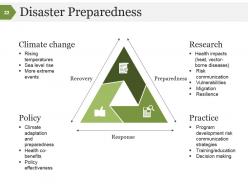
Slide 22: This slide presents Disaster Preparedness. With this slide you can show the recovery, preparedness and response.
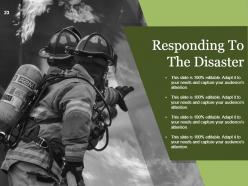
Slide 23: This slide shows Responding To The Disaster. Use this slide to write about the disaster.
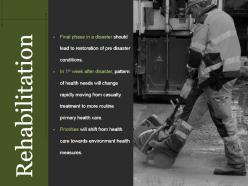
Slide 24: This slide showcases Rehabilitation. We have mentioned some of the rehabilition factors. You can use it as per your requirement.
Slide 25: This slide displays Recover/ Reconstruction. You can use this as per your need.
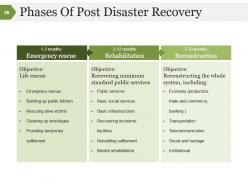
Slide 26: This slide presents Phases Of Post Disaster Recovery with these functions- Economy, Transportation, Telecommunication, Social and heritage, Institutional, Reconstruction, Rehabilitation, Emergency rescue.
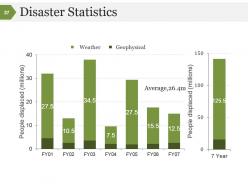
Slide 27: This slide shows Disaster Statistics showing about these parameters- Weather, Geophysical.
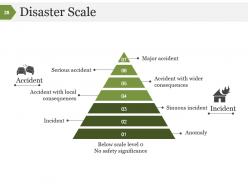
Slide 28: This slide presents Disaster Scale and also showing- Below scale level 0, No safety significance, Major accident, Accident with wider consequences, Sinuous incident, Anomaly, Incident, Accident with local consequences, Serious accident.
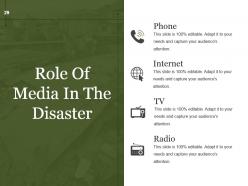
Slide 29: This slide presents Role Of Media In The Disaster with these four parameters- Phone, Internet, TV, Radio.
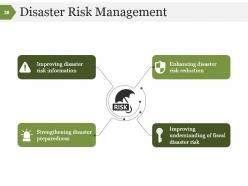
Slide 30: This slide shows Disaster Risk Management with these four parameters- Improving disaster risk information, Enhancing disaster risk reduction, Strengthening disaster preparedness, Improving understanding of fiscal disaster risk.
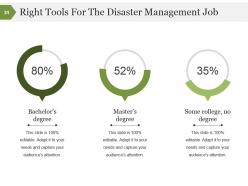
Slide 31: This slide presents Right Tools For The Disaster Management Job. You can add your content or percentage in it.
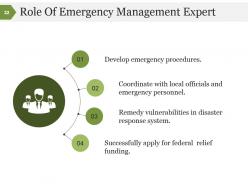
Slide 32: This slide presents Role Of Emergency Management Expert with these four points to consider- Develop emergency procedures, Coordinate with local officials and emergency personnel, Remedy vulnerabilities in disaster response system, Successfully apply for federal relief funding.
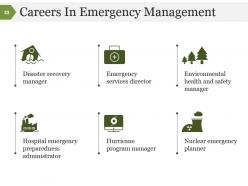
Slide 33: This slide presents Careers In Emergency Management with these parameters we have mentioned- Disaster recovery manager, Hospital emergency preparedness administrator, Emergency services director, Hurricane program manager, Environmental health and safety manager, Nuclear emergency planner.
Slide 34: This is a Coffee Break slide to halt. You may change it as per requirement.
Slide 35: This slide is titled Charts & Graphs to move forward.
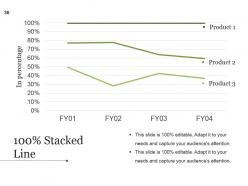
Slide 36: This slide shows a Stacked Line graph in terms of percentage and years for comparison of Product 01, Product 02, Product 03 etc.
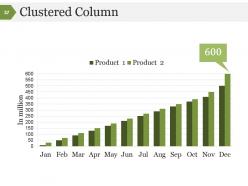
Slide 37: This slide showcases Clustered Column. Analyse the comparison with this and use it as per requirement.
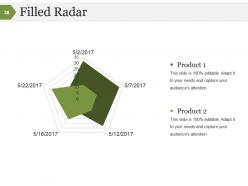
Slide 38: This slide presents Filled Radar. With these you can use it as per your requirement.
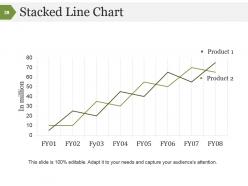
Slide 39: This slide shows a Stacked Line graph in terms of percentage and years for comparison of Product 01, Product 02.
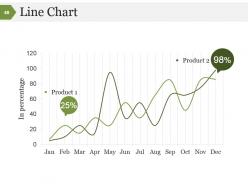
Slide 40: This slide shows a Line Chart for two product comparison
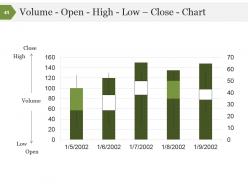
Slide 41: This slide displays a Stock Chart with volume as parameter in terms of high and low, open and close.
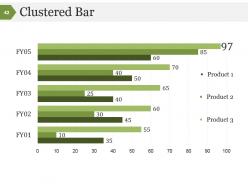
Slide 42: This slide showcases clustered graph. You can use it as per your need.
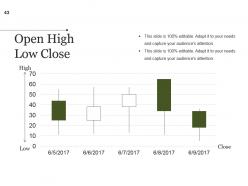
Slide 43: This slide shows Open High Low Close.
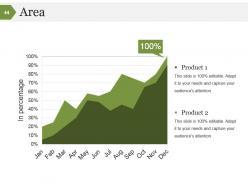
Slide 44: This is an Area Chart slide for product/entity comparison.
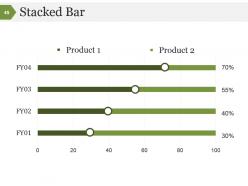
Slide 45: This slide shows a Stacked Line graph in terms of percentage and years for comparison of Product 01, Product 02, Product 03 etc.
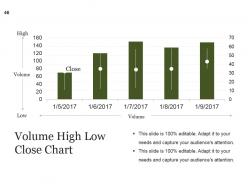
Slide 46: This slide displays a Stock Chart with volume as parameter in terms of high and low, open and close.
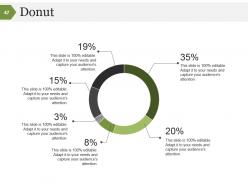
Slide 47: This slide showcases donut pie chart.
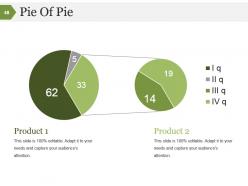
Slide 48: This slide shows Pie Of Pie. You can use as per your requirement
Slide 49: Disaster Management Process And Significance Icon Slides
Slide 50: This slide is titled Additional slides.
Slide 51: This is Our mission slide with imagery and text boxes to go with.
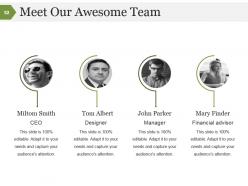
Slide 52: This is Our team slide with names and designation.
Slide 53: This is an About us slide to state company specifications etc.
Slide 54: This is an Our Goal slide. State your important goals here.
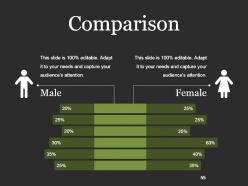
Slide 55: This slide showcases Comparison. You can compare the male and female percentage.
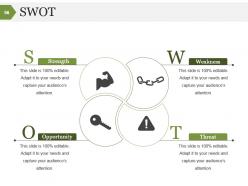
Slide 56: This slide shows Competitive SWOT Analysis to assess the indispensable factors.
Slide 57: This slide displays Financial Projections And Key Metrics for customers and employees.
Slide 58: This is a Business Quotes slide to quote something you believe in.
Slide 59: This is a Post it slide to mark reminders, events etc.
Slide 60: This is a Dashboard slide to show- Strategic System, Success, Goal Process, Sales Review, Communication Study.
Slide 61: This is a Timelines slide to show- Plan, Budget, Schedule, Review.
Slide 62: This slide shows continuation of timeline.
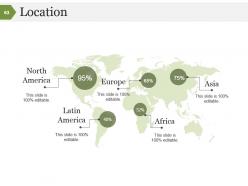
Slide 63: This slide showcases Global Project Locations with a World map and text boxes to make it explicit.
Slide 64: This is a News Paper slide to flash company event, news or anything to highlight.
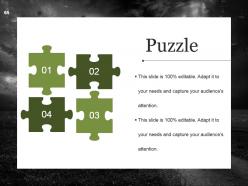
Slide 65: This slide presents a PUZZLE slide with the following subheadings- Integrity and Judgment, Critical and Decision Making, Leadership, Agility.
Slide 66: This is a Target slide. State your targets here.
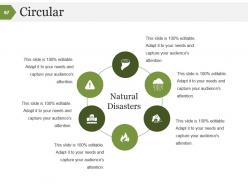
Slide 67: This is a Circular slide to show information, specification etc.
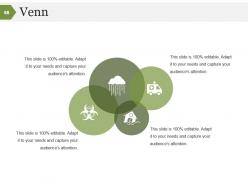
Slide 68: This is a Venn diagram image slide to show information, specifications etc.
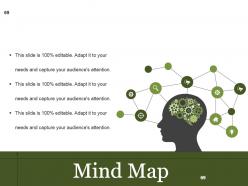
Slide 69: This slide shows a Mind map for representing entities
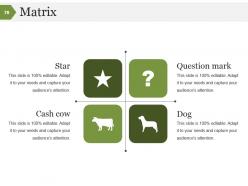
Slide 70: This slide shows a Matrix in terms of High and Low.
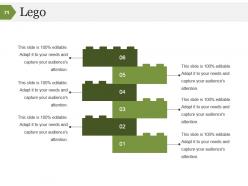
Slide 71: This is a LEGO slide with text boxes to show information.
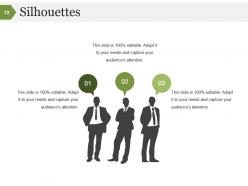
Slide 72: This is a Silhouettes image slide with the subheadings- INVENTORY, PAYMENT, CASH, CREDITCARD, CHECKOUT.
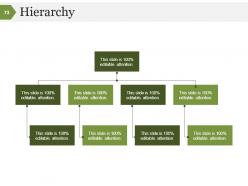
Slide 73: This is a Hierarchy slide showing- Supply Chain Manager, Supply Chain Council, Sourcing, Supplier Quality Engineer, Procurement, Logistics & Management, Supplier Management, Student, Contract Management.
Slide 74: This is a Bulb Or Idea image slide to show information, innovative aspects etc.
Slide 75: This is a Magnifying glass image slide to show information, scoping aspects etc.
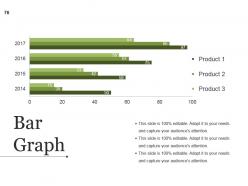
Slide 76: This is a Bar Graph image slide to show product comparison, growth etc.
Slide 77: This is a Funnel image slide showing: Calls-to-action, Reachability, User Experience, Color Schemes, Engagement, Simplicity.
Slide 78: This is a Thank You slide for acknowledgement.
Disaster management process and signifiance powerpoint presentation slides with all 78 slides:
Be on a good footing with our Disaster Management Process And Signifiance Powerpoint Presentation Slides. You will certainly cover a lot of ground.








FAQs for Disaster management process and signifiance
Start with your biggest risks - floods, fires, whatever hits your area most. Build everything around those threats first. You'll need early warning systems and clear communication channels so people actually know what's happening. Map out who does what during emergencies because chaos isn't helpful when stuff goes sideways. Resource management matters too - supplies, personnel, all that. Honestly, the community buy-in part is make-or-break though. If people don't get it or care, your whole plan falls apart. Regular drills keep everyone sharp. Recovery planning comes last but don't skip it.
Drones are honestly amazing for this stuff - they can check out dangerous areas where you'd never send people. AI scans satellite images to predict floods and spot the worst damage. Real-time data makes coordination way smoother, plus social media monitoring shows you exactly where help's needed most. Mobile apps let survivors reach emergency services fast. Cloud systems keep your data safe even when local networks go down. The speed improvement is crazy compared to like 10 years ago. I'd start with whatever tech your area already has and expand from there. Way more manageable that way.
Honestly, community engagement makes or breaks disaster recovery - I've seen it firsthand. People know their neighborhoods better than any government official ever will. When locals help plan emergency responses, they're way more likely to actually listen when evacuation orders come through. You gotta start these conversations early though, not when a hurricane's already headed your way. Find your neighborhood leaders first. Figure out who needs extra help during emergencies. My aunt's community did this after their flooding and it saved lives the next time around. Work with groups that already exist - don't reinvent the wheel.
You'll mostly deal with natural stuff - hurricanes, earthquakes, floods, wildfires. Then there's the human-caused mess like cyberattacks, terrorist threats, industrial accidents. COVID definitely put pandemics on everyone's radar too (ugh). Each disaster needs a completely different game plan though. Flood response? Nothing like handling a data breach. I'd focus on what's actually likely in your area first. Coastal areas should worry more about hurricanes than earthquakes, you know? Pick your top 3-4 risks and build real strategies for those before getting overwhelmed with everything else.
Ugh, climate change is making disaster planning such a nightmare. Weather patterns we used to rely on? Totally scrambled now. You're getting way more extreme events, and they're hitting in weird combinations - like droughts that set up massive wildfires, or when crazy rainfall triggers landslides. Plus all the environmental damage makes things worse. Deforestation means floods get nastier, dead coral reefs can't protect coastlines anymore. Honestly feels like we're always playing catch-up. Your best bet is building flexibility into plans and focusing on adaptation instead of just looking at what happened before.
Skip the boring classroom stuff and jump straight into hands-on practice. Your volunteers need to actually DO first aid, run through evacuations, practice radio calls - that kind of real scenario training. Theory can wait honestly. Make sure everyone knows their exact role when things go sideways, because confusion kills response time. Oh and definitely drill them on incident command structure so they're not stepping on each other's toes. The skills fade super fast though, so you'll need regular refresher sessions. Trust me, muscle memory is everything when actual emergencies hit.
Look, most disaster programs totally mess this up - they rebuild houses but ignore people's heads. Get mental health pros on your team from the start, don't wait. Train everyone to spot trauma signs and do basic psychological first aid. Mobile counseling is huge, plus peer groups work really well. Partner with local mental health orgs too. Here's the thing though - you gotta track psychological recovery just like you'd track housing or jobs. Make therapy as normal as handing out water bottles. People won't ask for help otherwise.
Honestly, Katrina was the wake-up call - when communication systems fail, everything falls apart fast. You've gotta map out who's most vulnerable in your area ahead of time, not during the chaos. Community folks are always your real first responders anyway, so building that local resilience beats just planning reactive stuff. The 2004 tsunami showed how crucial international coordination is, and COVID? That mess proved you need supply chains that can actually pivot. Practice your evacuation routes regularly too - I know it sounds boring, but you don't want to be figuring that out when stuff hits the fan.
So basically FEMA or local emergency folks run the show, but NGOs like Red Cross jump in with shelters and food distribution. They set up these joint command centers to share info and resources - works way better than you'd expect honestly. The smart ones already have partnerships mapped out before disasters hit. Government handles the big infrastructure stuff while NGOs are better at actually helping people on the ground. Oh and volunteer coordination too - that's huge. If your org does disaster work, definitely get those relationships sorted now rather than scrambling later when everything's chaos.
Honestly, it's a total mess - everyone's got different protocols and legal systems they're working under. Communication breaks down fast when teams can't even talk to each other properly. Moving equipment across borders during emergencies? Good luck with that paperwork nightmare. Plus you've got countries with completely different tech capabilities trying to work together. Political drama between nations doesn't magically disappear during disasters either. Your best bet is setting up those mutual aid agreements way ahead of time and doing joint training exercises. That way when everything hits the fan, people already know each other and aren't figuring out basics.
So basically, risk assessments show you what could actually go wrong and how likely each thing is. That way you're not just throwing money at random problems. Look at your biggest threats first - floods, earthquakes, cyber attacks, whatever applies to your area. Then spend your time and budget on those instead of everything else. Like, don't buy generators if your main risk is data breaches, you know? Once you know your top risks, you can train people for those specific scenarios. It sounds boring but it's honestly way better than scrambling when stuff hits the fan.
Map out your most vulnerable communities first - that's where you'll get the biggest impact. Early warning systems are key, but make sure they work for people without smartphones too. I'd definitely focus on community-based prep programs since locals actually know their area's risks. Transportation is a huge problem for elderly and low-income families during evacuations, so plan for that. Oh, and don't sleep on communication strategies - honestly, that's where a lot of places mess up. Building better infrastructure in high-risk spots helps long-term too.
Honestly, communication can make or break disaster response. When emergencies hit, you've got responders, agencies, and regular people all needing to stay connected - otherwise it's total chaos. The tricky part is that disasters love knocking out cell towers and internet (Murphy's law, right?). So you need backup plans: ham radios, social media when it works, even going door-to-door old school style. Don't forget about language barriers either. Having multiple ways to reach everyone isn't just smart planning, it's what keeps rescue efforts from turning into a complete mess.
So disaster recovery basically lives or dies by how well you can move stuff around. Emergency supplies, food, medical gear - it all has to get where it's going fast. Honestly, it's like the world's most stressful delivery job. The trick is having backup plans already mapped out before everything goes sideways. Your distribution networks need to be flexible since roads and bridges might be toast. Multiple agencies are usually involved too, so tracking inventory gets messy quick. The smart move? Pre-position resources in strategic spots so you're not starting from zero when crisis hits.
So there's the obvious stuff - response times, evacuation rates, casualty numbers, how fast infrastructure bounces back. But honestly? The "soft" metrics matter just as much. Community preparedness surveys, public awareness levels, how satisfied stakeholders actually were. Training frequency is huge too. Plus resource availability and whether agencies actually coordinated well during real events (spoiler: they often don't). Post-incident reviews are where the magic happens though - that's when you see what worked vs what you thought would work. Set up dashboards to track this stuff regularly, not just when everything's on fire.
-
The Designed Graphic are very professional and classic.
-
Nice and innovative design.