


Quality Risk Management Powerpoint Presentation Slides




Try Before you Buy Download Free Sample Product
 Impress Your
 Audience
 100%
100% Editable
 Save Hours
 of Time


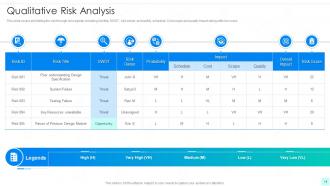
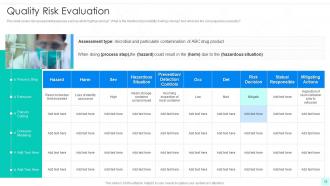
This Quality Risk Management PowerPoint presentation covers the risk based approach to quality management. It includes assessing, controlling, communicating, and reviewing quality concerns. The pharmaceutical business can use this ppt since product quality significantly impacts customer health and safety. This template shows details on quality risk assessment with the help of different tools and methodologies for the pharmaceutical industry. It also covers information on the risk tolerance capacity of the stakeholders and a tracker for future risk possibilities. Further, it includes risk assessment processes such as risk identification, analysis and evaluation. Next, it covers the risk control process, such as risk reduction, risk acceptance, and risk control policy, along with risk communication and review processes. This presentation enfolds risk management methodologies such as risk ranking and filtering, fault tree analysis, hazard operability analysis, hazard analysis and critical control point. Further, it comprises failure mode analysis and failure mode, effects and criticality analysis. Lastly, it covers risk tolerance capacity and risk tracker. Download our 100 percent editable and customizable risk management ppt, which is also compatible with google slides.
People who downloaded this PowerPoint presentation also viewed the following :
Content of this Powerpoint Presentation
Slide 1: This slide introduces Quality Risk Management. State Your Company Name and begin.
Slide 2: This slide states Agenda of the presentation.
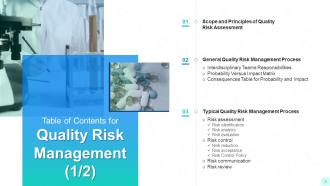
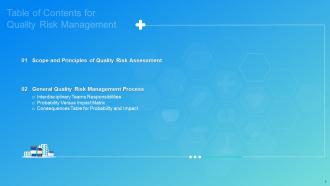
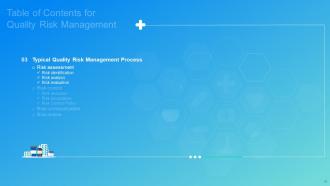
Slide 3: This slide presents Table of Content for the presentation.
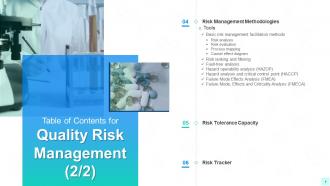
Slide 4: This is another slide continuing Table of Content for the presentation.
Slide 5: This slide highlights title for topics that are to be covered next in the template.
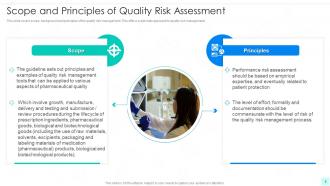
Slide 6: This slide shows Scope and Principles of Quality Risk Assessment.
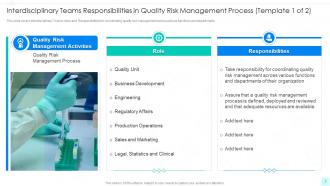
Slide 7: This slide covers Interdisciplinary Teams roles and Responsibilities.
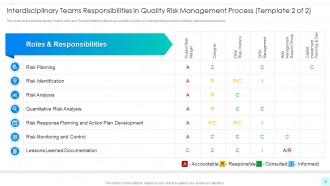
Slide 8: This is another slide continuing Interdisciplinary Teams roles and Responsibilities.
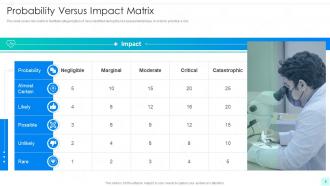
Slide 9: This slide covers risk matrix to facilitate categorization of risks.
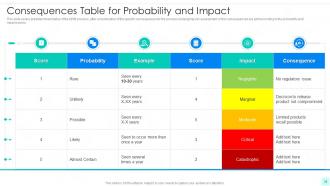
Slide 10: This slide displays Consequences Table for Probability and Impact.
Slide 11: This slide highlights title for topics that are to be covered next in the template.
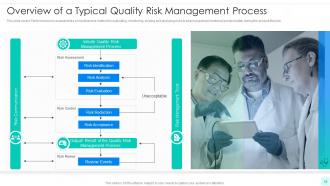
Slide 12: This slide represents Overview of a Typical Quality Risk Management Process.
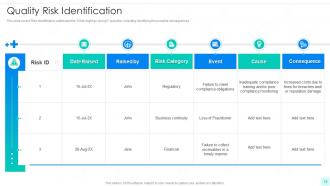
Slide 13: This slide showcases Quality Risk Identification.
Slide 14: This slide covers prioritizing the risk through risk register.
Slide 15: This slide covers risk assessment purposes.
Slide 16: This slide highlights title for topics that are to be covered next in the template.
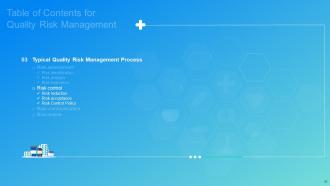
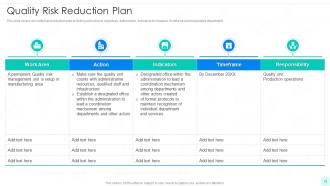
Slide 17: This slide covers risk control and reduction plan.
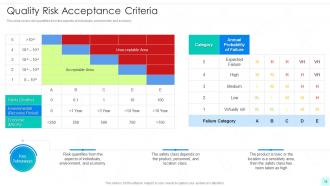
Slide 18: This slide covers risk quantifies from the aspects of individuals, environment, and economy.
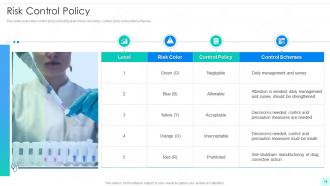
Slide 19: This slide showcases Risk control policy including level of risk, risk colour, control policy, etc.
Slide 20: This slide highlights title for topics that are to be covered next in the template.
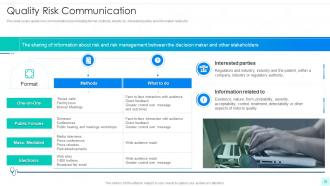
Slide 21: This slide covers quality risk communication plan including format, methods, etc.
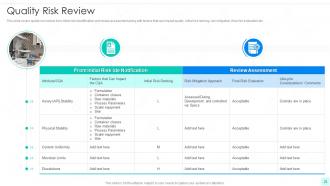
Slide 22: This slide presents quality risk review from initial risk identification.
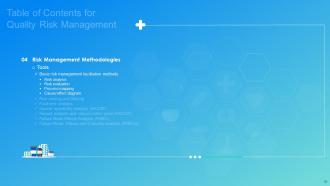
Slide 23: This slide highlights title for topics that are to be covered next in the template.
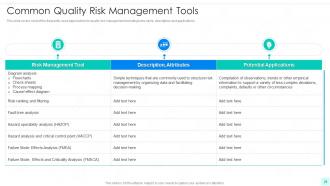
Slide 24: This slide displays Common Quality Risk Management Tools.
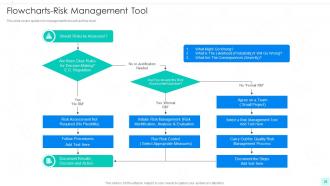
Slide 25: This slide covers quality risk management tool such as flow chart.
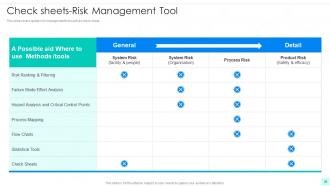
Slide 26: This slide covers quality risk management tool such as check sheet.
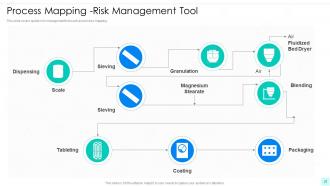
Slide 27: This slide displays Process Mapping -Risk Management Tool.
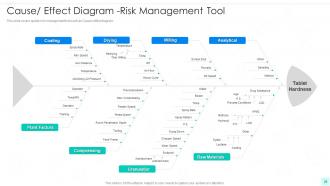
Slide 28: This slide covers quality risk management tool such as Cause/ effect diagram.
Slide 29: This slide highlights title for topics that are to be covered next in the template.
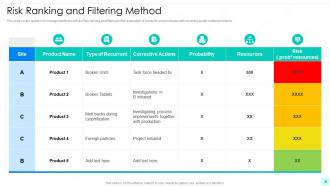
Slide 30: This slide covers quality risk management tool such as Risk ranking and filtering.
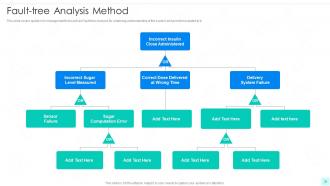
Slide 31: This slide represents quality risk management tool such as Fault-tree Analysis.
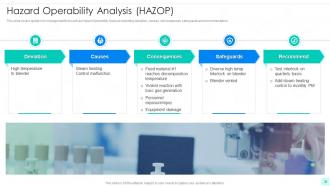
Slide 32: This slide showcases quality risk management tool such as Hazard Operability Analysis.
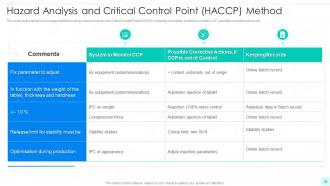
Slide 33: This slide shows Hazard Analysis and Critical Control Point (HACCP) Method.
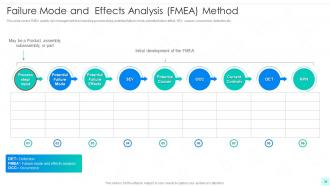
Slide 34: This slide presents Failure Mode and Effects Analysis (FMEA) Method.
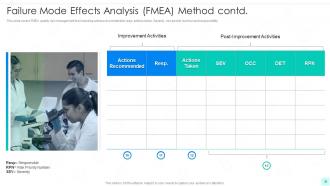
Slide 35: This is another slide continuing Failure Mode Effects Analysis (FMEA) Method.
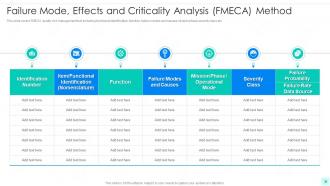
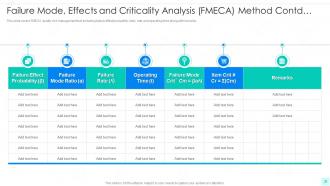
Slide 36: This slide displays Failure Mode, Effects and Criticality Analysis (FMECA) Method.
Slide 37: This is another slide continuing Failure Mode, Effects and Criticality Analysis (FMECA) Method.
Slide 38: This slide highlights title for topics that are to be covered next in the template.
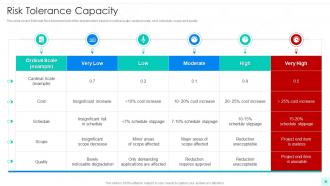
Slide 39: This slide represents Estimate Risk tolerance level of the stakeholders.
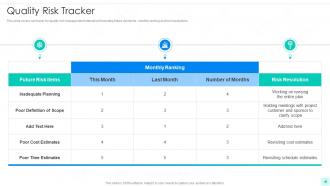
Slide 40: This slide showcases risk tracer for quality risk management internal unit.
Slide 41: This slide displays Icons for Quality Risk Management for Pharmaceutical Industry.
Slide 42: This slide is titled as Additional Slides for moving forward.
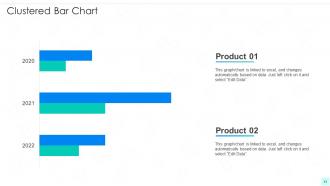
Slide 43: This slide provides Clustered Bar chart with two products comparison.
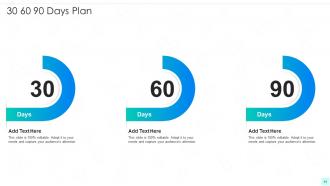
Slide 44: This slide provides 30 60 90 Days Plan with text boxes.
Slide 45: This slide displays Mind Map with related imagery.
Slide 46: This slide presents Roadmap with additional textboxes.
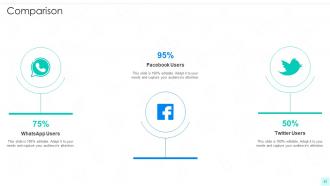
Slide 47: This is a Comparison slide to state comparison between commodities, entities etc.
Slide 48: This slide contains Puzzle with related icons and text.
Slide 49: This is Our Target slide. State your targets here.
Slide 50: This slide depicts Venn diagram with text boxes.
Slide 51: This is a Thank You slide with address, contact numbers and email address.
Quality Risk Management Powerpoint Presentation Slides with all 56 slides:
Use our Quality Risk Management Powerpoint Presentation Slides to effectively help you save your valuable time. They are readymade to fit into any presentation structure.







FAQs for Quality Risk Management
So QRM is basically about being smart and systematic with risk management. First, map out where things could go wrong in your processes. Then figure out how likely each problem is and how bad it'd be if it happened. Focus your energy on the biggest risks first - don't waste time trying to fix every tiny possibility. Base decisions on actual data, not just hunches (though experience definitely counts too). Document everything and review it regularly so it stays current. The whole thing needs to integrate with your quality system from start to finish.
Honestly, just start by looking at what you're already doing and figure out where things actually go wrong. Each company's totally different - pharma rules don't make sense for software teams, obviously. Make the risk criteria fit your industry stuff and whatever regulations you deal with. The framework's structure is solid, but tweak everything else to match your reality. I'd pick one department first though, see what actually works instead of trying to fix everything at once. Way easier to expand later once you know what doesn't suck.
Risk assessment is basically where you map out everything that could go wrong - from your raw materials all the way to final release. You'll score each risk based on how likely it is and how bad the impact would be. Honestly, it takes forever but you can't really rush it. The thing is, this whole step feeds into your risk control later on, so if you mess up here your entire system gets wonky. I'd start by sketching out your processes first, then go through each step looking for potential failure points. It's tedious but worth doing right.
So QRM integration is basically mapping out what could go wrong at every stage - development, manufacturing, post-market stuff. You identify risks early and put controls in place before things actually blow up. Way smarter than the old "oh crap, fix it later" method we all used to rely on. The whole point is catching problems when they're cheap to solve instead of scrambling after launch. Plus you're building quality right into your process rather than hoping testing catches everything (spoiler: it won't). Start by looking at what you're already doing - I bet you'll find you're doing more risk management than you think. Just needs better structure.
Honestly, the cultural stuff hits hardest - people just refuse to change how they've always worked. Leadership buy-in is tough too. Your teams will probably struggle with the actual risk assessment methods, especially if systematic thinking isn't their thing. Resources are always an issue since QRM eats up time and usually needs new training or tools. Integration with existing quality systems? Total nightmare - way messier than anyone tells you upfront. Start with small pilot programs though. Show some quick wins first, then expand from there. Much better than trying to flip everything at once.
Honestly, you've got to speak different languages to different people. Executives just want the big picture impact stuff, but your tech teams need all the nitty-gritty details. Visual stuff helps a ton - risk matrices, dashboards, whatever makes it easier to digest. Don't be like me and only send updates when everything's on fire (learned that one the hard way). Set up regular check-ins so people aren't surprised. Always use the same format too - makes life easier for everyone. Oh, and here's the key thing: include actual next steps with names attached. Nobody wants a "here are all our problems" email without solutions.
Start with brainstorming sessions and basic risk matrices - they're pretty straightforward. FMEA is solid too if you want something more structured. Fishbone diagrams are actually clutch for figuring out root causes (I swear by these when I'm banging my head against the wall). For trickier problems, fault tree analysis works well. HAZOP studies are good but kinda intense. Process mapping shows you where risks like to hide in your workflows. Pick whatever matches your team's skill level though. Don't jump into the complex stuff right away - build up from simple brainstorming first, then add tools as you go.
Look, regulators don't care about your fancy QRM documentation if it's just sitting in a binder somewhere. What they really want to see is how you actually use risk management day-to-day. FDA and EMA folks will literally pick a random risk and trace it from start to finish - how you found it, what you did about it, the whole story. I've seen companies get roasted for treating this like just another compliance box to check. Your team better be ready to show real examples where risk decisions changed your SOPs or shifted resources around. Otherwise you're toast.
Look, continuous monitoring is basically your safety net - it catches problems before they blow up in your face. You can't just build your QRM system and forget about it (trust me on this one). Regular reviews help you spot trends and see if your fixes are actually working. New hazards pop up all the time when processes change. It's like having an early warning system so quality issues don't come out of nowhere and wreck your day. Just make sure someone's actually responsible for tracking those key indicators - otherwise it's pointless.
Honestly, tech makes QRM so much easier - you can automate risk assessments instead of doing everything manually. Real-time monitoring catches problems early, which is huge. Digital risk management tools blow spreadsheets out of the water for tracking controls and generating reports. The audit trails alone are worth it. Predictive analytics will spot patterns you'd never see otherwise, though I swear some of these tools are unnecessarily complicated. Just pick something that plays nice with what you're already using and doesn't make your team want to throw their computers out the window.
You need both leading and lagging indicators to actually see what's happening. Leading stuff - risk assessments, how fast you fix problems, training compliance - tells you if your system's working. Lagging ones are customer complaints, recalls, audit failures. I swear, most teams get obsessed with just checking compliance boxes and totally miss the real quality trends. Balance both types so you can catch problems before they cost you serious money. Pick maybe 3-5 metrics that connect to your biggest risks and check them monthly. Don't overcomplicate it.
Honestly, cross-functional teams are a game changer for risk assessments. You get so many different perspectives - manufacturing sees stuff quality never would, supply chain catches timing issues, regulatory spots compliance gaps. Quality teams can get stuck in theoretical mode sometimes (sorry quality folks). But when you pull everyone together, they bring real-world knowledge of what actually breaks down day-to-day. The ownership piece is huge too. People buy in way more when they're part of identifying the risks instead of just getting handed a list. Try grabbing one person from each major area for your next session. You'll be surprised how many "oh shit, what if..." moments come up that you'd totally miss otherwise.
QRM is like your early warning system - you're scanning for what might blow up before it does. Root cause analysis? That's your detective work after things already went wrong (and trust me, they will). Here's the thing though - they actually work together pretty well. When you find out why something failed, that info should go right back into your risk planning. Your QRM also gives you better places to start looking when you're troubleshooting. Honestly, you need both running or you'll just be putting out fires constantly instead of preventing them.
Dude, AI and ML are seriously changing the game with quality risk assessments. These systems can crunch through tons of data and actually predict failures before they happen - way ahead of traditional methods. Pretty wild, right? Historical data gets combined with real-time inputs to create these early warning systems that keep learning. What's really neat is how they update risk profiles continuously instead of those boring annual reviews we used to do. Though honestly, you'll still need someone checking the AI's work to make sure it's not missing context or making weird recommendations that don't fit your situation.
Dude, you can't just treat quality and risk stuff like a checkbox during audit season. Get people comfortable reporting problems without fear - nobody talks if they think they'll get thrown under the bus. Cross-functional teams are huge too, departments need to actually communicate about risks instead of staying in silos. Training works better with real case studies from your industry rather than generic compliance modules (honestly, those are such a snooze fest). But here's the thing - if your leadership only cares about hitting deadlines and staying under budget, your team will pick up on that vibe and prioritize accordingly.
-
I had them make a presentation for an office retirement party. They were very helpful in understanding what we wanted and delivered the perfect presentation. Highly recommended!
-
The designs are very attractive and easy to edit. Looking forward to downloading more of your PowerPoint Presentations.