

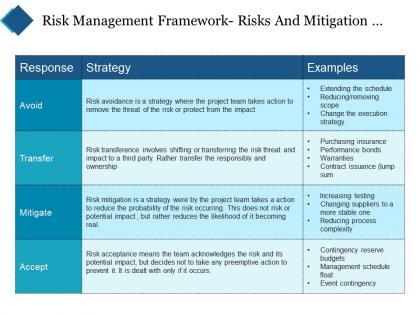
Risk Management Framework Risks And Mitigation Strategies Ppt Templates




Try Before you Buy Download Free Sample Product
 Impress Your
 Audience
 100%
100% Editable
 Save Hours
 of Time


Cement your growth with our Risk Management Framework Risks And Mitigation Strategies Ppt Templates. Build big on a firm foundation.
People who downloaded this PowerPoint presentation also viewed the following :
Risk Management Framework Risks And Mitigation Strategies Ppt Templates with all 5 slides:
Acquire freedom to chase your dreams with our Risk Management Framework Risks And Mitigation Strategies Ppt Templates. They ensure you never feel caged in.




FAQs for Risk Management Framework Risks And Mitigation
Okay so there are five main pieces to get right: identifying risks, assessing them, treating them, monitoring, and communication. First you figure out what could actually go wrong. Then assess how likely each thing is and what the impact would be. For treatment, you've got four options - accept it, avoid it, reduce it, or transfer it to someone else (like insurance). Monitoring means checking how things change over time. Communication keeps everyone on the same page, which honestly gets overlooked way too often. Don't try to perfect everything at once though - pick one area and build from there.
So first figure out what regs actually apply to your business - SOX, HIPAA, PCI-DSS, whatever. Then you gotta cross-reference those requirements against your NIST controls. Some will match up perfectly, but others you'll need to beef up or add from scratch. Honestly, the documentation is where most people mess this up. Create a matrix showing how each RMF control maps to regulatory stuff - trust me, auditors love seeing everything laid out clearly. Makes those compliance reviews way less painful. Oh and some controls will cover multiple regs at once, which is nice when you find those.
Look, stakeholder engagement is what'll make or break your whole framework. Different teams spot risks leadership totally misses - finance catches regulatory stuff, IT sees cyber threats, operations knows where things actually fall apart. Here's the thing though: if people don't help build it, they won't use it when everything hits the fan. I've seen this happen way too many times. You need their input to catch blind spots and get real buy-in. Map out who should be involved first, then start having those conversations ASAP. Trust me on this one.
So basically, a Risk Management Framework is just a structured way to figure out what could go wrong before you make big decisions. You know how we usually just wing it? This actually makes you sit down and think through the "what ifs" ahead of time. It helps you spot potential problems, figure out how likely they are to happen, and decide which ones to worry about first. Plus you can build backup plans - which honestly saves your butt later when things inevitably go sideways. Try using it on your next big project decision and see how it goes.
Honestly, most companies treat it like checking boxes instead of actually protecting themselves. People rush through without training anyone properly - so everyone's just going through motions without getting the point. Don't overcomplicate things either. I've watched teams build these ridiculous bureaucratic nightmares that nobody wants to touch. You can't just steal another company's framework and slap it on yours, doesn't work that way. Keep it simple at first. Get your leadership on board. Make sure people understand why they're doing risk assessments in the first place - that's half the battle right there.
So tech can totally transform your risk management - automated data collection and real-time monitoring are huge wins. Predictive analytics help catch risks early, which honestly feels like having superpowers sometimes. AI and machine learning spot patterns you'd never see doing things manually. Your dashboards stay updated automatically instead of you constantly refreshing reports. The time savings on manual stuff is insane. I'd start by figuring out what's eating up most of your time right now, then find tools to fix those pain points first. Don't try to overhaul everything at once.
For risk assessment, I'd start with a basic risk register - just list out what could go wrong and rate each one by how likely it is and how bad it'd be. SWOT analysis is honestly my favorite though, super easy to get everyone involved. Brainstorming sessions work well too, or you could dig into data from past projects if you have it. Sometimes bringing in an expert is worth it for tricky stuff. Pick maybe 2 or 3 approaches that make sense for your project size. The trick is actually checking back on these regularly instead of doing it once and forgetting about it.
Honestly, a good risk framework just spreads safety responsibility around instead of dumping it all on one team. You'll want people comfortable reporting problems without getting in trouble - that's huge. Build risk talks into regular meetings and daily decisions. Think of it like safety bumpers that keep you on track automatically. Leadership needs to actually show they care through reviews and funding (not just lip service). The real win? You stop playing whack-a-mole with problems and start preventing them. Training people to spot risks first is where I'd start - that's when you'll see the mindset really shift.
Track your leading and lagging indicators - stuff like how fast you're finding risks versus closing vulnerabilities. Compliance scores matter too, obviously. The big win is catching risks before they blow up into actual incidents. Nobody has time for constant firefighting, trust me. Mean time to remediation is solid to watch. Build a dashboard showing trends over time instead of just snapshots - way more useful. I'd start with maybe 3-5 metrics that actually matter to your specific setup, then expand from there once you get the hang of it.
Look, quarterly check-ins are your friend here. Actually dig into what's working and what's total garbage. I'd track your key risk stuff and incident patterns - boring but necessary. Different departments will catch things you completely missed, so loop them in. The real trick? Don't just hoard data like some weird collector. Act on it. Tweak processes, update your risk appetite, train people when things change. My old boss used to say "make it breathe" which sounds cheesy but honestly makes sense. You want a system that actually evolves, not some manual gathering dust somewhere.
So your risk framework needs to stay flexible since new cyber threats pop up constantly. Set up regular assessments that hunt for emerging stuff, not just the same old risks. When something fresh hits - and it definitely will - you'll want rapid response protocols ready. Makes your team way faster at assessing and rolling out controls. Oh, and don't make risk identification some boring annual thing. Keep threat intelligence current and honestly, just put emerging risk reviews on every meeting agenda. The whole point is staying ahead of whatever's coming next.
Risk assessments are honestly the foundation of your whole RMF process. During categorization, you're figuring out what assets need protection. Then when selecting controls, assessments tell you which safeguards actually make sense. The monitoring phase? More assessments to spot emerging threats. Here's the thing though - people treat them like a checkbox exercise, but they shouldn't be. You need that assessment mindset woven throughout every phase. Otherwise you're making security decisions based on stale info from six months ago. Short version: they keep you grounded in what's really happening instead of what you think is happening.
Honestly, you've got to know your crowd first. Executives just want the big picture stuff - what's gonna hurt the bottom line? But your front-line people need the nitty-gritty details about their actual jobs. Skip the corporate speak and use visuals like heat maps instead. Nobody reads those massive annual reports anyway (learned that the hard way). Set up regular check-ins with real examples they'll actually get. Oh, and always tie it back to business results - otherwise they'll zone out. Map who needs what level of detail first, then figure out your game plan.
So qualitative risk assessment is basically "high/medium/low" gut-check stuff, while quantitative puts actual numbers on everything. Qualitative's way faster - perfect when you're missing data (which happens more than anyone wants to admit). Numbers give you precision but you'll need decent historical data and time to do the math. Honestly, most people end up mixing both approaches anyway. Start with qualitative to spot the big issues, then crunch numbers on whatever scares you most. Really depends on your deadline and what info you've actually got to work with.
Honestly, your past screw-ups are the best data you'll ever get for risk management. Look at what actually went wrong and what red flags everyone missed. Way too many teams just sweep this stuff under the rug instead of mining it for insights. Take those lessons and update your risk categories - like, actually use them to build better assessment criteria. Document where things fell apart most. Then create controls specifically around those weak spots. I know it sucks reliving the painful stuff, but those experiences become your best defense against future disasters if you're smart about it.
-
Unique and attractive product design.
-
Unique research projects to present in meeting.