

 0 Comment
 Customer Reviews

The business plan's done. Nobody's touching it.
Not because the numbers are wrong—they're probably fine. But somewhere between the executive summary and the financial projections, someone has to explain why a concierge service is worth funding, worth scaling, worth trusting. That part doesn't write itself.
There's a specific kind of paralysis that hits when you know your idea works but can't make the document say so. A personal concierge service startup, a corporate concierge offering, a luxury concierge business model—any of these can be genuinely strong businesses. The problem isn't the idea. It's the gap between knowing it and showing it on paper.
And the plan keeps expanding. The concierge service target market section alone requires demographic breakdowns, psychographic overlays, geographic filters. Then comes the pricing section. Then the revenue projections. Then someone asks about liability. Then someone else asks about the legal structure. The document grows, the clarity shrinks, and the investor meeting is Tuesday.
What makes it worse is the formatting. A business plan that looks unfinished signals an unfinished business. Investors read dozens of these. A cluttered slide, an inconsistent layout, a table that doesn't breathe—these aren't minor aesthetic complaints. They're credibility signals.
So the templates exist. Because this problem is old and common and everyone hits it eventually. Someone building a hotel concierge business plan needs a different structure than someone pitching a virtual concierge business plan or a senior concierge care model. The category is wide. The underlying anxiety is the same.
SlideTeam's concierge service business plan templates handle the part that's hardest to start: the structure. Ready-made frameworks for financial modeling, service planning, market analysis—content-ready slides that let you focus on the actual business rather than the architecture of the document.
Here's what's available.
Template 1: Financial Modeling and Planning for Cleaning Concierge Business Plan in Excel
Financial clarity is what separates a fundable concierge business plan from one that raises more questions than it answers. This PPT template is built for founders and analysts who need to present five-year financial projections—2023 to 2027—in a format stakeholders can actually follow. It covers payback period, DCF valuation, scenario analysis, break-even analysis, and full financial statements. Explore more concierge service business plan frameworks to complement this financial model. The blue-cell input structure lets practitioners adjust figures to fit sector-specific needs. It suits concierge business plan financial projections for cleaning, lifestyle, or corporate service models. The template is 100% editable and customizable.
[product_image id=843816]
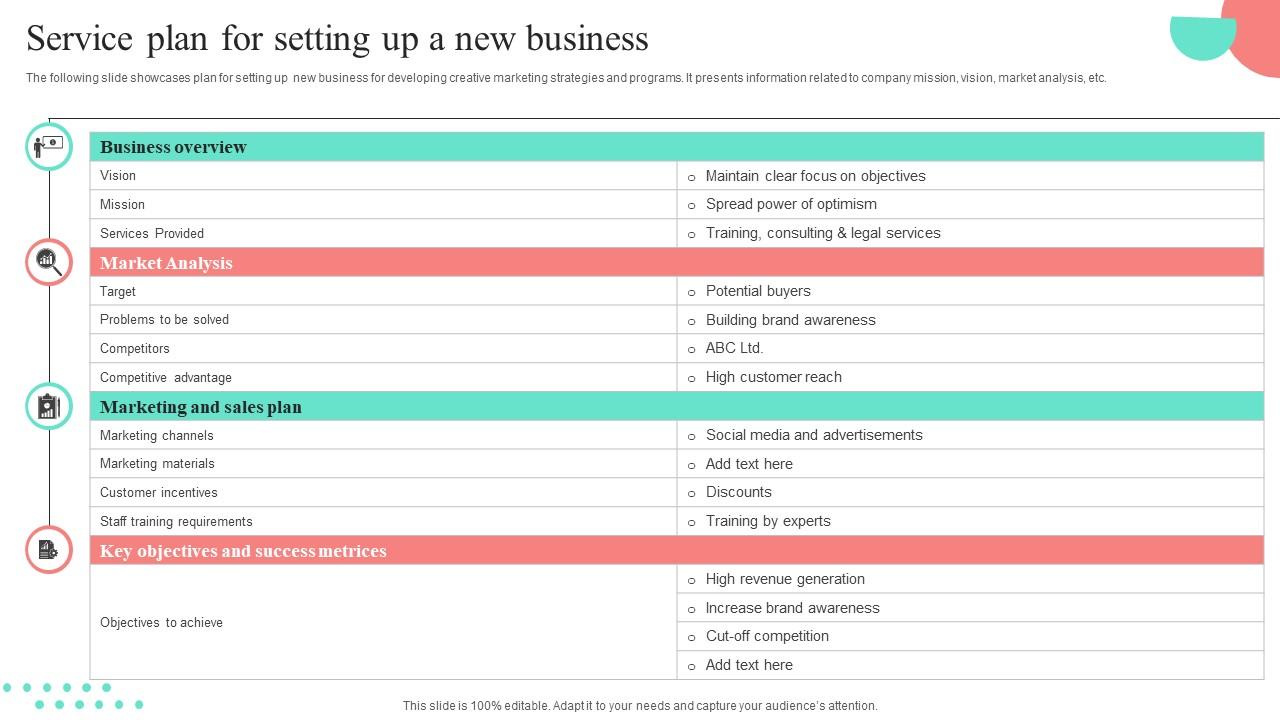
Template 2: Service Plan for Setting Up a New Business
Getting a new concierge service off the ground requires more than a good idea—it requires a structured plan that communicates intent clearly. This PowerPoint slide is built for founders presenting company mission, vision, market analysis, and success metrics in one cohesive view. It works well for a personal concierge service startup pitch or a corporate concierge service plan review. The layout keeps business overview and market context together, so the audience sees the full picture fast. The template is 100% editable and customizable.
Download this PowerPoint Template
Win Every Pitch with SlideTeam
SlideTeam's PowerPoint templates are the best in the industry for building a concierge service business plan that commands attention and earns trust. These content-ready slides cover everything from financial projections and market segmentation to service pricing and executive summaries—saving hours of formatting work. Use these ready-made frameworks to present your luxury concierge business model with the clarity and polish investors expect. Deploy these templates today and turn your concierge vision into a fundable, professional proposal.
FAQs on Concierge Service Business Plan
What are the core components that must be included in a concierge service business plan to attract investors?
Investors look for six things: an executive summary, a clear market opportunity, a defined service offering, a revenue model, financial projections, and a go-to-market approach. The executive summary carries the most weight—it sets the tone for everything that follows. Financial projections covering at least three years, with break-even and ROI clarity, are non-negotiable. Skip the jargon; show the numbers and the path to profitability.
How do you define and segment the target market for a luxury concierge service?
Start by segmenting on income level, lifestyle demands, and time scarcity—not just demographics. High-net-worth individuals, busy executives, and dual-income households are the three segments most concierge services serve. For a luxury concierge business model, layer in psychographic data: what these clients value, how they spend, and what they currently outsource. A tight segment beats a broad one every time.
What pricing models work best for personal concierge services, and how should they be presented in a business plan?
Three models work consistently: hourly billing, monthly retainers, and tiered membership packages. Retainers provide predictable revenue and suit corporate concierge clients. Tiered memberships work well for personal and lifestyle concierge services. In the business plan, present each tier with clear deliverables and margins. Show the blended revenue mix and how pricing scales with demand. Avoid vague ranges—investors want specific numbers.
How can a concierge service business differentiate itself in an increasingly competitive market?
Specialization is the fastest path to differentiation. A medical concierge business plan, a real estate concierge offering, or a senior concierge care model each serves a distinct need that generalist services don't. Beyond niche focus, response time, a dedicated point of contact, and CRM-backed client history create loyalty that competitors can't easily replicate. Pick one differentiator and build the brand around it.
What startup costs should be anticipated when launching a concierge service, and how should they be outlined in a financial plan?
Typical startup costs include licensing and legal fees, liability insurance, CRM software, marketing, and initial staffing. For a home concierge service business plan, add vendor partnerships and logistics setup. Budget separately for working capital—most concierge businesses take three to six months to reach steady revenue. Group costs into one-time setup expenses and ongoing monthly burn. Present both clearly in the financial section.
How do you calculate the break-even point for a concierge service business?
Divide total fixed monthly costs by the average revenue per client. That gives you the number of clients needed to cover costs. For example, if fixed costs are $8,000 per month and average monthly revenue per client is $400, break-even is 20 clients. Track variable costs separately. Include this calculation explicitly in the business plan—it shows investors you understand the unit economics.
What legal structures are most suitable for a concierge service business, and how does the choice impact the business plan?
Most small concierge businesses start as an LLC—it limits personal liability without the complexity of a corporation. A sole proprietorship works for solo operators but offers no liability shield. If outside investors are involved, an S-Corp or C-Corp structure may be needed. The legal structure affects taxation, fundraising options, and operational risk. State the chosen structure early in the business plan and briefly explain the rationale.
How should a concierge service business plan address liability and insurance requirements?
General liability insurance is the baseline—it covers third-party property damage and bodily injury. Add professional liability (errors and omissions) coverage, especially if the service involves financial, medical, or legal coordination. If employees are hired, workers' compensation is mandatory in most states. Document coverage types, policy limits, and renewal schedules in the business plan. Investors treat gaps in insurance as operational red flags.