

 0 Comment
 Customer Reviews

What drives business forward isn't strategy or ambition alone—it's knowing what matters most, As organizations face competing priorities, rapid change, and complex decisions, it can be hard for them to remain focused on what truly matters. That is why having a system that filters choices and aligns actions with core principles is so crucial. This is where a value hierarchy comes into play. A value hierarchy provides individuals and organizations with a structured ranking of values to help guide everyday decisions, set long-term goals, or create internal alignment. Without value hierarchy, leaders may lead ineffectively, teams may collaborate poorly, and brands might miscommunicate Though its importance cannot be overstated, many businesses and organizations still fail to establish a defined value hierarchy. Instead, they focus on KPIs and deliverables while neglecting to account for how all efforts work together as one coherent unit. This leads to confusing messages, conflicting goals, and missed opportunities. There can even be discrepancies between what companies claim they value and the actual actions taken against that promise.
Refer to our blog on the Top 7 Hierarchy Pyramid Templates to improve your visual appeal. These templates offer valuable tools for expressing an intricate value proposition framework and prioritizing across multiple domains.
Establishing a value hierarchy can be complex. While recognizing business values may come naturally, organizing them in an actionable, meaningful, and communicable way can often prove tricky. SlideTeam provides the ideal solution with its "Must-Have Value Hierarchy Templates." Our comprehensive PPT set offers carefully designed templates that encompass every angle of value representation--from value pyramids and benefits hierarchies, emotional and functional value tiers, strategic value layers, perceived value rankings, brand value tiers, and core-to-augmented value. These polished, fully editable, content-friendly designs let you easily plug in values. Plus, they come in PNG and JPG formats, making them user-friendly as well!
Get an insight into our blog on Top 10 Department Structure Templates to empower individual contributors to matrix layouts that encourage cross-departmental synergy and cater to diverse operational needs.
Let’s browse the templates below!
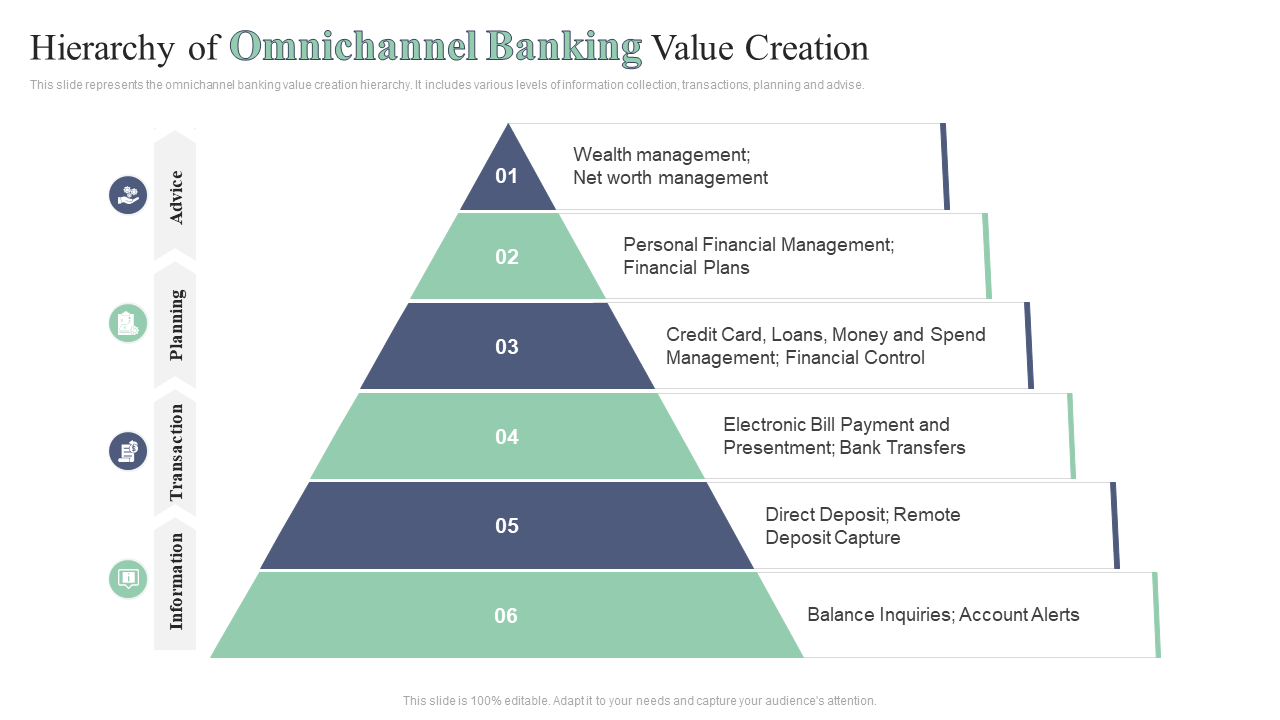
Template 1: Hierarchy of Omnichannel Banking Value Creation
This presentation slide conveys a set of progressively more valuable stages of value-based segmentation delivery to the customer by a bank. It includes balance checks, alerts , and direct deposit. The higher-value products and services, such as electronic bill payments, loans, and credit cards, are the focus of the slide as we move up. The uppermost tiers are leading-edge financial support through planning, counsel, and wealth management. Banks transition from simple delivery of information to personal financial guidance, inspiring further engagement from customers, and it is this layered product value structure that accounts for how. This slide walks institutions through how each service builds from the next, making it easier to plan their omnichannel strategy. Download it now.
Visualize Success with Every Slide
The only concept that should hold any value in constructing and executing your strategies – is the foundation behind all successful approaches to key functions, be it marketing, business development, product design, or customer service. The needs fulfillment hierarchy is the compass businesses rely on to take them toward true customer cravings. These frameworks range from the value ladder that runs from simple features to differentiating experiences and the value chain of needs that maps out every customer journey touchpoint. This helps decision-makers use value as a closer and more mindful guide to strategy.
These templates help streamline your strategy and make sure that your ideas are not just listened to but retained.Our slides are designed for marketers, consultants, product managers, CX teams, and basically anyone who wants to turn customer insights into sustainable impact, from startups to Fortune 500s. Grab SlideTeam’s value hierarchy templates now and create your next winning concept on the right foundation of mapping purpose, insight, and customer focus.
PS: Look out for our blog on Top 10 Corporate Structure Templates to reduce productivity, increase employee fatigue, and have a negative influence on bottom lines since they have no structure to follow.
FAQs on Value Hierarchy Templates
1) What are the 5 hierarchy of values?
The 5 hierarchy of values you will often find after meaning only talk about values that you, personally or systemically, hold in higher view than others. There is a generic site structure widely accepted, which consists of:
Survival Values – Fundamental needs, which include food, water, shelter, and safety.
Values Related To Security — The desire for stability, protection, and order in life.
Social Values – Being part of a group, building relationships and acceptance within a wider group.
Ego values — such as self-esteem, achievement, and recognition.
Self-Actualization Values — Growth, Meaning, and Purpose
This is very similar to Maslow's hierarchy of needs but in values-based contexts.
2) What are the 5 levels of customer value hierarchy?
The 5 levels of customer value hierarchy introduced by Philip Kotler — the levels of needs satisfied by a product/service to a customer are:
Core benefit – The most basic benefit the customer is really buying.
Core Product – The most fundamental level of the product, which delivers the basic benefit.
Expected Product- A bundle of features and conditions buyers expect under normal circumstances.
Augmented Product – Features or services that go beyond customer expectations.
Potential Product — All future transformations the product might undergo in order to attract and hold customers
3) What is the hierarchy of valuation?
Valuation hierarchy describes the ranking of the ways used to measure an asset value, primarily relevant with respect to finance and accounting. In fair value accounting (IFRS/GAAP), the hierarchy is:
Level I – market prices for identical assets or liabilities
Level 2 – Unadjusted quoted prices in active markets for identical or similar assets or liabilities or other inputs that are observable or can be corroborated by observable market data.
Level 3 — Inputs that cannot be directly observed and need to be modelled and estimated internally.
This hierarchy provides for reliability and consistency in valuing the assets on financial statements.