

 0 Comment
 Customer Reviews

Agriculture holds immense importance for human survival through its supply of food, fiber, and raw material for everyday life. As global population increases, the demand for higher crop yields and food production becomes more vital. This is where pesticides play a crucial role. Pesticides enhance crop protection against harmful insects, weeds, and plant-related diseases that can destroy an entire harvest or edible quality of the harvest.
Pesticides are not recent inventions in agriculture. Many ancient civilizations have used pesticides to protect crops from insects and pests. Pesticides help farmers grow more crops on less land by protecting them from pests, weeds and diseases as well as raising productivity per hectare.
Pesticides protect crops and provide higher crop yields, contributing to more stable food prices. In addition, by reducing tedious manual work, pesticides help the land produce more food, while fighting off possible pest threats with ease. With the increasing importance of pesticides, potential harm to the environment and health of individuals and consumers needs to be balanced. This means pesticides must be used safely and responsibly. Having said that, agriculture and pesticides still remain essential for ensuring global food security, sustainable development and economic stability.
To this end, SlideTeam is the go-to resource as we have curated expert-level, 100% editable, customizable, and content-ready presentations on Agriculture and Pesticides.
Let’s explore some of the infographics available with us, now!
Template 1: Conservation Agriculture & Agroforestry Guide to Reducing Pesticide Pollution
Get practical insights, innovative techniques, and actionable solutions for sustainable farming practices that meet environmental sustainability and agricultural productivity goals. Use the template for reducing pesticide pollution by implementing conservation agriculture and agroforestry. Describe the practices and principles of conservation agriculture and agroforestry, e.g., minimal soil disturbance, diversification of crops, permanent soil cover, and describe how these practices may reduce pesticide requirements. The presentation identifies what systems would provide, including improvements in soils, improvements in biodiversity, and resilience to climate change. Download template now.
[product_image id=1394631]
Template 2: Methyl Parathion Pesticide Toxicology Agriculture PowerPoint Slide
This PowerPoint Presentation engages with the implications of Methyl Parathion pesticide toxicology in agriculture. It discusses its chemical properties, health effects, regulations, and safe uses. Methyl parathion is an hazardous organophosphate insecticide that is used in agriculture as an insecticide on crops, especially cotton. It kills insects by primarily acting as an inhibitor of acetylcholinesterase, an important chemical associated with the human nervous system, causing potential nerve injury and death. Humans can be exposed to methyl parathion gas by inhalation, skin contact, or ingestion, while occupational exposure is a concern, primarily for applicators. This PPT is a guide about Methyl Parathion and its role in agriculture. Download template now.
[product_image id=1233061]
Template 3: Xenobiotics In Agriculture and Pesticides Xenobiotics PPT Slides
In agriculture, xenobiotics refer to a class of pesticides that are chemical compounds foreign to their agricultural environment. Xenobiotics can have detrimental effects on both the ecosystem and human health. This PPT covers the following headings: Precision, Bioremediation, Education, Alternatives, Monitoring, Integrated Practices, Regulations, and Research. We must be vigilant of the many xenobiotics in agriculture, but the most relevant class of xenobiotics for the fields is pesticides. Pesticides are intended to control pests, but can also be potential risks to the agricultural environment because of their toxicity, persistence, and bioaccumulation in living organisms. Monitoring the environment on a regular basis is important to ensure xenobiotics are being addressed for their ecosystem impacts and to control their effects.

Template 4: Polyethylenimine in Agriculture and Pesticide Formulations PowerPoint
Polyethylenimine (PEI) is an agent used in agricultural practices and pesticide formulations as a delivery system for pesticides. PEI can improve pesticide effectiveness, especially in regard to foliar applications. When PEI is included with pesticide formulations, it may be used to prepare microencapsulated formulations. Polyethylenimine enhances pesticide uptake and distribution on plant surfaces, and it can protect pesticides from degradation in environmental conditions. This slide covers the benefits of Polyethylenimine in Agriculture namely: Enhances absorption, Stabilizes formulations, Biodegradable options, Controlled release, Soil amendment, Adjuvant properties, Compatibility and Safety profile.

Template 5: Conservation Agriculture and Agroforestry Overview PPT Template
This PPT on Conservation Agriculture and Agroforestry covers: Crop Rotation, Cover Cropping and Agroforestry Systems. Agroforestry and Conservation Agriculture (CA) are two complementary methods for sustainable agriculture. CA emphasizes limiting soil disturbance, providing a continuous soil cover, and diversifying crops, Agroforestry emphasizes the application of tree features within agriculture. CA happens when the three principles of CA are met: limiting soil disturbance, having a permanent soil cover, and diversifying the number of plants, by crop rotations or crop associations. The template can be used to improve the health of the soil resource, the efficiency of water and nutrient use, resilience to climate change, and enhance biodiversity.

Template 6: Importance of Conservation Agriculture PPT Template
Conservation agriculture has significance with respect to developing sustainable food systems and the environment, providing advantages with soil health, reducing synthetic input use, management of water and nutrients and climate change mitigation. The slide highlights conservation agriculture: Soil Health, Biodiversity, Water Conservation and the Cost-Effectiveness. By working to maintain soil cover, minimize disturbance of the soil, and increase diversity of plant species, conservation agriculture helps to build biodiversity and identify natural processes that improve resilience of agricultural systems. Conservation agriculture increases resilience through a reduction in the use of synthetic inputs, enhancing ecosystems to be less impacted by the environment.

Template 7: Understanding Agroforestry Practices PPT Template
In this PPT, we have covered the following about Agroforestry: Intercropping, Shelterbelts, Agroecological Techniques, Crop Rotation, Mulching and Cover Crops. Agroforestry integrates agriculture and forestry practices to generate goods and services, while also protecting the environment, increasing biodiversity, and providing sustainable livelihoods. It is a holistic approach that focuses on creating sustainable and productive agricultural systems that also provide environmental benefits and have positive social and agroecological impacts. Download our ready-to-use template and get a complete understanding about Agroforestry.

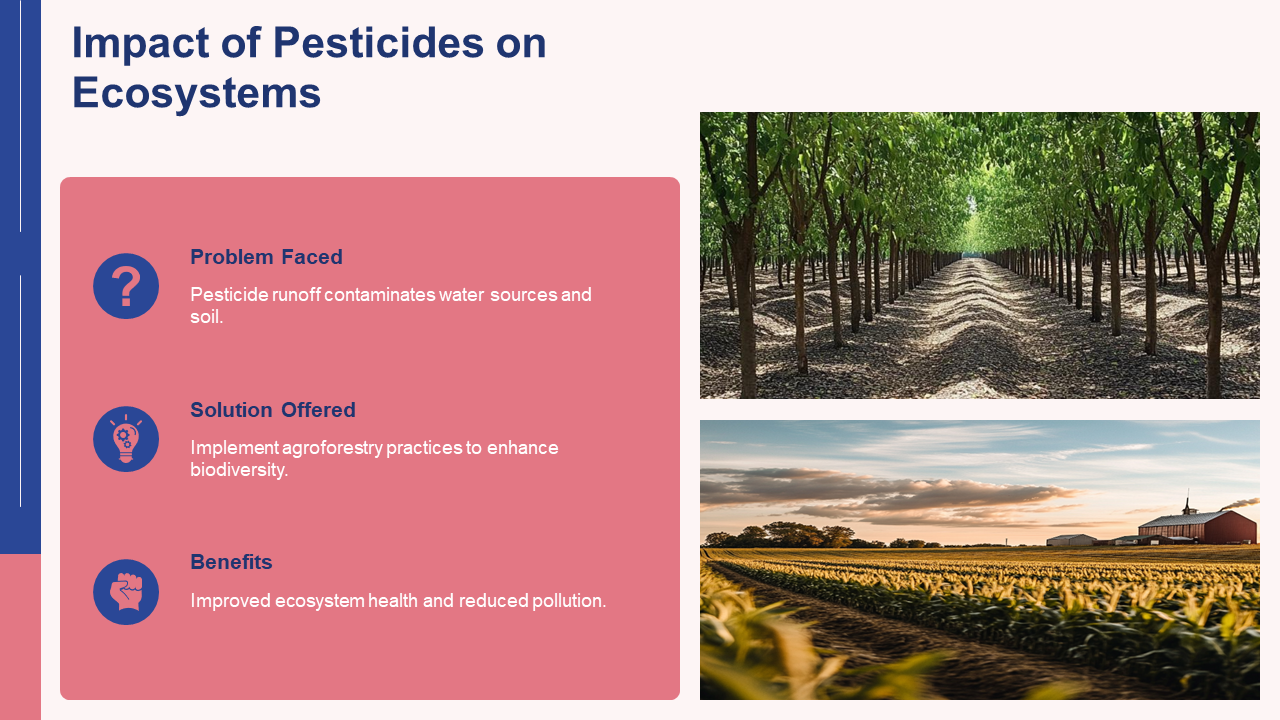
Template 8: Impact of Pesticides on Ecosystems PPT Template
This slide discusses the impact of Pesticides on Ecosystems and covers the problems faced, solutions offered and benefits. Farmers regularly run into issues, such as crop loss both due to natural events, disease and pests. Pesticides provide solutions to such problems by managing insects, weeds and fungi that can harm crops. The benefits of pesticides include the ability to increase productivity, increase the quality of the food produced, decrease labor costs and contribute to the effectiveness, sustainability and ability to produce enough food to feed a growing global population.
Template 9: Conservation Agriculture Principles PowerPoint Template
There are three points describing principles of conservation agriculture in the template, each with a brief explanation: Soil Health, Integrated Pest Management and Water Conservation. Conservation agriculture utilizes three core principles: minimum soil disturbance, permanent soil cover, and crop diversification. These principles are focused on improving soil health, reducing erosion, and improving resource efficiency in agricultural systems. Applying these principles, conservation agriculture leads to benefits, such as increased soil organic matter, improved water infiltration, improved nutrient cycling, soil cover and minimal disturbance protecting soil from wind and water erosion, crop diversification supporting a larger range of beneficial insects, organisms in the soil, plants and improved water infiltration.

Template 10: Soil Health in Conservation Agriculture PPT Template
Conservation agriculture has the potential to improve soil health by mitigating the losses and costs associated with chemical and mechanical destruction of the soil. Practices and principles, such as reduced tillage, crop rotations, permanent cover and more can improve the physical, chemical, and biological properties of soil, and move toward a system that is both productive and sustainable. CA offers an effective solution to obtain soil health benefits and create more sustainable and effectively productive agriculture systems. The template can be used as a guide to improve soil structures, increase soil organic matter, and promote and increase biological activity. Download template now.

FARMS VS. PESTS: THE BATTLE BEHIND EVERY HARVEST
Agriculture and pesticides are closely linked as pesticides are necessary for protecting crops for food security. Agriculture involves crops, which are prone to insects, fungi, weed and other pests that minimize yield or quality. Through the effective use of pesticides, farmers can control pests, preventing drastic crop losses and enabling large-scale food production. Pesticides support the control of pests that threaten crops, such as herbicides for weeds, insecticides for insects, and fungicides for fungi. It
also helps increase productivity and minimize labor costs associated with food production, which also adds to economic viability.
Pesticide use requires forethought to prevent unnecessary negative effects on the environment, human health or biodiversity. However, as agriculture increases in support of food security, sustainable agricultural practices encourage appropriate use of pesticides, integrated pest management (IPM) practices, searching for better alternatives that are safer for humans and the environment.
FAQs on Agriculture and Pesticides Presentation
1. What is the role of pesticides in agriculture?
Pesticides are a vital component of agriculture. They protect crops from pests, diseases, and weeds that destroy yields and compromise the quality of food. Pesticides increase productivity, promote uniform harvests, and help satisfy the global demand for food. Pesticides, when used responsibly, can promote a sustainable form of farming through the reduction of crop loss and advancement of efficiency found in modern agricultural methods.
2. What are the 5 types of pesticides?
The five major types of pesticides include insecticides (to kill insects), herbicides (to control weeds), fungicides (to limit infections caused by fungi), rodenticides (to kill rodents), and bactericides (to kill bacteria that can harm plants) and each has its own important function in achieving protection of crops and high productivity. Each category serves the purpose of controlling threats that can affect the quality of crops and reduce harvest quality.
3. What are the disadvantages of pesticides?
Disadvantages of pesticides include: polluting the environment and harming beneficial insects such as bees, plus causing the build-up of pesticide-resistant pests. Overuse of pesticides can decline soil health and pollute water sources, and pesticides can also pose health risks to humans and animals through exposure and possibly long-term effects. Sustainable pest management practices are important to reduce these low-priority impacts from pesticides.