

 0 Comment
 Customer Reviews

An estimated 40 million people live with bipolar disorder worldwide, according to the World Health Organization. It excludes no young and older adults and is primarily observed among working-age people. Although the disorder affects both men and women equally, the available data suggests that women are highly prone to it.
Download our depression presentation templates with examples and samples to create awareness about depression and how to manage it.
As more and more people are susceptible to such mental health disorders due to reduced work-life balance, stress, sensitivity, negativity clogged around social media, etc, heated discussions on mental health are very important at this time and age. Besides, the millennials and GenZ are breaking the stereotypes and reducing the stigma attached to mental health disorders. They are now open and feel extremely unpressurized to talk about it. More awareness needs to be created among the communities that lack knowledge about specific mental health disorders.
This blog is for you if you want to raise your voice or take a stand on addressing mental health issues or trying to talk to your stakeholders about them while seeking investment to curb them. We have ready-made presentations, but of course, they are customizable to your needs, which can save you time and energy. Not only that, but you should also look out for fresh ideas and news that you may have never known before.
Pain Points around Bipolar disorder that need to be addressed:
The treatment options for people suffering from this disorder are low, as per WHO reports. While many lack access to support and services in low and middle-income countries, often men and women are misdiagnosed for this. Besides, in many communities in these countries, there is a stigma afresh about mental health disorders, which is paving the way for limited access to health care.
Bipolar disorder is one of the main reasons for social exclusion and limited opportunities in the fields of education, employment, and housing. It also strains relationships at work, school, college, etc. It can even lead to suicide as the sufferers face demeanment in society, and many get subjected to substance abuse.
This blog can help you address most of these pain points by offering solutions and opportunities to overcome them. Download now!
Let’s explore!
Template 1: Introduction to Bipolar Disorder
The slide talks about the introduction to Bipolar Disorder and presents two key aspects related to the disorder. They include mood stabilization and predictive assessments. Mood stabilization is an approach that helps to implement neuroscience-based interventions to advance mood stabilization therapies and help patients manage their emotional state amd mood swings effectively. This may enhance their overall quality of life. Predictive assessments help to make use of neuroscience research to develop predictive assessments. This may help improve the early diagnosis of bipolar disorder, which helps in tailoring treatment plans. It also enables healthcare providers to intervene before severe episodes occur. Use this slide to explain the basics of what bipolar disorder means and how to manage it among patients who are suffering from extreme and moderate disorders.

Template 2: Neuroscience Overview of Bipolar Disorder
This slide talks about the neuroscience overview of bipolar disorder and presents three key areas of focus within the neuroscience approach to understanding and treating bipolar disorder. They include genetic insights, neural imaging, and targeted therapies. The genetic insights may help to identify some of the genetic factors responsible for bipolar disorder, develop personalized treatment strategies, and improve patient outcomes through tailored therapy protocols. Neural imaging can help in using neuroimaging techniques to visualize brain structure and function differences in individuals suffering from bipolar disorder. It also enhances understanding of the disorder and improves treatment approaches. The targeted therapies help in developing pharmacological therapies based on neurological findings and enable targeted interventions that mitigate symptoms. This also helps in improving the quality of life for bipolar disorder patients.

Template 3: The Role of the Amygdala
This slide talks about the role of the Amygdala and its key components. They include emotional regulation, risk assessment, treatment targeting, and neurofeedback techniques. Emotional regulation is all about understanding how the amygdala processes emotions can improve therapeutic approaches for mood stabilizations; risk assessment is all about identifying amygdala activity patterns that can help predict mood swings and potential triggers in bipolar patients; treatment targeting is all about developing treatments that specifically target amygdala functioning may enhance treatment efficacy for bipolar disorder and neurofeedback techniques are all about using neurofeedback to train amygdala response could provide patients with better emotional control strategies. This slide is perfect for educators, researchers, and healthcare professionals seeking to deepen their knowledge of the Amygdala.

Template 4: Neuroinflammation in Bipolar Disorder
This slide talks about a SWOT analysis (Strengths, Weaknesses, Opportunities, and Threats) of neuroinflammation in bipolar disorder. It lists the strengths, weaknesses, opportunities, and threats of this disorder. Some of the strengths include emerging research that presents neuroinflammation as a promising treatment target for bipolar disorder, and a strong correlation has been observed between inflammation and mood changes in patients. However, the weaknesses are limited understanding of neuroinflammation's impact on bipolar disorder mechanisms that exist today, and current research often lacks longitudinal studies for lasting effects analysis. There are opportunities for this that include increased funding for neuroscience research, which can lead to breakthroughs in understanding disorders, and collaborative research efforts, which can enhance knowledge about neuroinflammation in bipolar disorder. The threats are competition for research funding could limit studies focusing on neuroinflammation adequately, and public misconceptions about mental health may hinder participation in relevant studies.

Template 5: Challenges in Bipolar Disorder Research
This slide talks about the challenges in bipolar disorder research. They include complexity of diagnosis- bipolar disorder often overlaps with other mental health conditions, complicating diagnosis; Variability in symptoms- symptoms can vary greatly among individuals, making research outcomes difficult to generalize; Biological mechanisms unknown- the precise neurobiological mechanisms of bipolar disorder remain poorly understood in research; Limited longitudinal studies- few long-term studies adequately track bipolar disorder over time; Stigma and funding issues- stigmatization of mental health affects funding and support for bipolar disorder research; Ethical considerations- research involving vulnerable populations requires careful ethical considerations and protocols. It is important to know these challenges in order to find ways to address them and create mental health awareness.

Template 6: Introduction to Bipolar Disorder
This is another slide that presents an introduction to this disorder. It has important elements such as microbiome influence, dietary interventions, and customized therapies that can be employed to manage bipolar disorder. Microbiome influence helps to understand how the microbiome affects mood and can lead to new treatment approaches tailored to individual responses in bipolar disorder patients; dietary interventions help in implementing specific dietary changes based on microbiome research that can help stabilize mood and prevent episodes of mania or depression in bipolar disorder. Customized therapies help in developing personalized therapies that target the microbiome, which may result in improved outcomes for patients who have bipolar disorder.

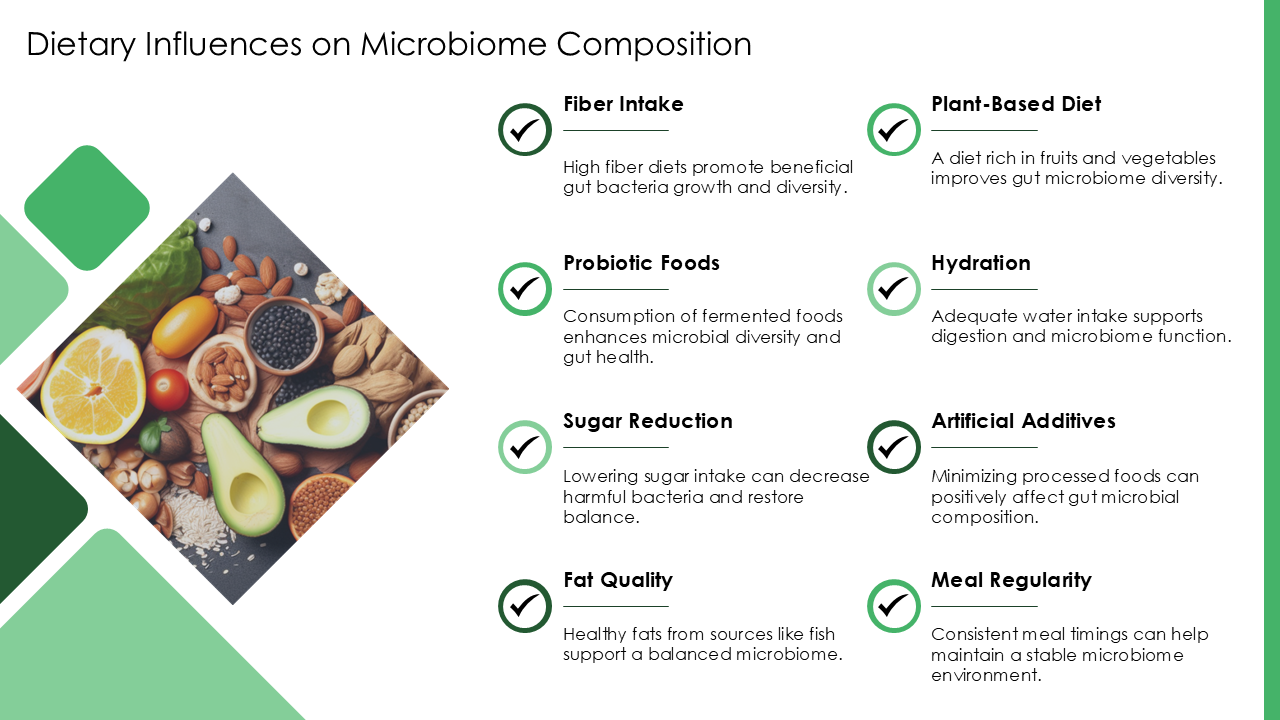
Template 7: Dietary Influences on Microbiome Composition
The slide focuses on various dietary factors that impact the gut microbiome. It presents eight key areas, each with a brief explanation and a checkmark symbol, suggesting these are positive influences. Fibre intake- High fibre diets promote beneficial gut bacteria growth and diversity; plant-based diet- A diet rich in fruits and vegetables improves gut microbiome diversity; probiotic foods- Consumption of fermented foods enhances microbial diversity and gut health.; hydration- Adequate water intake supports digestion and microbiome function; sugar reduction- Lowering sugar intake can decrease harmful bacteria and restore balance; artificial additives- Minimizing processed foods can positively affect gut microbial composition; fat quality- Healthy fats from sources like fish support a balanced microbiome; meal regularity- Consistent meal timings can help maintain a stable microbiome environment.
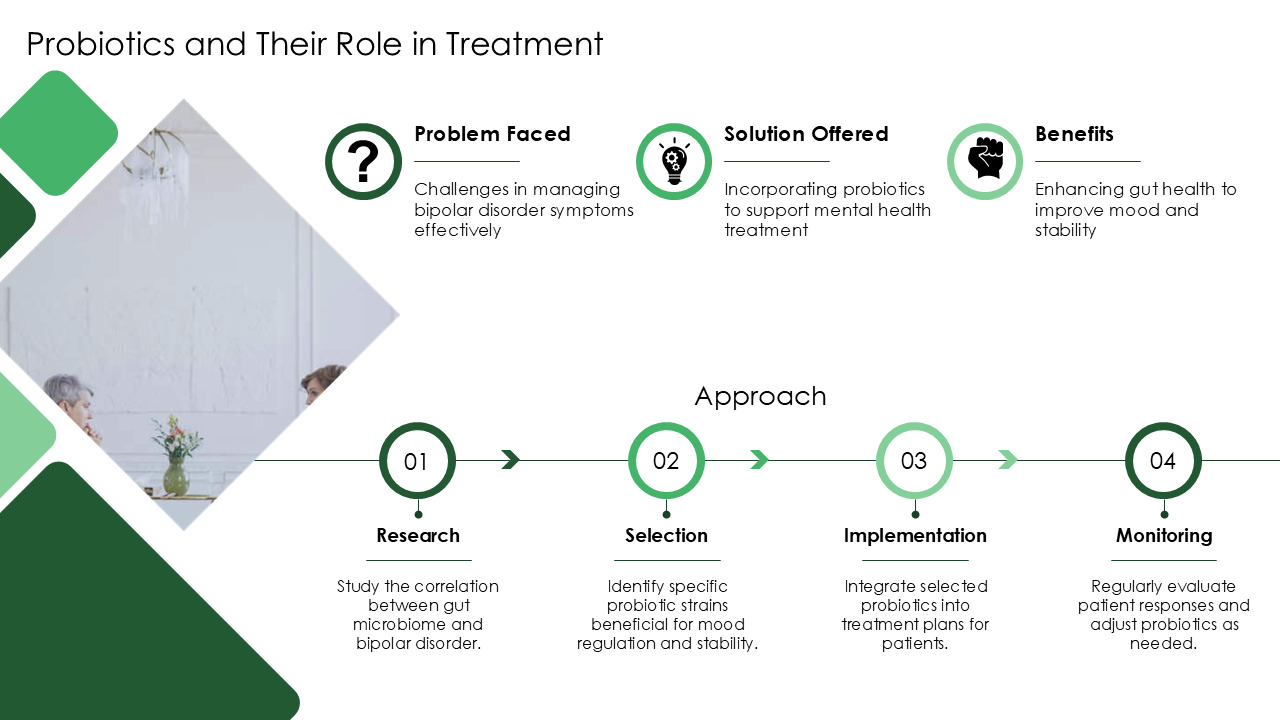
Template 8: Probiotics and Their Role in Treatment
The slide talks about probiotics and their role in treatment and focuses on how probiotics can be used to address challenges in managing bipolar disorder. It includes problems faced, solutions offered, benefits, and approaches. It talks about what are the challenges faced in managing bipolar disorder symptoms effectively and incorporating probiotics to support mental health treatment as a solution. Probiotics enhance gut health to improve mood and stability. The approach includes several steps. They are research that includes studying the correlation between the gut microbiome and bipolar disorder, a selection that includes identifying specific probiotic strains beneficial for mood regulation and stability, an implementation that includes integrating selected probiotics into treatment plans for patients, and monitoring that includes regularly evaluating patient responses and adjust probiotics as needed.
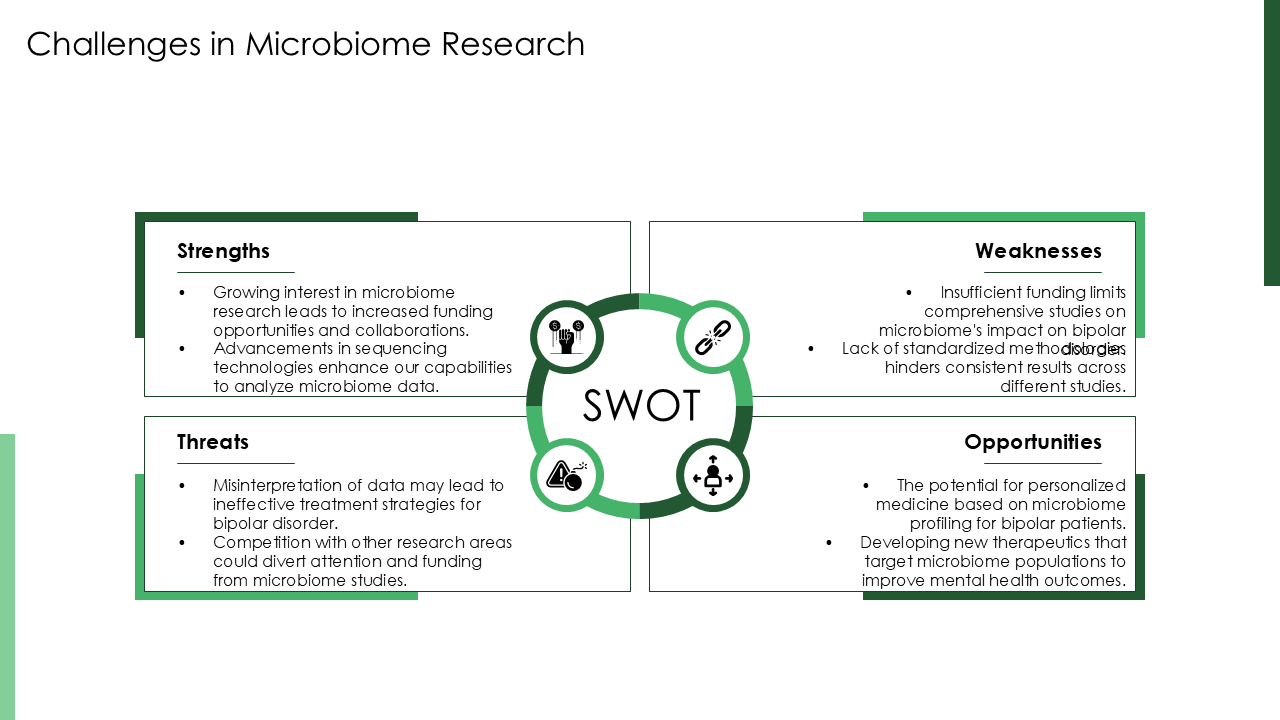
Template 9: Challenges in Microbiome Research
This slide presents a SWOT analysis (Strengths, Weaknesses, Opportunities, and Threats) of Challenges in Microbiome Research, specifically in the context of bipolar disorder. Some of the strengths include growing interest in microbiome research, which leads to increased funding opportunities, collaborations, and advancements in sequencing technologies that enhance our capabilities to analyze microbiome data. The weaknesses include insufficient funding, limited comprehensive studies on the microbiome's impact on bipolar disorder, and a lack of standardized methodologies that hinder consistent results across different studies. The opportunities include the potential for personalized medicine based on microbiome profiling for bipolar patients and the development of new therapeutics that target microbiome populations to improve mental health outcomes. The threats are misinterpretation of data that may lead to ineffective treatment strategies for bipolar disorder, and competition with other research areas could divert attention and funding from microbiome studies.
Template 10: Best Practices for Mental Health Interventions
The slide outlines four best practices for mental health interventions, each presented in a separate section with a checkmark symbol indicating a positive action. They include engaging patients to encourage active participation of patients in their treatment plans and decision-making to improve outcomes, educating families to provide resources and support to families, helping them understand bipolar disorder and its management, monitoring symptoms to regularly track symptoms and side effects to adjust treatments based on individual patient responses and promoting lifestyle changes to encourage healthy lifestyle management, such as exercise and diet, to enhance overall mental health. With this slide, delve into the best practices for mental health interventions, one of the crucial slides to have in your presentations. It is perfect for professionals seeking to enhance their understanding of this emerging field in psychiatry.

Over to you!
Now, you know everything about bipolar disorder and its implications for the people who have it. This blog provides you with everything from symptoms of bipolar disorder and causes of bipolar disorder to mood swings, depressive episodes, brain chemistry, and cognitive-behavioral therapy. Download them and use them for your presentation that is aimed at creating awareness about the disorder or educating your students or your employees, etc. You won't regret having them as they offer you basic to advanced, simple to complicated, all of it to make your task simple.
Check out our mental health infographic templates with examples and samples.