



 0 Comment
 Customer Reviews

“ Customers don’t expect you to be perfect. They expect you to fix things when they go wrong. “ - Donald Porter, former VP, British Airways.
In October 2022, Medibank witnessed a cyberattack that cost Australia’s prominent health insurer lawsuits, regulatory scrutiny, and the trust of almost 10 million customers. Among the many ways it responded to this catastrophe, it overhauled its call center technology infrastructure, enabling a localized support system instead of a centralized one. It made every customer feel heard. They appreciated the human touch guided authenticity, which resulted in an increased first call resolution rate and improved customer experience.
Numbers suggest that 90% of the American clients consider customer service as a make-or-break factor while deciding a business’s potential. Every two out of three people desire a human touch from call center agents when they require their support. With so much at stake and such higher expectations, taking your call center operations could be fatal.
SlideTeam, in this blog, proposes a significant project plan for fulfilling customers’ expectations, integrating different tools, technologies, and methods.
Agents are a call center’s linchpin, serving as the air traffic controller of customer journeys. It begins with covering the most essential needs through its recruitment plan, specifying certain parameters for an agent’s onboarding. It then nurtures the entire workforce planning through a systematic training program.
Explore our communication implementation plan templates to unlock and unleash the secrets of effective business-client communication.
Our project also outlines the methods to incorporate the appropriate technical tools, helpdesk software, and standardized scripts to get the best out of your agents. With our recommended performance metrics, you can easily monitor and nurture their growth and make your investments cost-effective.
Check out more of our call center metrics templates for detailed and niche performance tracking.
Let’s explore!
Template 1: Call Center Implementation Project Plan Template
This bundle with 30+ PPT templates offers both qualitative and quantitative measures to optimize your call center design. It contains a well-nourished plan with an understanding of the project scope in different aspects, like technology, staffing, and call quality. It allows you to set up dedicated timelines to complete and monitor project-related milestones. Further, you can allocate your budget to different outcomes and measure their impact strategically. Use performance metrics and KPIs to evaluate agents’ performances and employ an improved staffing strategy to get the best human resources on board. Rebuild your technology infrastructure for a seamless customer experience. Download now!
[product_image id=1486929]
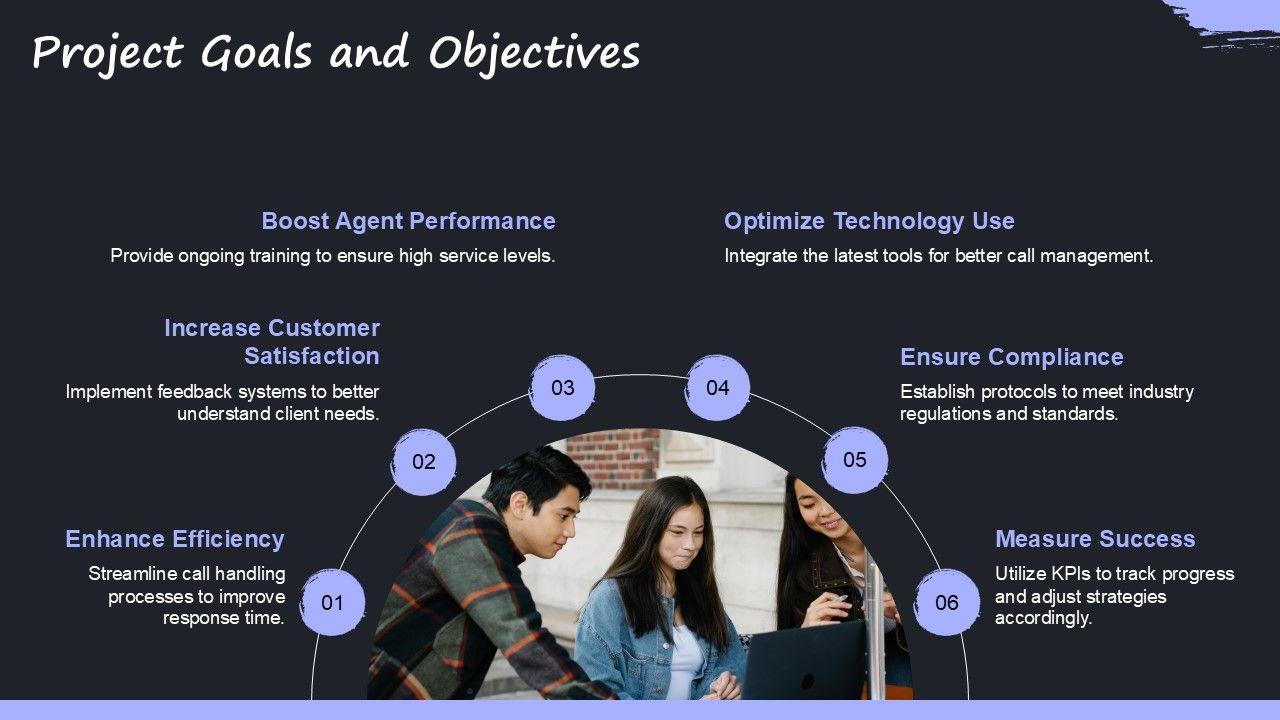
Template 2: Project Goals and Objectives
This template kills two birds with one stone by highlighting the ongoing underlying operational challenges that you can convert into the objectives you want to achieve through the proposed project. It also mentions concise ways of completing targets like enhancing customer experience, boosting agent performance, optimizing technology usage, and ensuring compliance. Use it to exhibit the depth and expansive nature of your plan during a presentation. Download now!
Template 3: Scope of Call Center Implementation
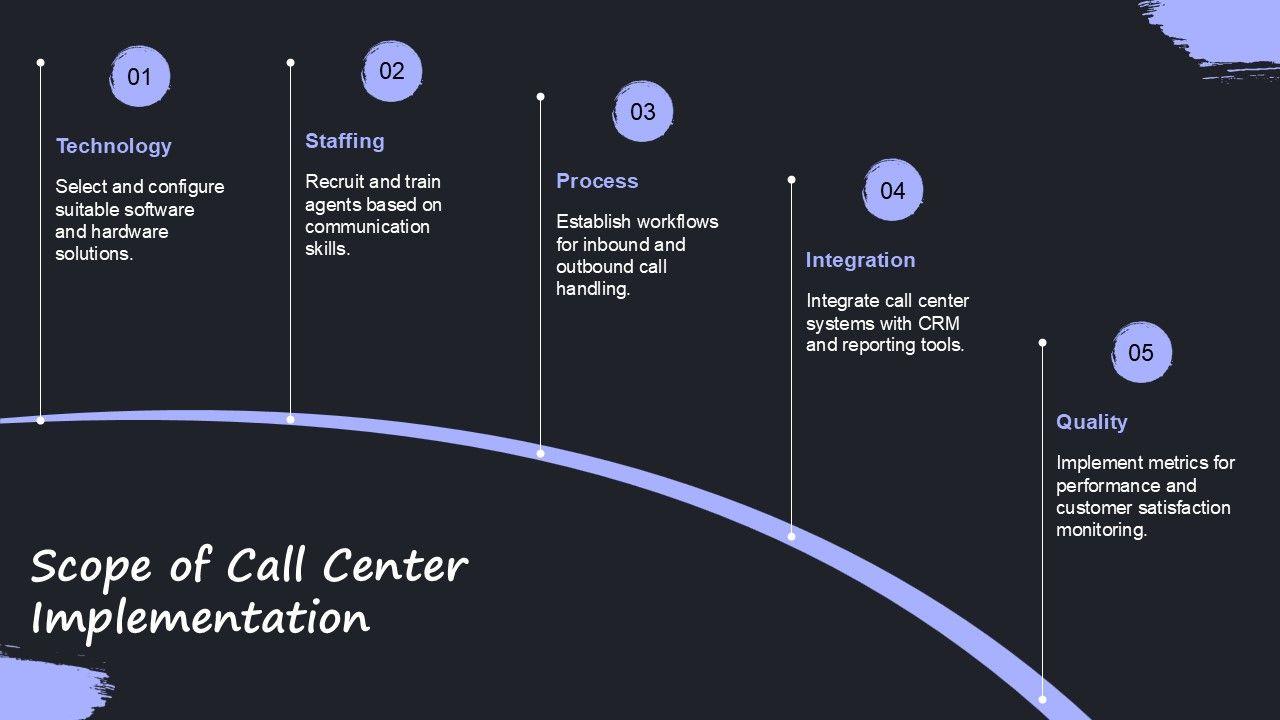
Here is a PPT template that compiles all your project scopes into one place for your stakeholders and partners to see through its resourcefulness. From staff training and employing hardware solutions to CRM integration and performance metrics for quality assurance, it helps you sum up and pitch why your client needs a call center upgrade through your plan. Explore this to create an ideal and impactful pitch.
Template 4: Workforce Planning and Staff Training
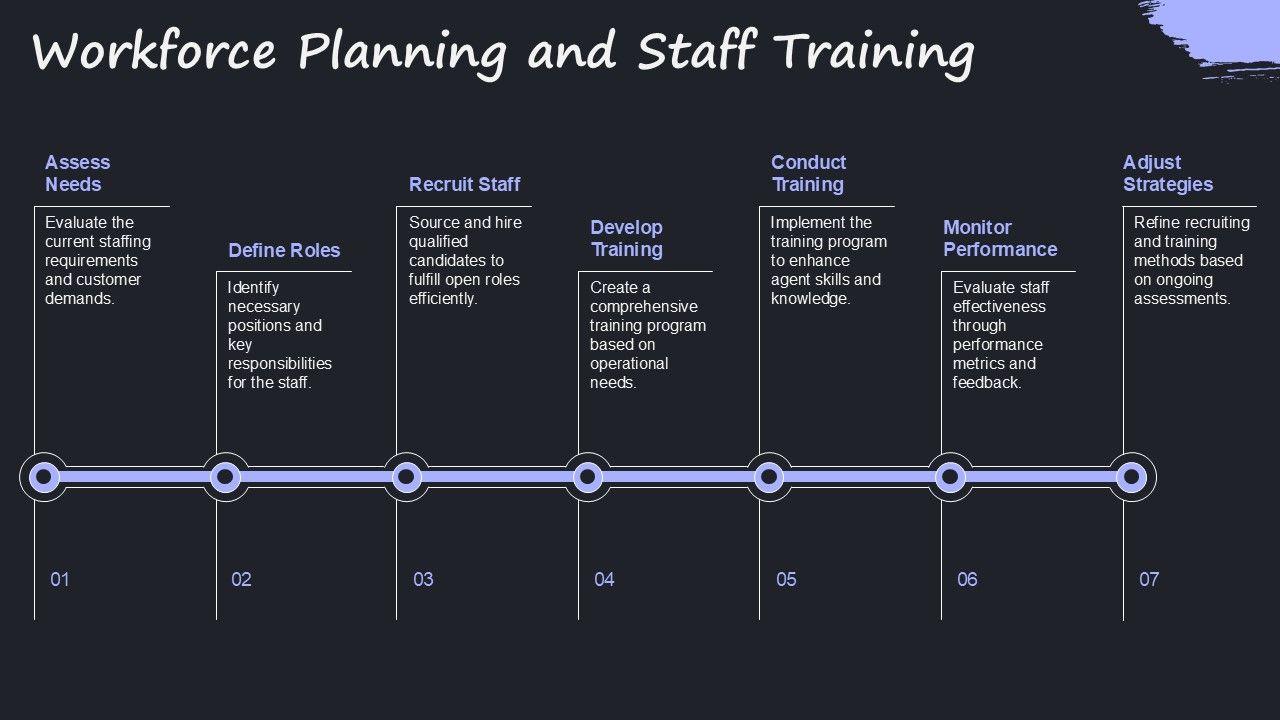
This template fosters a robust staffing strategy in terms of providing training productively and organically. Our workforce planning document employs a step-by-step method, or process mapping strategy, in other words, where it gives necessary importance to defining open positions and responsibilities based on staff requirements and customer demands. This helps you map out a framework to ensure the right and adaptable training strategies for the suitable personnel for optimum productivity.
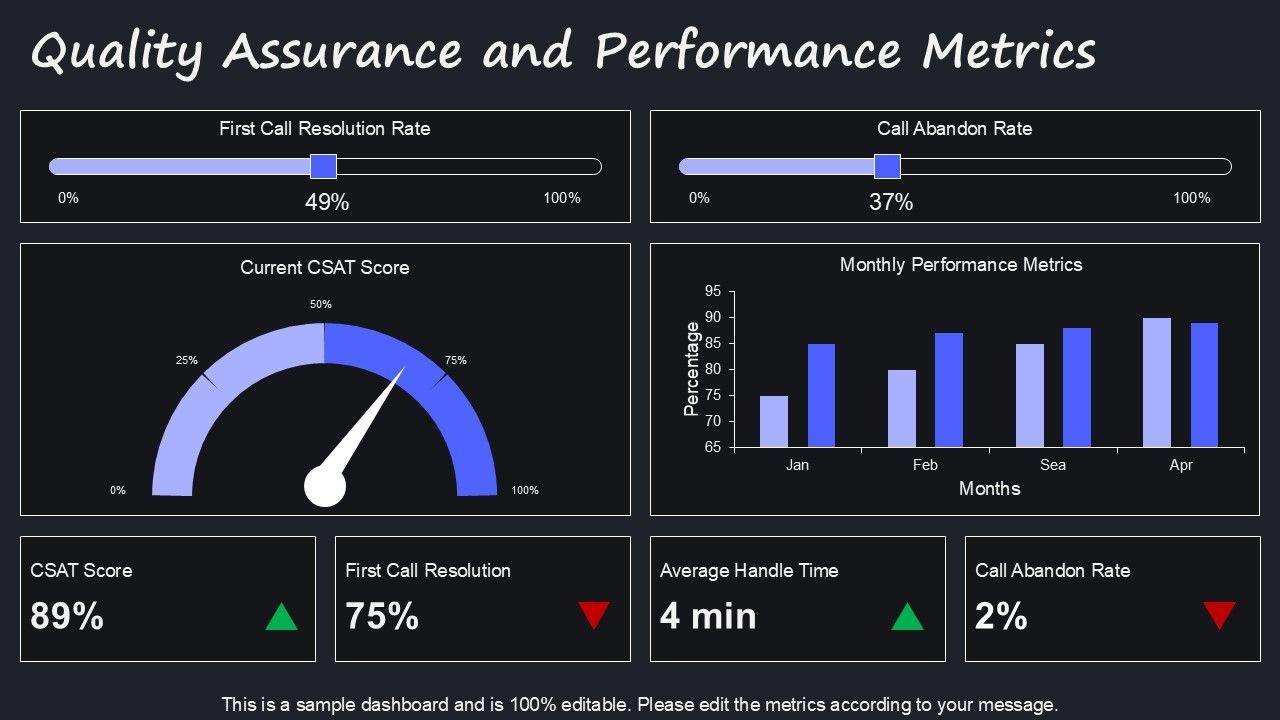
Template 5: Quality Assurance and Performance Metrics
This slide explores the objective methods to evaluate the performance of your call center agents. It contains critical performance metrics and indicators, such as call abandon rate, first call resolution rate, CSAT score, and average handle time, to monitor your current performance. Additionally, it helps with informed decision-making as it converts complex raw data into simple and comprehensible charts. Use this to identify areas to fix and implement quality assurance strategies.
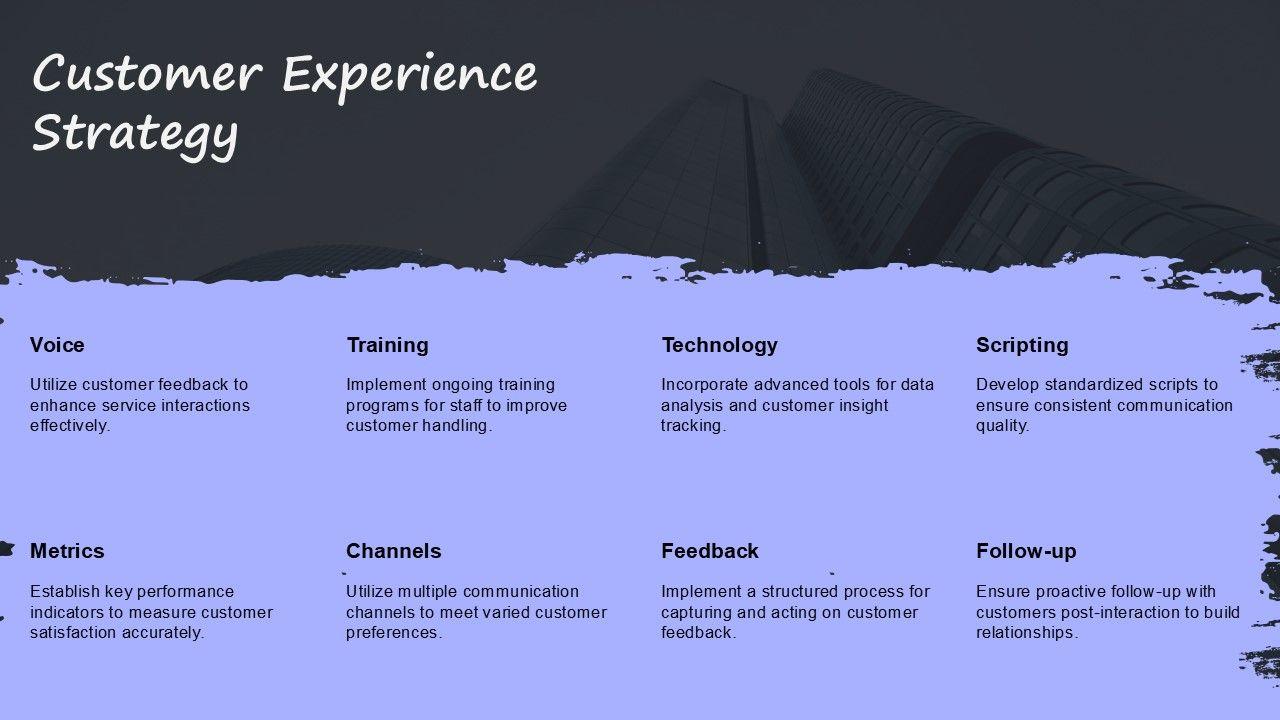
Template 6: Customer Experience Strategy
Since your entire modus operandi is customer-centric, this template carries a few elementary techniques essential to optimizing customer experience. It highlights the importance of implementing a staff training program, incorporating standardized scripts, utilizing multiple communication channels, and using KPIs together to measure and enhance the call quality. Additionally, it encourages you to use honest customer feedback for gathering precise and relevant information and building long-term relationships. Download now!
Template 7: Telephony and Communication Systems
Does your call center operate with a siloed data system, contributing to a higher call resolution time? Does your software consistently break down, leading to dropped calls? Are your agents low on confidence while providing real-time answers? You may need to upgrade your telephony systems. This template encourages you to adopt critical measures, such as CRM integration, technology infrastructure, and troubleshooting protocols, to plug these holes. Download now!

Template 8: Data Management and Reporting Systems
This template streamlines the fundamental call center operations by putting an efficient performance monitoring and improvement system in place. It sets the targets for objectives, such as data accuracy, response time, user adoption, and cost efficiency. It compares their actual rates against the desired ones on selected metrics to suggest improvements. Furthermore, it offers a highlight section to log critical assessment details on the same file. Download now!

Template 9: Testing and Quality Assurance Processes
Many call centers launch new systems without proper requirements analysis, leaving them confused about what needs to be tested for optimum quality. Many also struggle with a comprehensive test analysis, missing out on identifying glitches before going live. This template identifies some of the recurrent bottleneck problems and puts a four-step action plan into place. Use it to document your testing requirements and improvise your quality assurance strategy accordingly.

Template 10: Resource Allocation and Budgeting
This template assists your financial audit with a customizable structured table that allows you to track your actual spending against the plan. Use this to find your budget savings or cost overruns on projects like staffing and training, technology investments, and operational overhead. It also allows you to log the project impact to assess the usefulness of your financial resources. Utilize the bullet points to present a quick assessment summary.

Using Support as a Branding Tool
A simple truth lies at the base of every call center implementation: communication is the key. Companies dread communication breakdown because one bad experience means losing the customer forever, further resulting in the loss of reputation and revenue. On the other side, a simple 5% customer retention through effective strategies leads to a substantial increase in profits.
With the risks and rewards both being enormous, your call center design doesn't need extravagant improvements, and this blog covers strategies that are reasonably straightforward in implementation.
Improve your sales, employees, and overall business performance using our improvement implementation plans.
FAQs on Call Center Implementation
What is the primary objective of implementing the call center?
The primary objective of implementing the call center is to optimize customer service through quick response time and higher call resolution, leading to healthy and long-term customer relationships. On an internal level, it aims to improve efficiency and resource-effectiveness, using a structured approach to deal with queries and boost sales through appealing and proactive outbound calls.
Who is the target customer segment that the call center will serve?
The target customer segment of a call center is existing customers who have used the products and services of a business. They may need support with troubleshooting, billing, refunds, or product quality. Similarly, it targets potential customers to purchase their services through quotations, product guidance & pitching. It also serves business partners, distributors, and suppliers who might query regarding orders and payments.
What services will the call center provide (inbound, outbound, technical support, sales)?
Call centers offer inbound services that are customer-centric in nature. It resolves their queries, complaints, and requests related to the purchased products and services. Outbound services are company-specific, which a call center optimizes to ensure acquiring and retaining maximum customers through generated leads through loyalty programs and regular follow-ups. It also provides technical support in helping with the product installation and troubleshooting, whenever required.