

 0 Comment
 Customer Reviews

The course catalog says one thing. What do students truly learn? That's different.
Not because teachers aren't trying. Most are. But there is this gap—always a gap—between what the syllabus promises and what actually happens when you're three weeks behind schedule, two students are lost, and the projector won't connect.
Someone asks, "Are we covering critical thinking in math?" And you realize nobody knows. Not really. Sarah mentions it in her lessons. David builds it into a group project. But is it systematic? Is it measurable? Is it happening enough to matter?
Districts love talking about coherent curriculum. Teachers know curriculum is what actually happens when you close the classroom door. The space between those two things is where curriculum mapping lives—trying to make the invisible visible and the assumed explicit.
Most teachers already track this stuff mentally. They are aware of the connections between units, the skills that reinforce each other, and the learning outcomes that receive the most attention. The challenge isn't knowledge. It's documentation. Making the intuitive systematic.
That's where curriculum design templates come in. Not because curriculum mapping is rocket science, but because starting from scratch is brutal. Because the blank document sits there, waiting for you to organize everything you already know into something that makes sense to someone else.
SlideTeam's lesson planning templates handle the structure—the frameworks you need when you can't afford to miss connections or duplicate content. Ready-made layouts that let you focus on standards-based curriculum, not building the system.
Here are the templates when documenting your curriculum can't be an afterthought.
Template 1: Curriculum Mapping Template
This comprehensive template merges systematic curriculum alignment with powerful gap identification capabilities. The integrated assessment cycles ensure seamless standards tracking, while performance dashboards deliver instant visibility into learning effectiveness across all grade levels. Strategic stakeholder matrices foster meaningful collaboration between educators, administrators, and department heads. Every component leverages fully customizable elements, enabling you to tailor instructional design frameworks precisely to your institution's unique requirements. Perfect for creating detailed academic standards alignment reports and curriculum mapping presentations that drive measurable learning outcomes. Download this strategic template now.
[product_image id=1695813]
Template 2: Core Principles of Curriculum Mapping Template
This pre-built PowerPoint slide delivers three proven curriculum mapping principles—alignment, assessment, and collaboration—that actually work in practice. Educational leaders, curriculum coordinators, and training managers can use this PPT template for strategic planning sessions, faculty development, or stakeholder presentations. The customizable design presents curriculum alignment and instructional strategies clearly without academic jargon, letting you focus on implementation rather than slide design. Download this actionable preset today.

Download this PowerPoint Template
Template 3: Importance of Curriculum Mapping Template
You need this pre-designed PowerPoint slide when selling curriculum mapping initiatives to skeptical stakeholders who demand concrete justification. This actionable PPT template presents six research-backed benefits—enhanced learning, gap identification, collaboration promotion, consistency assurance, assessment facilitation, and curriculum review support—in a clean, numbered format that cuts through educational jargon. Educational leaders, curriculum design consultants, and department heads can use this customizable PPT preset for board presentations, faculty meetings, or administrative reviews where you must demonstrate measurable value through educational assessment. The pre-built structure transforms abstract curriculum concepts into stakeholder-friendly talking points that actually resonate with decision-makers focused on outcomes, not buzzwords. Download now.

Download this PowerPoint Template
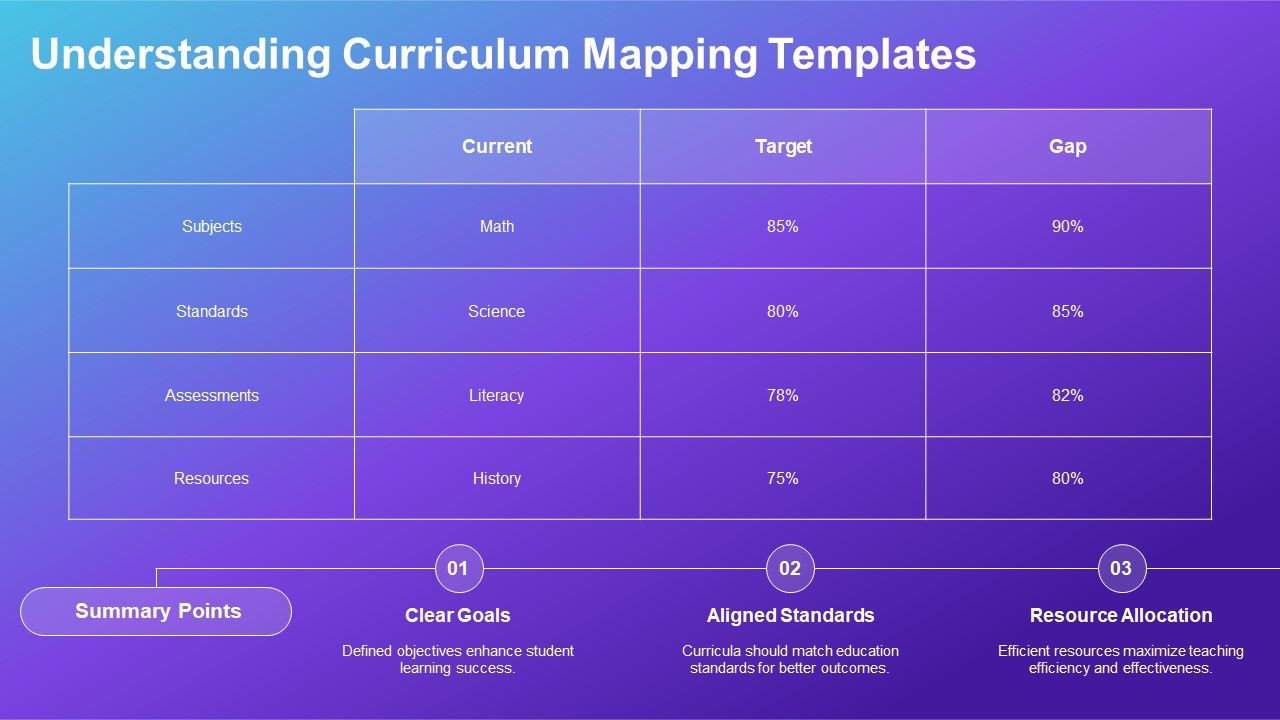
Template 4: Curriculum Gap Analysis Data Table Template
SlideTeam brings you this pre-built data comparison PPT template for curriculum gap analysis presentations. Strategic planners and education consultants can instantly showcase Current vs. target performance percentages across Math, Science, Literacy, and History using this actionable PowerPoint slide. The customizable preset delivers curriculum alignment insights, clear goals, and instructional design planning. This pre-designed template transforms quantitative data into digestible visual comparisons for curriculum evaluation, board presentations, and strategic planning sessions. Download now.
Download this PowerPoint Template
Template 5: Current Curriculum Mapping Trends Template
Data-driven insights merge with collaborative innovation to deliver comprehensive curriculum mapping strategies that drive educational excellence. This well-organized 2x2 grid highlights four key trends: data-driven decision-making, collaborative efforts, technology integration, and continuous improvement, making it easy to understand today's educational methods. The strategic layout enables seamless customization while ensuring maximum visual impact during presentations. Educational leaders can effortlessly contextualize contemporary curriculum design methodologies and demonstrate forward-thinking institutional practices with educational technology integration. Download this actionable template now!

Download this PowerPoint Template
Template 6: Stakeholder Profile Slide Template
This pre-built stakeholder profile PowerPoint slide cuts through introductory meeting chaos by presenting your curriculum design team—Project Manager, Curriculum Specialist, and Education Consultant—with clean photo placeholders and role definitions. Project teams and education consultants use this PPT template for planning meetings to make sure everyone understands their roles, which helps avoid changes in project goals that can disrupt curriculum mapping. The customizable layout delivers actionable team introductions for training workshops and client presentations focused on instructional strategies. Download this PPT preset now.

Download this PowerPoint Template
Template 7: Gap Analysis Framework Template
You need this pre-designed gap analysis PowerPoint slide for strategic planning when current training falls short of targets. The PPT template maps existing curriculum problems against desired outcomes through a clear current state/desired state framework with curriculum mapping and curriculum alignment. Project managers and training consultants can customize this actionable preset to identify specific performance gaps and build concrete action plans through instructional design. Download this practical slide template now.

Download this PowerPoint Template
Template 8: Goal-setting Checklist Template
Streamline your strategic planning process with this comprehensive eight-step framework that transforms complex goal setting into actionable execution. The intuitive dual-column layout delivers instant visual clarity, making it effortless to navigate from curriculum mapping through stakeholder engagement to feedback integration. Each numbered step provides structured guidance that ensures nothing falls through the cracks during critical planning phases. The professional design captures attention immediately while maintaining focus on essential deliverables. Perfect for creating project management roadmaps and implementation guides that drive results. Download this template now!

Download this PowerPoint Template
Template 9: Data Visualization of Subject Performance Template
SlideTeam brings you this actionable template that exhibits curriculum progress without the usual consultant theater. This customizable PowerPoint slide delivers actionable bar chart comparisons across six quarters, highlighting engagement metrics and performance scores that training managers and educational consultants can present to stakeholders. The pre-designed template cuts through typical reporting fluff with clear Subject A versus Subject B tracking, perfect for performance reviews where you need measurable outcomes from your assessment tools and instructional strategies. Download this PPT preset now.

Download this PowerPoint Template
Template 10: Adapting Curriculum for Diverse Learners Template
You need practical curriculum adaptation strategies that actually work in classrooms. This pre-built PowerPoint slide delivers six actionable instructional strategies—flexible pacing, varied resources, group work, assessment methods, cultural inclusion, and regular feedback—in a clean timeline format perfect for curriculum development sessions, teacher training, or administrative presentations. Educators, curriculum coordinators, and department heads can customize this PPT template for strategic planning meetings where inclusive learning isn't just compliance theater but genuine student success. The cascading layout logically connects each adaptation method, making complex differentiation concepts digestible for stakeholders who need results, not rhetoric. Download this pre-designed template to streamline your next inclusive education initiative.

Download this PowerPoint Template
Transform Educational Outcomes with Curriculum Mapping Templates from SlideTeam
SlideTeam's PowerPoint templates are the best in the industry for curriculum mapping presentations. These content-ready slides provide structured frameworks that save educators valuable planning time while ensuring comprehensive curriculum alignment. Our custom-made templates feature professional layouts that clearly visualize learning objectives, standards, and instructional strategies. Deploy these ready-made PowerPoint slides to streamline your curriculum development process and ensure educational success.
FAQs on Curriculum Mapping
What are the key components of an effective curriculum mapping template?
Start with clear learning outcomes for each course or unit. Include assessment methods that measure these outcomes directly through curriculum alignment. Map content topics to specific time periods or weeks using curriculum mapping. Add prerequisite connections between courses to show student progression paths. Include resource requirements like textbooks and materials needed for each unit.
How can curriculum mapping templates enhance alignment between learning objectives and assessments?
Templates create direct links between what you want students to learn and how you test them through curriculum mapping. Map each learning objective to specific assessment tools in columns or grids. This reveals gaps where objectives lack proper testing or assessments measure unintended skills. Review the completed map to adjust either objectives or assessments for better curriculum alignment. The visual format makes misalignment obvious and correction straightforward.
What strategies can educators use to customize curriculum mapping templates for different grade levels or subjects?
Educators should modify content complexity based on grade level through effective curriculum design - use simpler vocabulary for elementary, add analytical skills for high school. Adjust time blocks to match attention spans and class periods per subject. Include subject-specific assessment methods like labs for science or portfolios for art. Create separate columns for grade-appropriate standards and learning objectives that align with state requirements using curriculum mapping.
In what ways can technology streamline the curriculum mapping process?
Technology automates data collection from existing course materials and learning management systems. Digital platforms allow multiple faculty members to collaborate simultaneously on curriculum mapping. Digital curriculum tools generate visual maps and reports that highlight gaps or overlaps between courses. Cloud-based systems enable real-time updates and instant access to curriculum data across departments.
How does collaborative curriculum mapping among teachers improve instructional coherence?
Teachers work together to identify content gaps and overlaps across grade levels through curriculum mapping. This creates clear learning progressions that build on previous knowledge. Teams align their lessons through curriculum alignment to ensure students receive consistent instruction. The result is smoother transitions between classes and reduced content repetition, making learning more efficient for students.
What role does backward design play in developing a curriculum mapping template?
Backward design starts with end goals first. Define what students must know and do by course completion. Then identify specific assessments that measure these learning outcomes. Finally, plan lessons and activities that prepare students for those assessments. This approach ensures your curriculum design connects learning objectives directly to instruction methods. Each template component serves the final learning targets rather than random content coverage.
How can curriculum mapping templates accommodate diverse learning needs and styles?
Use multiple assessment formats within your template - tests, projects, presentations, and practical work. Include visual, auditory, and hands-on instructional strategies for each topic. Build in flexible pacing options where students can spend more time on difficult concepts. Add choice points where learners select from different assignment types to demonstrate the same learning outcomes.
What are some common challenges educators face when implementing curriculum mapping templates?
Educators struggle with three main issues when using curriculum mapping templates. First, teachers resist changing their existing lesson plans and workflows. Second, curriculum alignment across different grade levels and subjects creates confusion about what goes where. Third, keeping the maps current requires constant updates as standards change and new materials arrive. Start with pilot groups, provide clear alignment guides, and assign specific staff to maintain updates regularly.
How do you measure the effectiveness of a curriculum map in achieving educational outcomes?
Track student performance data before and after curriculum mapping implementation. Compare test scores, graduation rates, and skill assessments across mapped versus unmapped courses. Survey teachers about clarity in lesson planning and alignment between courses. Measure time students need to master key learning outcomes. Review how well graduates meet employer or higher education requirements. Use this data for curriculum evaluation to identify gaps and adjust the map accordingly.
What are best practices for regularly updating and revising curriculum mapping templates?
Review your curriculum mapping every semester. Compare actual teaching outcomes against planned objectives. Update content based on student performance data and industry changes. Involve all faculty members in the revision process to ensure curriculum alignment. Remove outdated topics and add emerging skills that students need. Test changes with a small group before full implementation.
How can curriculum mapping templates support interdisciplinary teaching approaches?
Curriculum mapping templates identify content overlap between subjects. Teachers use these maps to plan joint lessons that connect math with science or history with literature through effective integration strategies. The templates show which skills appear in multiple courses, making it easier to coordinate timing. Schools save time by eliminating duplicate topics and create stronger student learning through connected concepts across departments.
What resources are available for educators looking to develop their own curriculum mapping templates?
Educators can access free curriculum mapping templates through state education department websites and curriculum consortiums. Most learning management systems like Canvas and Blackboard include built-in mapping tools for curriculum design. Professional organizations such as ASCD offer downloadable frameworks. Google Sheets and Excel provide simple templates that align standards with learning objectives and assessments. Start with basic three-column formats: standards, instructional strategies, and assessments before adding complexity.
How does curriculum mapping aid in meeting accreditation and compliance standards?
Curriculum mapping creates clear documentation of what you teach and when you teach it. This documentation directly shows accreditors that your program covers required standards and competencies for accreditation compliance. You can quickly identify gaps before accreditation reviews and fix them. The visual format makes it easy for external reviewers to verify that students receive all mandated content across their program timeline through effective curriculum alignment.
What impact does curriculum mapping have on student engagement and achievement?
Curriculum mapping connects learning objectives across courses and grade levels through effective curriculum alignment. Students see clear paths between subjects and understand how skills build over time. Teachers identify gaps and redundancies, then adjust their instructional strategies accordingly. Research shows mapped curricula increase test scores by 15-20% and improve student retention rates because learning feels more coherent and purposeful.
How can feedback from students and parents inform revisions to curriculum mapping templates?
Collect feedback through surveys and focus groups twice per year as part of curriculum evaluation. Students identify content gaps and pacing issues they experience directly. Parents highlight skills their children need for real-world application. Use this input to adjust learning objectives, modify assessment methods, update instructional strategies, and reallocate time between subjects. Document changes in your curriculum mapping template and track student performance outcomes after revisions.