

 0 Comment
 Customer Reviews

“In today’s world, the customer is not just the king — they are the empire.” - Michael LeBoeuf
Just think about the brands that you love.
What makes you keep going back to those brands? Is it just about the product?
Chances are the way they make you feel.
That’s the power of customer engagement.
Today businesses are not just thriving about the customer acquisition rather they are more focused on customer retention.
If you use a strong customer engagement strategy, your customers will always feel connected, represented, and valued.
What happens if a business does not have a defined and workable plan for engagement?
Without a clear customer engagement plan, organizations can miss chances to use personalized marketing. With time, this can result in unhappy customers, less satisfaction, and a fall in the company’s revenue. Having random engagement with clients will weaken your chances to receive feedback and adapt. It’s the same as using no directions — you’re active, but not making progress.
In such cases, using customer engagement action plan templates become very useful.
Benefits of using Customer Engagement Action Plan Templates
Using such templates provides you with an easy plan and leads to better customer relationships faster. With SlideTeam’s customer engagement PPT templates, you can find step-by-step guides to enhance engagement, use personal outreach, and establish a common approach in different units. They help link the team members by setting common targets, reviewing their achievements, and making the customer experience better.
If you are planning for customer retention, you can download the below given templates to create a robust customer engagement plan.
Slide 1 – Impact of Current Brand Engagement Strategy
This slide presents the consequences of a customer engagement strategy that is not strong enough for businesses. It highlights challenges caused by unorganized customer involvement plans, changing customer experiences, and an absence of personalized support in real-time. This can have a negative effect on customer retention. This analysis plays an important role in making customers’ interactions smoother and offering better feedback. After finding these pain points, organizations can boost their personal marketing efforts and make their communication simpler to create lasting relationships with clients.

Slide 2 – Importance of Customer Engagement Strategies
This slide outlines the main advantages of using a strong customer engagement strategy. It promotes ways such as rewarding loyal customers, creating personal advertising, and providing support on different channels. These strategies are part of a plan to retain customers for the long term and make their experiences more positive. Having a regular process of gathering feedback from customers improves both services and the offerings given, according to the approach. With this slide, companies learn where to improve connections to sustain customers’ happiness and advance further.

Slide 3 – Gap Analysis: Issues and Solutions
The slide focuses on how the team can improve from the current state to the desired state by using a planned approach. It highlights main problems such as unhappy clients, late responses, less individual communication, and fewer loyal customers. Possible solutions include designing a constant customer feedback process, utilizing CRM to do targeted marketing, and improving the speed of customer service. Dealing with these gaps enables businesses to strengthen their customer experience, rightly measure the level of engagement, and come up with a strategy to keep customers happy and loyal.

Slide 4 – Customer Engagement and Retention Strategic Plan
The slide presents the strategy to improve customer satisfaction. The main steps include sending updates, gathering feedback from customers, encouraging the use of other products, and sharing the news about recent updates. Following these points help a company keep its customers satisfied and happier. When companies consistently message and use personal marketing, they help customers engage with them more and gain trust. The strategic plan ensures your business develops quality relationships with customers and keeps them from leaving.

Slide 5 – 5 Step Customer Engagement Plan
This slide outlines a customer engagement process that handles acquisition, activation, retention, referral, and monetization. The strategy uses email campaigns, SEO, landing pages, loyalty programs, and subscriptions to help in customer engagement. Every action is planned to help customers enjoy the brand and remain loyal in the future. With the help of the framework, businesses are able to evaluate engagement scores through various stages and refine their actions according to customers’ feedback. Taking care of customers individually and reaching them consistently lets companies keep them loyal and ensure they turn into regular purchasers.

Slide 6 – Customer Success Plan to Boost Engagement
This slide explains a plan aimed at helping customers by highlighting important things like the company’s features, difficulties, main objectives, and essential success indicators. It aims to gather all communications, manage resources properly, and train staff to boost the overall experience of customers. The plan ensures customers interact more effectively with support by increasing the chance that a problem gets resolved immediately. This plan supports companies in monitoring progress and using feedback to offer personalized advertising to their customers.

Slide 7 – Roles and Responsibilities for Customer Engagement Plan
This slide summarizes the tasks and duties related to having an effective customer engagement strategy. It brings out the roles each department or team plays in performing processes such as signing up new customers, generating leads, and managing feedback. It checks the tools and formats used to boost personalized marketing and assist in community building. With the help of factors such as Net Promoter Score, customer lifetime value, and renewal rate, the plan helps to boost customer experience and ensure loyal customers. It opens up ongoing communication with customers to strengthen how the strategy is put in place.

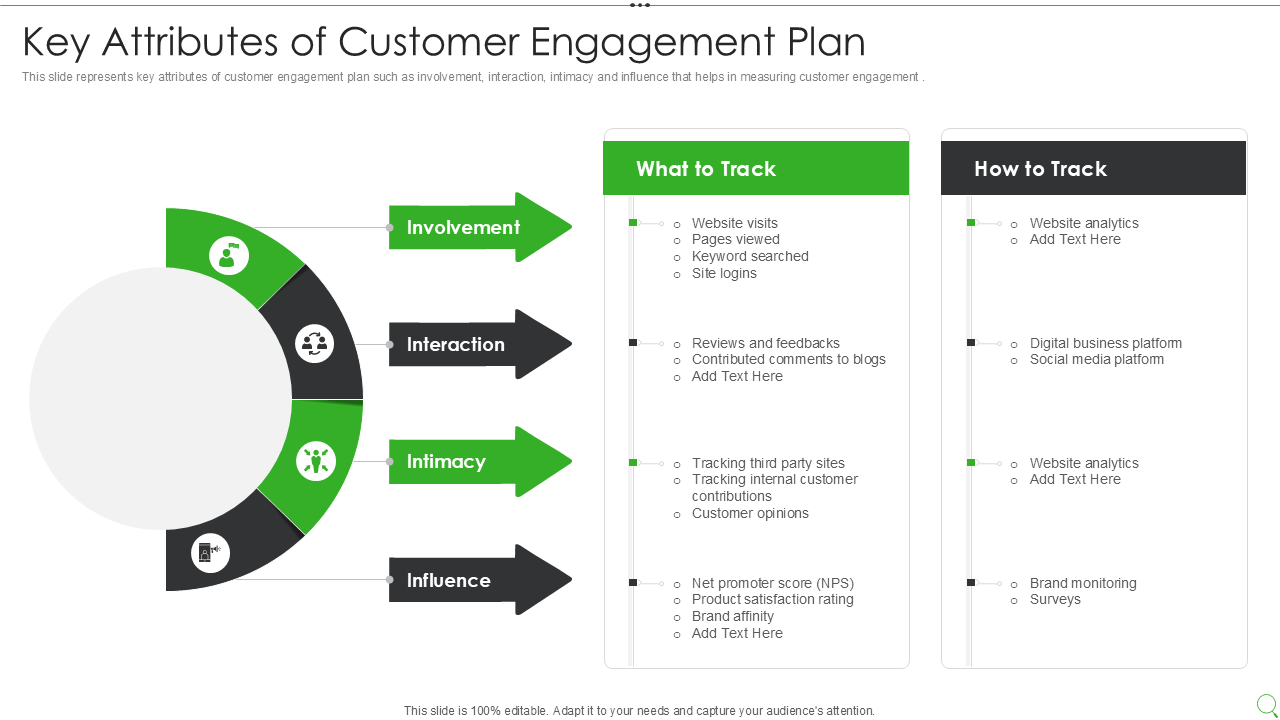
Slide 8 – Key Attributes of Customer Engagement Plan
This slide identifies the main things needed in a customer engagement strategy: involvement, interaction, intimacy, and influence. It explains what needs to be tracked like website visitors, customer feedback, and interest in the brand. With these engagement metrics, companies can make their customer service better and retain more customers. Gathering feedback improves the details of personalized marketing and improves relationships with customers. Using this method, companies gauge engagement well and guide their growth through smart changes to company strategies.
Slide 9 – Customer Engagement Plan
The slide explains a customer engagement plan through the use of the AIDA model and also includes brand behavior elements. It shows marketers how customers go through different mindsets before and after buying. Businesses can help improve customer experience by acting in ways that match what customers look for. Using the proper engagement measures at each stage helps improve the process of getting customer feedback. This model can help companies create experiences that each customer can relate to, resulting in long-term customer relationships.

Slide 10 - 6 Step Marketing Action Plan to Increase Customer Engagement Rate
The slide presents a 6-step strategy that is meant to increase the number of engaged customers. The procedure starts by laying out goals, doing some research, investigating various marketing methods, identifying important performance metrics, and writing useful content. It offers businesses a way to develop a customer engagement plan that relies on data and action. This template will help companies improve how they serve customers and receive more useful feedback. All stages are important for designing marketing that matches the individual’s interests. A strategy plan is key to customer retention as it helps the company maintain an active and interested consumer base.

Conclusion
Ensuring customer loyalty and a better customer experience can be done with the help of the customer engagement action plan templates. If businesses employ these templates, they can handle customer communication better, hold onto their customers longer, and constantly collect feedback. Also, these templates from SlideTeam can assist brands in carrying out marketing that speaks directly to who their customers are. If you want to improve customer satisfaction, these templates will help you start strong.
Get started now!
FAQs
-
Which key performance indicators are the focal point for measuring how well operations are being carried out here?
The dashboard often features process efficiency, how long things take, how frequently issues appear, the way resources are being used, and punctual delivery, allowing you to check if actions match set standards.
-
Can efficiency and productivity be compared as they have developed over time?
Efficiency and productivity trends are demonstrated with graphs such as time series, line, and bar graphs. With these visuals, it becomes obvious when and where performance changes and what the main issues are in weekly or monthly operations.
-
How can charts and graphs highlight the places where improvements can be made?
Heatmaps, charts of variance, and scorecards are useful for showing data. They point out any differences from the set targets, single out underperforming sections, and aid teams in zeroing in on the action points.