

 0 Comment
 Customer Reviews

Picture a clothing retailer. Customers dictate fashion trends each season, suppliers provide goods and materials, and rivals introduce new collections to attract consumers. Offstage, store employees and managers concentrate on smooth operations and great customer service.
These forces combined affect the micro-environment, which is the direct vicinity that directly impacts the way in which the brand will grow and develop. Examining them through environmental analysis makes firms conscious of their strengths and weaknesses, make wiser decisions, and keep competing in an uncertain environment.
Let's better comprehend the term environmental analysis!
Environmental analysis, or environmental scanning, and PESTLE analysis refer to a scientific examination of the external and internal forces that affect the performance and strategy of a company. This dynamic process uses a 360 degree approach to analyze the factors that affect the company environment.
Considering these variables, a business can convert uncertainties to certainties to a great extent. This external and internal factor analysis is crucial, since the information obtained assists organizations in identifying opportunities, countering risks, forecasting future trends, and harmonizing strategies for sustainable development.
Explore this blog on marketing environment templates to turn complex analysis into clear, structured, and actionable insights.
Objective of Conducting an Environmental Analysis
Environmental analysis is a systematic process that involves identifying, evaluating, and responding to the environmental factors that affect a business. It is needed in all businesses for the following reasons:
- It helps in identifying opportunities to leverage and risks to prepare for in the future.
- It provides insights into internal as well as external factors that affect the business.
- It reduces uncertainties and anticipates changes in the business environment.
- Assist managers in taking informed decisions by supplying data-driven insights.
- Environmental analysis also makes sure that the organizational objectives match the realities of the market and industry.
- It also helps businesses stay abreast by adapting quickly to environmental shifts.
With these objectives, let us understand the templates and how they help businesses to grow.
Also, check out our popular blog on the Top 10 Environmental Analysis Templates now!
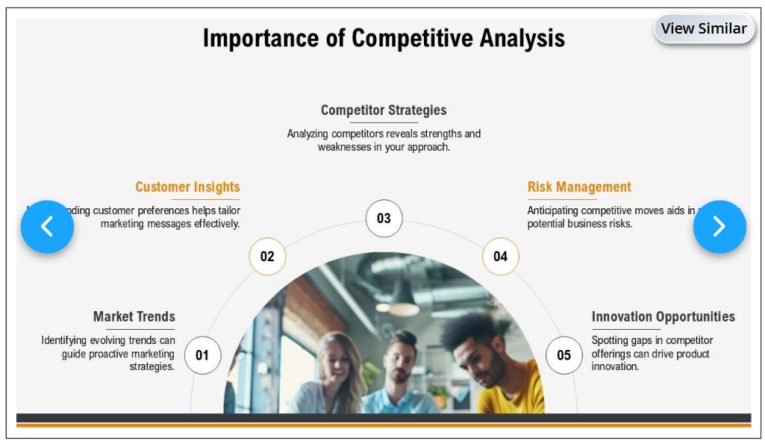
Template 1: Importance of Competitive Analysis
This PPT template highlights competitive analysis importance. It shows five key features: access to market trends, customer knowledge, competitor analysis, risk management, and opportunities for innovation. This slide helps depict why competitive analysis is important for business success and growth.
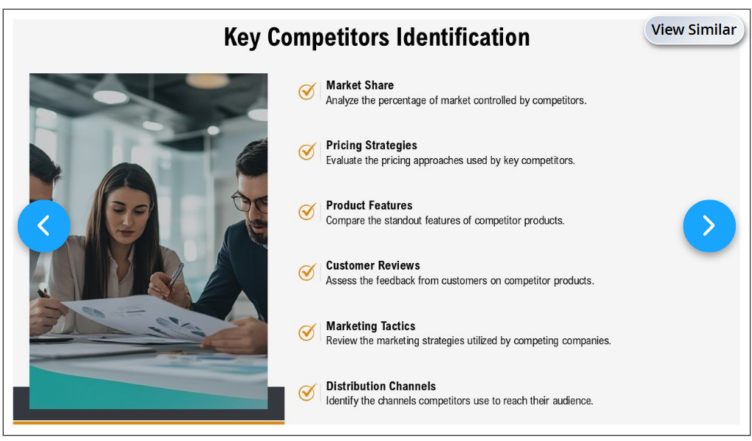
Template 2: Key Competitors Identification
How can we identify the key competitors for our business? This slide is designed to assist us in this task. It includes certain parameters through which we can analyze their strength, such as market share, pricing strategies, product features, customer reviews, marketing tactics, and distribution channels. Download now to start analyzing!
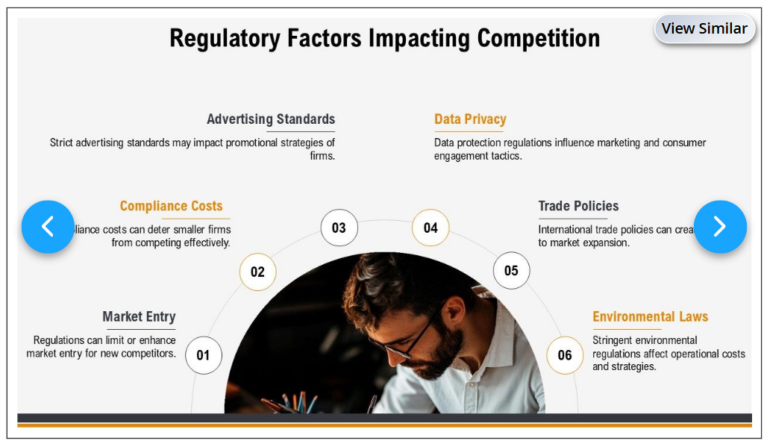
Template 3: Regulatory Factors Impacting Competition
This slide introduces some regulatory elements that positively impact the business. It contains six main points, i.e., market entry, compliance burden, advertising regulations, data protection, trade policy, and environmental regulations. Knowing these points is essential in order to succeed in business, and this presentation will try to provide you with the necessary information.
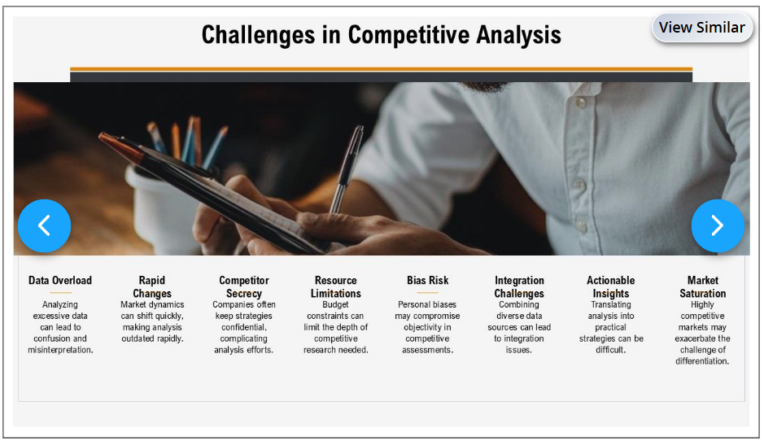
Template 4: Challenges in Competitive Analysis
What challenges come your way while doing competitive analysis? This slide helps you explore some major challenges or threats in the competitive analysis process. The steps include data overload, rapid changes, competitor secrecy, resource limitations, bias risk, integration challenges, actionable insights, and market saturation. The goal of this presentation is to build awareness of these challenges and prepare strategies to effectively overcome them.
Template 5: PESTEL Marketing Environmental Analysis Tool
This PowerPoint presentation highlights the PESTEL marketing environmental analysis tool. The slide helps to evaluate the impact of external factors on the organization. The factors used in the presentation are political, economical, social, technological, environmental, and legal environment analysis. All of the factors play a significant role in determining opportunities and threats. Through examination of these factors, companies can transform their response to changing markets, reduce threats, and plan for future growth.

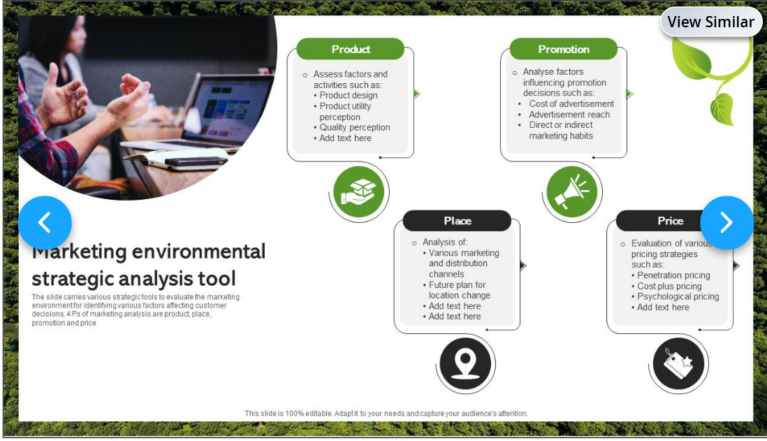
Template 6: Marketing Environmental Strategic Analysis Tool
This slide contains various strategic tools that can be used for market forces evaluation. It highlights the four P’s of the marketing mix—product, promotion, place, and price. These tools help in identifying various factors that affect customer decisions. By matching the 4Ps to environmental analysis, companies are able to suitably change their strategies according to variations in political, economic, social, technological, environmental, and legal situations. Get the presentation now!
Template 7: Techniques of External Marketing Environment Analysis
This slide shows the versatile methods of external environment scanning. These methods are not generic, but flexible tools that can be applied to comprehend the threats and opportunities in the market. The methods discussed in this presentation include SWOT analysis, Porter's five forces model, ETOP, market survey, and PESTLE analysis. By learning these techniques, you are able to assess and manage risks in time, making you always flexible and able to adjust to the dynamic business world.

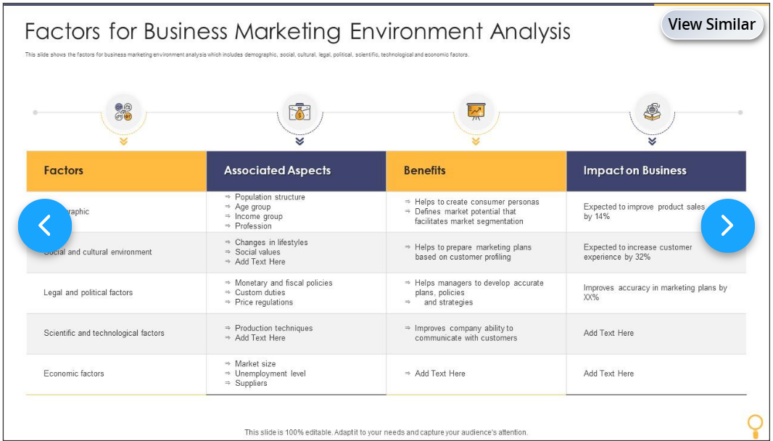
Template 8: Factors for Business Marketing Environment Analysis
This presentation showcases some factors important for business environment review. These factors are demographics, social and cultural environment, legal and political factors, scientific and technological factors, and economic factors. Also, the presentation includes associated aspects, benefits, and the impact on business of each factor on business performance. Download today!
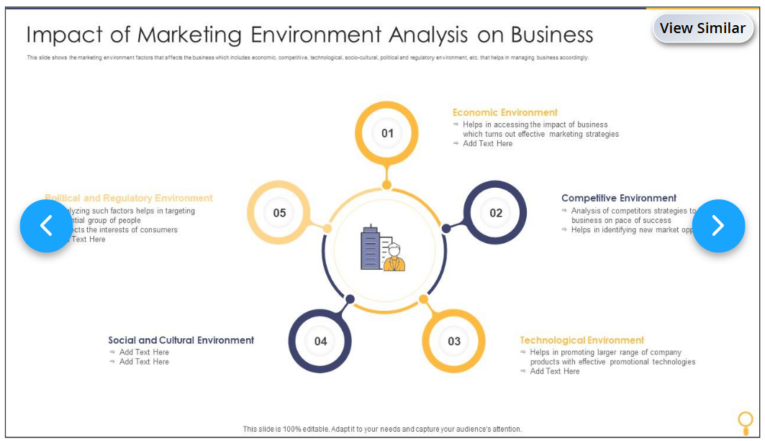
Template 9: Impact of Marketing Environment Analysis on Business
This circular diagram is so informative and eye-catching due to its use. This circular diagram clearly arranges the five main points of market analysis in such a way that the audience is better able to visualize the significance of marketing environment analysis in business. The diagram emphasizes the economic environment, competitive environment, technological environment, social and cultural environment, and political and regulatory environment.
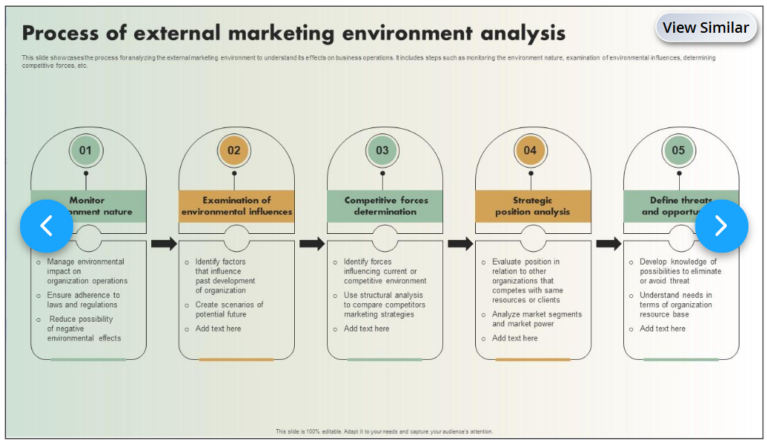
Template 10: Process of External Marketing Environment Analysis
This presentation highlights the process of external marketing environment analysis. The process includes five steps: monitoring the environment's nature, examining environmental influences, determining competitive forces, conducting strategic position analysis, and defining threats and opportunities. The slide helps us know the impact of external marketing environment analysis on business operations.
Wrapping Up
By scanning the trends in politics, society, and technology, a company can not just detect threats in advance but also billion-dollar opportunities—such as electric vehicles or the adoption of sustainable packaging worldwide.
These environmental analysis marketing templates facilitate the process by providing a systematic framework to identify such insights, emphasize opportunities, and convert them into implementable strategies.
PS: Read our blog on external environment templates today!
Environmental Analysis Marketing FAQs:
What are the key components of environmental analysis (micro and macro environment)?
The micro-environment is a complex web of interconnected factors that influence the business at its core. They consist of customers, suppliers, marketing intermediaries, competitors, and a company's employees and management, and each and every one plays a key role in the operations of the business.
On the other hand, Macro-environment is wide and dissimilar and includes social, political, and economic environment evaluation and technological, environmental, and legal components. All these components can have a significant influence on the whole industry.
How does PESTEL analysis (Political, Economic, Social, Technological, Environmental, Legal) fit into marketing analysis?
PESTEL analysis fits into marketing analysis in the following ways:
- Assessing possible threats and dangers
- Understanding the macro-environment
- Discovering new opportunities
- Influencing strategic planning
- Supporting and developing SWOT analysis
- Allowing long-term planning
What role do competitors, customers, and suppliers play in the micro-environment?
Competitors do more than offer similar products and services; they create a continually shifting marketplace. Their effect on the positioning, pricing, and product or service differentiation of a company makes the business world dynamic and engaging.
Customers are not a consideration but the foundation of any business. Their demand, buying decision, and opinion are the major driving factors behind a business's success, hence a crucial component of the business environment.
Suppliers are the spine of a business's running, offering the raw material, components, goods, and services that are the building blocks of its functioning.