





 0 Comment
 Customer Reviews

Without strong management, industries drift. Running such a business is akin to throwing a bottle in the sea with an important message and hoping that it will find the receiver among the millions of boats that float around.
Hence, industry management is crucial to keep businesses alive, agile, and competitive. In essence, industry management is the organized process of planning, controlling, and supervising industrial environments. It ensures efficiency, productivity, and sustainability. Planning material, technological, and human resources to meet industrial objectives allows a hosted service to align its strategies with existing market planning. The result is the maintenance of competitive advantage, flexibility, and increased profitability.
How does industry management act as the backbone of organizational success? Know here by reading our blog on Top 10 Industry Infographic Templates with Examples and Samples.
One of the main benefits of industry management is efficiency. Industry management improves efficiency by streamlining processes, removing waste, and leveraging resources in the best possible manner. When many staff and departments are working efficiently together, management contributes to organization coordination and teamwork, reducing bottlenecks. It strengthens decision-making by pulling data and understanding the markets, so organizations respond to important changes more quickly.
Explore here Top 10 Industry PPT Templates with Samples and Examples.
Another significant benefit that industry management affords is productivity. Industry management achieves productivity by focusing the organization’s skilled workforces, technology, and strategies in more direct alignment to achieve a goal or collective mission. Management fosters innovation. Industries adopt new methods and technologies and connect to the outside competitive environment. Maintaining quality assurance is a big benefit as well in industry management.
To make it simple, SlideTeam has curated 100% editable, customizable, and content-ready presentations. Let’s explore!
Template 1: R and D Process Pharmaceutical Industry Management PPT Template
The process of research and development in the pharmaceutical industry drives innovation, creates safe medicines, ensures regulatory policies are followed, and supports advancement of healthcare globally. This SlideTeam template outlines three areas of management in the Pharmaceutical R&D Process: Clinical Trials (verifying its efficacy/safety), Regulatory Affairs (ensuring that the regulatory affairs process of seeking approval from regulatory agencies is appropriately managed), and Quality Control (setting control measures to ensure product consistency/reliability). Each of these steps highlighted supports regulatory compliance and assures that safe and effective pharmaceuticals are delivered to patients. Grab a template now.
[product_image id=1536160]
Template 2: Budget Plan for IT Industry Management PPT Template
The SlideTeam PPT shares an IT Industry Management budget plan that accounts for Planned vs Actual spending categories, such as Software Designing costs, employees, Project costs, Network/system infrastructure, and Licensing. This template represents the Pharmaceutical R&D Process in managing three areas of importance. The team conducts clinical trials to evaluate the effectiveness of drugs; maintains consistent communication with authorities; and quality control is established through the process, which builds product consistency and provides regulatory assurance.

Template 3: Scope of Hospitality Industry Hotel Management Industry PPT Template
This template presents the Hospitality Industry, emphasizing four primary areas of focus for success within hotel management: Customer Service (efforts for guest satisfaction), Operational Efficiency (how to improve operations for profitability), Marketing Strategies (how to bring guests in and highlight business) and Sustainability Practices (how to minimize impact on the environment and influence buyers' purchasing choices). The Hospitality Industry requires hotel management to continually be engaged in providing incredible customer service. This creates loyalty and generates repeat business. Managers strive to improve operations to attain operational efficiencies towards profitability.

Template 4: Best Practices for Industrial Safety Management PPT Template
This SlideTeam slide presents Industrial Safety Management and explains four essential best practices: Training (training employees on the safety procedures), Inspections (finding and reducing workplace hazards), Equipment (ensuring tools are well-maintained and the worker is using them appropriately), and Culture (creating a safety-first culture for reporting issues). For effective Industrial Safety Management, teams practice the basics of training and managers conduct frequent inspections to mitigate hazards to prevent accidents.
[product_image id=1485766]
Template 5: Diversity Projects in Finance Industry Management PPT Template
This template manages the Diversity Project in Finance by connecting particular programs to measurable outcomes. Programs such as "100 Women in Finance" and "Wall Street Bound" aim to educate and recruit diverse talent. These projects result in an increase in hiring women (Wall Street Bound) and improved retention rates (100 Women in Finance) of participants, providing industry evidence of benefits to diversity and inclusion. Download template now.

Template 6: Importance of R&D in Pharma Sector PPT Template
Research and Development in the pharmaceutical industry spurs innovation, promotes drug discovery, safeguards patient safety, enhances competitiveness and meets changing health care demands. The PPT emphasizes the significance of R&D in the Pharma Industry, showing four aspects of the pharma R&D process; innovation (promoting new drug developments), market competitiveness ( quickly developing unique therapies), regulatory adherence (in compliance with strict regulations and processes when tested), and cost per the R&D process (reducing R&D costs via technology and partnerships). Download the template and know the benefits of R&D in the Pharma Industry.

Template 7: Budgeting and Funding for R&D Project PPT Template
Budgeting and funding R&D projects ensures resource allocation, financial stability, innovation support, risk reduction, and successful project execution. This template for R&D funding employs a Gantt chart to map out project timelines. Management has the Proposal stated from February to June, and Approvals are received in August and September. Teams then assign funds from March to May and conduct a Review from April to July. Tracking funding and budgeting milestones across the year is clearly represented in this template.

Template 8: Key Stakeholders in Hotel Management PPT Template
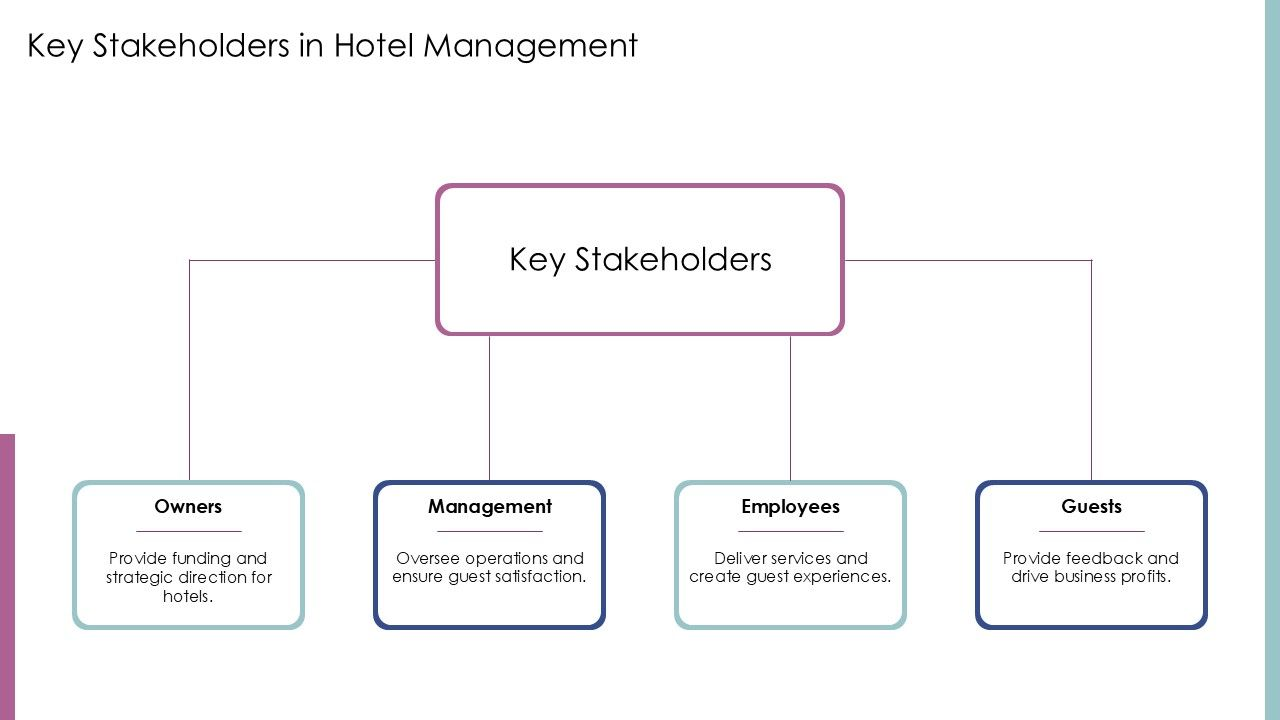
The SlideTeam powerpoint template showcases key stakeholders in Hotel Management, which can be broken down into four major categories. Owners supply the capital and define the strategic direction. Management runs the hotel and ensures guest satisfaction. Employees provide services and help to create great experiences for guests. Guests provide feedback and generate profits through their use of the business.
Template 9: Understanding Industrial Safety Standards
This template defines four important stakeholders and contributors to the evolution of safety standards. It starts with the industry owner, who outlines the financial backing and defines the strategic intent of the safety standards. The template gives a clear understanding of the industrial safety standards, download now.

Template 10: Risk Assessment and Management Strategies
Here is a high-quality slide by SlideTeam template that shows a matrix with Risk Evaluation and Management Plans. Risks are classified by likelihood and impact, across High, Medium, and Low levels and given as percentages. The template specifies management strategies, including Monitoring (audits, PPE) and Mitigation (training, emergency drills). Important findings include the need for increased training, audits, and proper PPE to help decrease incidents and injuries.

Industry Management: The Engine of Business Success
The role of industry management is significant for effective operation, development, and competitiveness of businesses in each industry. A function of the management activity is the organization of readily available resources, improved processes, and strategic directional decisions that address market realities and future objectives. Proper and effective management of the industry ensures that a business can monitor trends, adopt new methods, and enforce productivity against quality expectations. Management ensures collaboration across divisions is appropriate and effective, and that processes are organized and sustainable in nature.
Good management within industry can build organizational resiliency to economic downturn and global issues, assuring profit and stability. Management roles in industry involve employee education and up-skilling, technology competency, and processing input from customers to enable transitional innovation. Therefore, management is foundational for the industry to operate competitively, sustain naturally, meet customer needs, and generate revenue in the process. Without proper management, a business will experience loss of time, energy, or whatever may be perceived, opportunities and ineffective processes in a marketplace of motion and rapid change.
PS: To understand the topic better, read our blog on Top 10 Industry Overview Templates with Examples and Samples.
Industry Management FAQs
Management practices are necessary to address a rapidly changing market by using agility, continuous innovation, and data-driven decision-making to better manage your response. The organization needs to focus on technology investments, adaptable workforces, and facilitative leadership. Continuously monitoring market trends, consumer preferences, and competitive actions allow the organization to act quickly. Flexibility and resilience help organizations remain competitive, sustainable, and poised. |
Industry managers grapple with challenges in transitioning to sustainable production. Initial capital costs, unease about change, and limitations with existing green technologies pose barriers to adoption. Challenges such as profitability versus sustainable practices, regulatory compliance, and supply chain complexities add to the difficulty. Another barrier in the transition is getting stakeholder support and the long-term commitment that sustainable systems require. |
Incorporating technology leads to a significant improvement in operational efficiency for industry management by automating processes and reducing errors to streamline workflows. Moreover, it allows for real-time data analysis, promotes better decision-making, and improves resource allocation. Advanced technologies, such as AI, IoT, and cloud-based systems, lead to greater productivity as well as cost savings and improved innovation. Thus, technology ensures industries can remain competitive, flexible, and resilient in an ever-changing market. |