

 0 Comment
 Customer Reviews

Have you ever wondered how doctors prepare for complex surgeries or create the right fitting prosthetics for patients? The answer is medical 3D printing. 3D Printing in Healthcare is all about creating three-dimensional objects layer by layer by leveraging digital blueprints. This revolutionary technology, known as additive manufacturing, creates a variety of medical devices, including implants, prosthetics, surgical tools, anatomical models, and even tissues and organs. Healthcare innovation specialists can use advanced materials like biocompatible plastics, metals, and hydrogels, tailored to the specific application.
Take a tour of Medical Imaging Technology templates here!
Medical 3D printing is crucial for personalized healthcare, enabling the creation of custom implants, dental devices, and prosthetics tailored to an individual's anatomy. This personalization effect improves outcomes, setting a path to effectiveness in the treatment. To popularize this innovation in healthcare, doctors, surgeons, and researchers may need templates to explain 3D printing applications. This is where SlideTeam's easy-to-use templates come into the picture. These templates facilitate many discussions around medical 3D printing during conferences, training sessions, or academic discussions. Take a look at all these templates now!
Template 1: Medical 3D Printing Technology PPT Designs ACP
This PPT bundle is your comprehensive peak into advancements in healthcare innovation, i.e., Medical 3D Printing. This bundle covers topics like applications, benefits, and future potential of 3D printing in the medical field. This deck is perfect for healthcare professionals, researchers, and educators seeking to present key insights on additive manufacturing in medicine. It also includes slides discussing the historical evolution, principles, and types of 3D printing technology. You can also find insights into the application, challenges, and more associated with medical 3D printing. Download it now!
[product_image id=1273892]
Template 2: Medical 3D Printing Technology Introduction
This slide discusses the applications of Medical 3D Printing Technology in creating 3D-printed prosthetics and surgical models. It explains how customizable prosthetic limbs improve comfort and functionality by perfectly fitting individual needs. This slide also emphasizes the use of 3D-printed anatomical models that help surgeons practice complex procedures. This way, they enhance their skills and minimize risks during surgeries. The slide depicts the transformative impact of 3D printing in advancing patient care and surgical precision. Download it now!

Template 3: Historical Evolution of 3D Printing
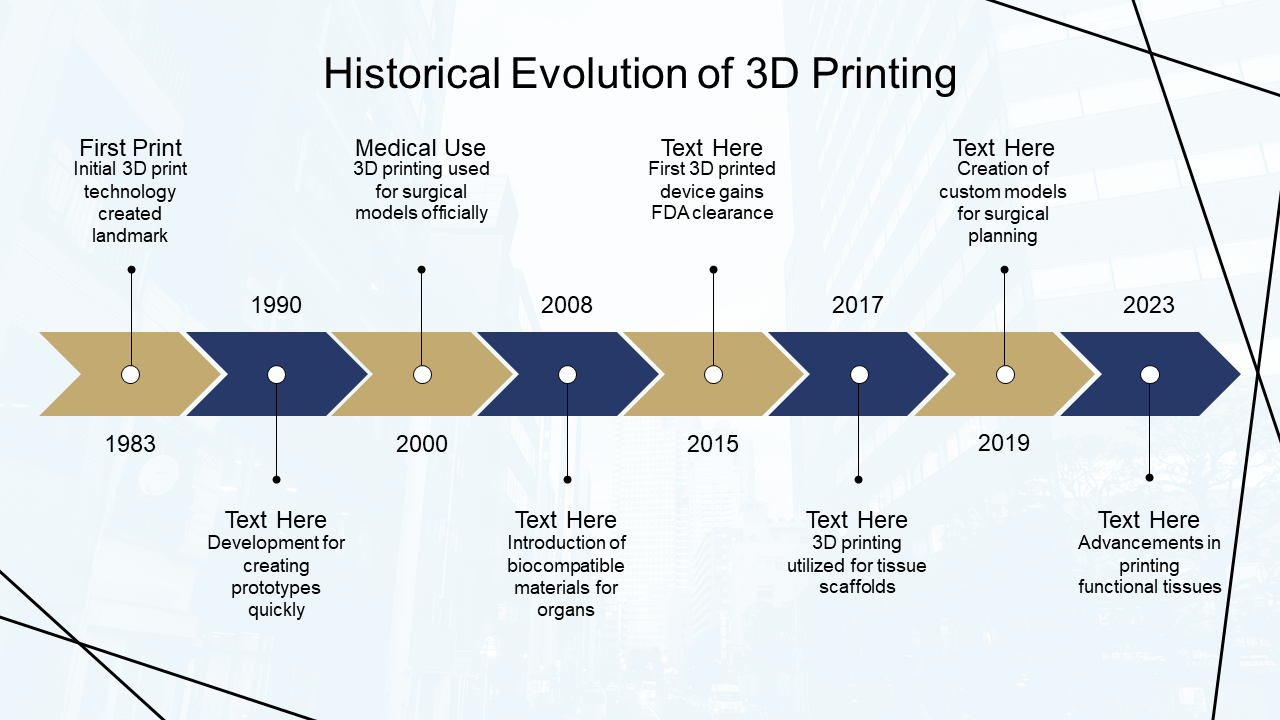
This slide template illustrates the historical evolution of 3D printing in the medical field. It highlights key milestones, from the first 3D print in 1983 to its use in surgical planning by 1990 and FDA-approved devices by 2000. The slide highlights key advancements, including custom surgical models (2008), biocompatible materials (2015), tissue scaffolds (2017), and functional tissue printing (2023). Download it now!
Template 4: Core Principles of Medical 3D Printing
This template mentions the core principles of medical 3D printing, emphasizing two key aspects. It highlights the importance of patient-specific models, focusing on creating personalized solutions tailored to individual patient anatomy. This slide also talks about the significance of Regulatory Compliance in medical 3D printing. It ensures compliance with medical standards and regulations, guaranteeing the effectiveness and quality of 3D-printed devices and implants. Download it now!

Template 5: Types of 3D Printing Technologies
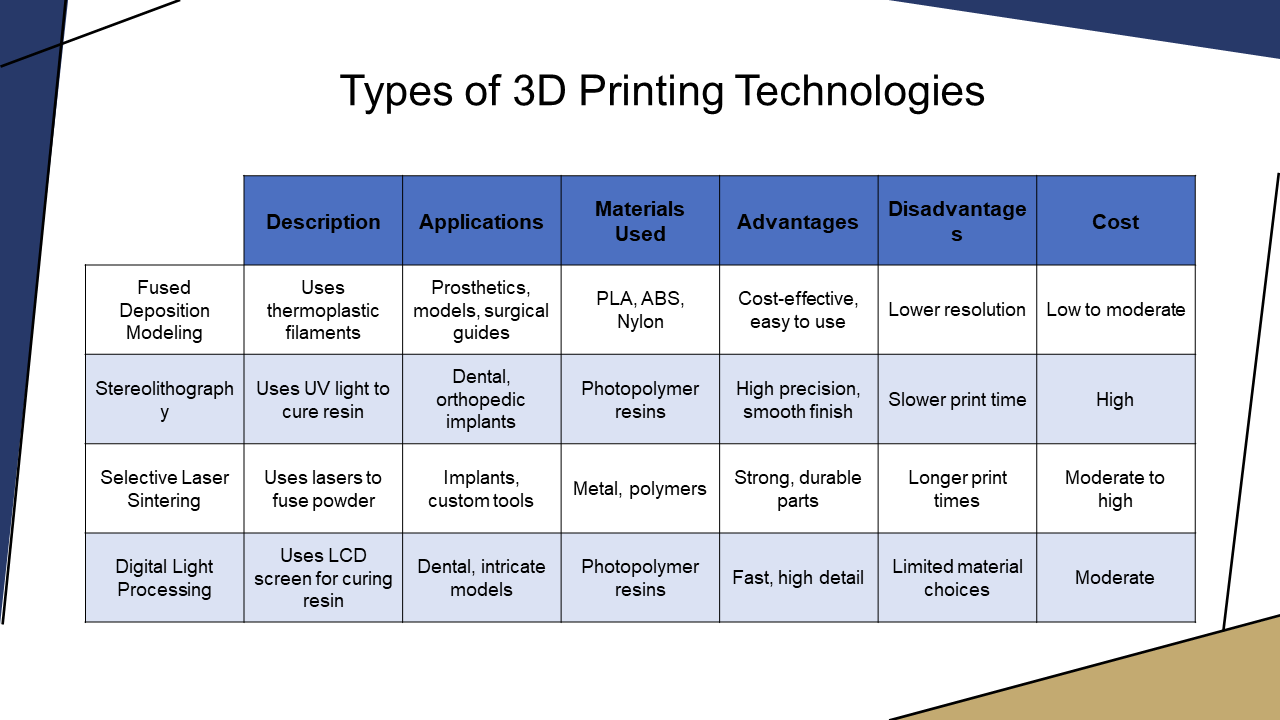
This slide template explores the types of 3D printing technologies used in the medical field. It lists some major types, including Fused Deposition Modeling, Stereolithography, Selective Laser Sintering, and Digital Light Processing. The slide also highlights 3D Printing applications, like prosthetics, implants, and surgical models. It also includes a column detailing materials like thermoplastics and resins, highlighting their advantages such as cost-effectiveness and precision. You can also glance into the disadvantages and costs via the slide for a comprehensive comparison of various medical uses. Download it now!
Template 6: Materials Used in Medical 3D Printing
This template highlights the common materials used in medical 3D printing, showcasing a variety of options tailored for specific applications. It includes PLA for prototypes, PETG for functional parts, and PA (Nylon) for durable components. Titanium is listed in the slide for its use in implants due to its biocompatibility, while Hydrogel mimics soft tissue properties. TPU serves flexible parts like orthotics, and Resin delivers high-resolution details for surgical models and guides. Download it now!

Template 7: Customized Medical Devices and Implants
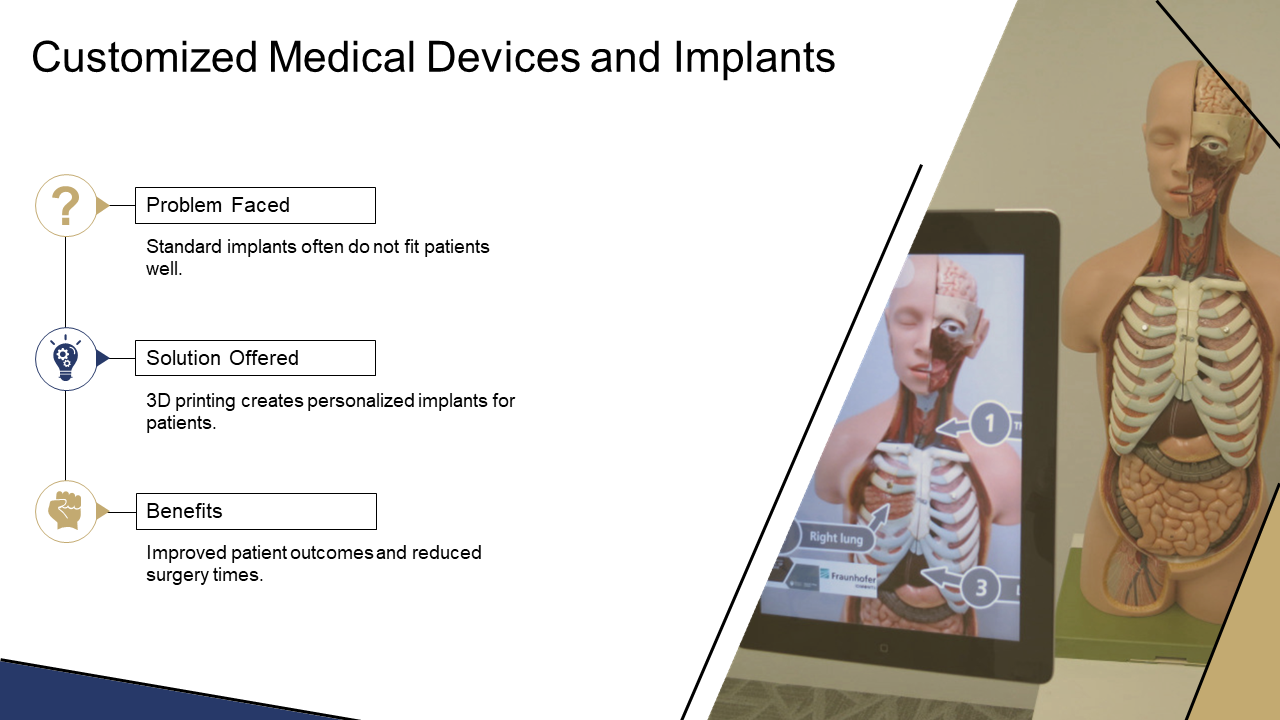
This template highlights the importance of customized medical devices and implants in solving the issue of poor fit with standard implants. It emphasizes how 3D printing offers personalized solutions, enabling the creation of implants tailored to individual anatomy. This innovation not only ensures a better fit but also results in improved patient outcomes and reduced surgery times. All in all, this slide demonstrates the significant impact of 3D printing on efficiency and the overall quality of medical care. Download now!
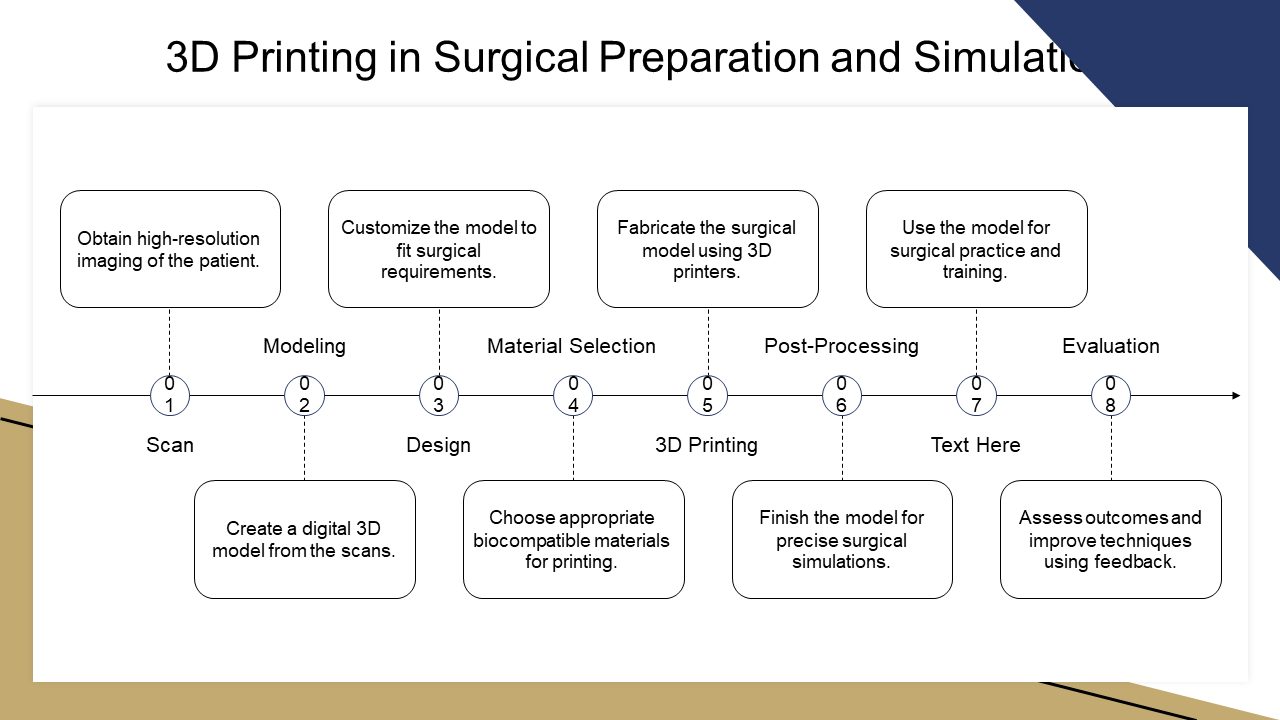
Template 8: 3D Printing in Surgical Preparation and Simulation
This slide describes the process of 3D printing in surgical preparation and simulation. It starts with obtaining high-resolution imaging of the patient, followed by creating a digital 3D model from scans. The model is then customized to fit surgical needs, using biocompatible materials for printing. After fabrication, the model is used for surgical practice and training. Finally, the post-processing and evaluation step helps refine techniques, improving surgical outcomes and skills through continuous feedback. Download it now!
Template 9: Bioprinting: The Future of Tissue Engineering
This slide presents the vision, mission, and values of 3D bioprinting technology. The vision aims to revolutionize healthcare by creating lab-grown organs and tissues for transplantation and therapy. The mission also focuses on advancing bioprinting technology to develop personalized medical solutions that improve patient outcomes. The slide highlights how innovation, integrity, and collaboration drive the transformation of tissue engineering and improve healthcare quality. Download it now!

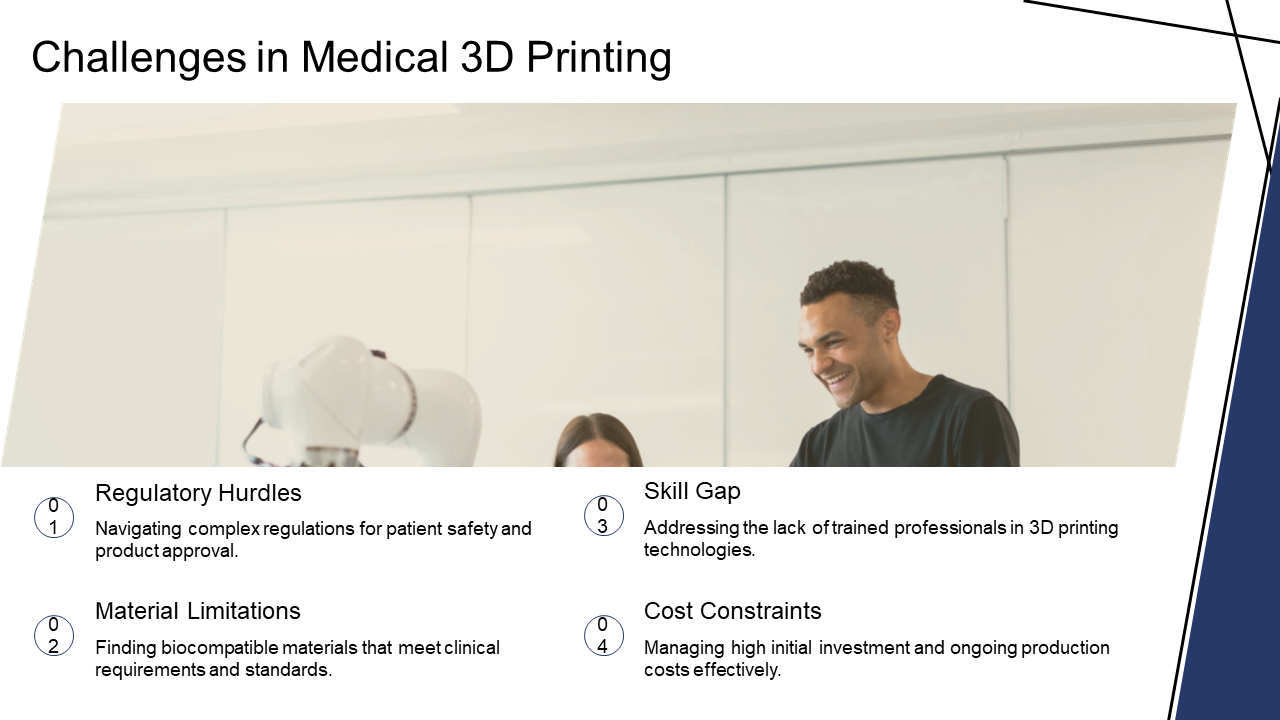
Template 10: Challenges in Medical 3D Printing
This slide mentions the possible challenges that take place in medical 3D printing. It begins with Regulatory Hurdles, such as navigating complex regulations for patient safety and product approval. Another challenge is Material Limitations, which include finding biocompatible materials that meet clinical standards. The slide also addresses the Skill Gap, focusing on the lack of trained professionals in 3D printing technologies. Finally, it mentions Cost Constraints, which involve managing high initial investments and ongoing production costs effectively in the medical industry. Download it now!
Final words
Medical 3D printing is transforming healthcare by enabling personalized solutions, from custom implants and prosthetics to surgical models and tissue engineering. This technology provides significant benefits in creating tailored medical devices. Templates are ideal for healthcare professionals, researchers, and educators to effectively communicate and implement 3D printing innovations.
The templates shared above cover topics like materials, customization, surgical preparation, and challenges. You can also leverage templates on the latest technology trends to explain the Medical 3D printing process in a better way. Make sure to also dive deeper into 3D print technology by checking out its templates here. You never know just how much you might discover about this technology as you explore it further!