





 0 Comment
 Customer Reviews

What is the most effective method for evaluating the education system? It is achieved by monitoring and assessing the curriculum and techniques, and updating the system on a regular basis.
Educational evaluation identifies areas of strength and areas for improvement, while evaluation of learning at that point provides us with information on how students understand concepts. The monitoring of academic performance involves tracking each learner to ensure that no one is left behind. Outcome measurement links teaching practices to real outcomes. Every step is a value-added process.
Formative assessment facilitates the process of continuous improvement in the classroom. Summative assessment is a test at the end. Educational appraisal helps teachers refine their strategies to have a more positive impact. These processes are combined to form a roadmap to successful learning. Monitoring and evaluation in education is not only about data collection. It is the responsibility to establish accountability, initiate improvement, and guarantee that each student achieves their potential through purposeful, meaningful, and structured evaluation.
Monitoring and evaluation in education guarantee a clear and consistent measurement of progress. Assessment in education helps identify the strengths of students and areas where improvement is needed. Evaluating learning offers insights into how knowledge is understood and applied. These insights are then matched to measurable outcomes through academic performance tracking. Collectively, they develop an organized strategy toward enhancing teaching and learning.
SlideTeam offers Monitoring and Evaluation in Education PPT Templates that can be fully customized to deliver these concepts effectively. They simplify complicated information and render it visually appealing. Easy-to-customize designs enable instructors to define concepts clearly. Moreover, monitoring and evaluation in the educational sector become more accessible through sharing, discussion, and the professional implementation of impactful strategies.
Template 1: Evaluating and Monitoring Performance Lessons from Education
This PowerPoint deck highlights lessons on evaluating and monitoring performance from the education sector. The presentation bundle covers the introduction to performance evaluation, the importance of monitoring performance, the historical context, formative vs. summative assessment, and developing a framework. It also explores tools, data collection methods, common challenges, and case studies while emphasizing student achievement monitoring, learning outcomes assessment, and quality assurance in education. The PPT deck helps track progress, ensure accountability, and design strategies that improve teaching effectiveness and strengthen overall student success. Download now.
[product_image id=1450310]
Template 2: Introduction to Performance Evaluation
This presentation slide introduces the concept of performance evaluation. It focuses on setting goals, gathering data and feedback, and promoting continuous improvement. In the PowerPoint template, the importance of clear objectives in evaluating learning is also emphasized, and different assessment approaches are identified as the most effective means of providing accurate information about student progress. Constant feedback is used to enhance performance, while continuous improvement is employed to achieve lasting success. The PPT design enables the refinement of instructional strategies, effective tracking of outcomes, and the development of a systematic approach. Download it now.

Template 3: Importance of Monitoring Performance
This PPT template emphasizes the importance of tracking performance through regular evaluation and data-driven actions. The presentation setup consistently facilitates timely learning assessments, enabling educators to respond accordingly to feedback and results and adjust their teaching methods. Program evaluation enhances the effectiveness of data, guides resource allocation, and improves the impact of teaching. The PowerPoint diagram helps them monitor progress, increase accountability, and create a plan to reinforce student achievement, while also encouraging the idea of continuous learning. Download now.

Template 4: Historical Context of Educational Evaluation
This PowerPoint design provides the historical background of education assessments. The PPT layout highlights major milestones, such as the introduction of standardized testing in 1900 and the Brown v. Board decision in 1954. In addition to this, the Elementary and Secondary Education Act of 1965, the 1983 Nation at Risk report, the No Child Left Behind legislation of 2001, and the 2015 Every Student Succeeds Act reform. The presentation slide illustrates how each factor influenced the learning practices related to evaluation. It assists in examining policy influence, tracking progress, and planning studies that help enhance education in the future. Download now.

Template 5: Formative vs. Summative Assessment
This presentation diagram depicts formative and summative assessment. The PowerPoint template records the unique purposes, time, concentration, and results. Formative assessment is used to track learning and, in the process, provide continuous feedback on student learning to guide curriculum development and enhance instructional strategies. Summative assessment evaluates learning at the close of an instructional unit and focuses on end-of-unit achievement to aid impact assessment of grades or certification. This PowerPoint image serves to distinguish assessment plans, enhance teaching effectiveness, and inform better decisions. Download now.

Template 6: Developing a Performance Evaluation Framework
This PPT slide contains instructions on how to create a performance evaluation framework. The presentation diagram serves to define objectives that align with the educational goal, gather relevant data through assessment and observation, and interpret the results to inform decision-making. Further, it highlights the use of a structured assessment as an indicator of effective learning and quantifiable improvement. This PowerPoint graphic enables systematic assessment processes, allowing for the effective tracking of student performance and the adoption of strategies to improve teaching effectiveness. Download now.

Template 7: Tools for Effective Performance Monitoring
This PowerPoint graphic indicates practical performance monitoring tools. It includes data analysis, benchmarking, a feedback system, goal setting, frequent check-ins, training programs, technology tools, and stakeholder engagement. The strategies facilitate constant enhancement and contribute to the monitoring of progress. The PPT template facilitates the execution of systematic monitoring procedures, data-driven decision-making, and the improvement of effective teaching overall. It also enables action to be taken on quantifiable student and institutional performance outcomes. Download now.

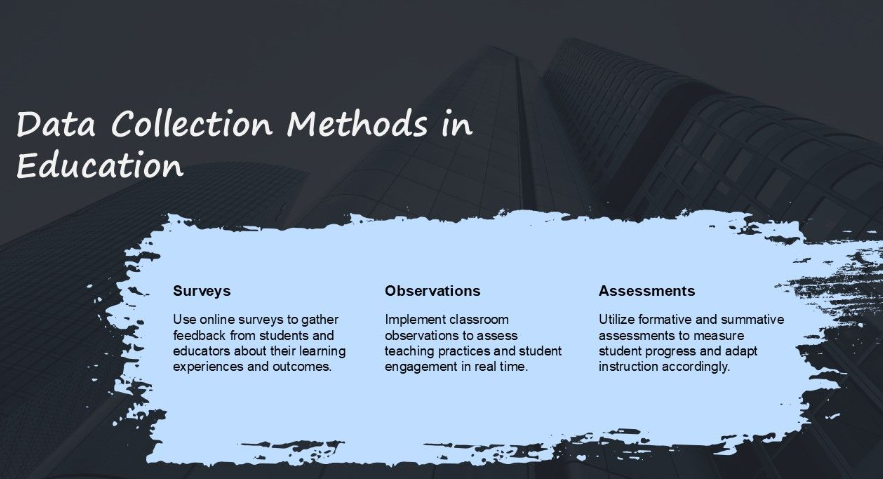
Template 8: Data Collection Methods in Education
This presentation illustration features key data collection methods in education. The PowerPoint design highlights primary data collection techniques in the learning process. It contains surveys to gather feedback from both students and educators, as well as classroom observations to evaluate teaching practices and student interaction. Additionally, it describes formative and summative assessments to measure student improvement. These procedures aid proper learning assessment and effective teaching judgments. This PPT layout helps in organizing and presenting information. It also enhances understanding of performance to improve educational outcomes. Download now.
Template 9: Common Challenges in Performance Evaluation
This performance evaluation PPT framework outlines typical pitfalls in performance measurement. The presentation slide reports the data quality problems, resistance to change, limited resources, subjectivity of rating, misalignment, and challenges in implementing feedback. These issues may affect the validity and the usefulness of performance evaluations. This PowerPoint visual enables the detection of potential barriers, simplifies assessment procedures, and plans strategies to overcome the stumbling blocks. It also provides an organized and clean methodology to achieve more credible and actionable performance indicators. Download now.

Template 10: Case Studies in Educational Performance
This PowerPoint template highlights case studies in the field of education performance. The PPT image highlights issues, resolutions, and quantifiable benefits. Students with lower performance in standardized testing can benefit from the introduction of adaptive learning technology in the classroom, leading to improved interaction and increased scores. This presentation layout helps illustrate real-world solutions. It also presents practical solutions, justifying the use of evidence-based decision-making and enhancing the sense of what works to improve student learning outcomes. Download now.

Evaluation Drives Growth in Education
Educational monitoring and evaluation are crucial in enhancing learning outcomes. Student progress and difficulties are identified through educational assessments. The review of learning provides clarity, as it demonstrates the absorption and application of knowledge. The two processes guarantee improved teaching practices and outcomes. These insights are easily presented in our PowerPoint layouts. They are professional, customizable to the maximum, and aesthetic. The complicated data is simplified and made clear. Through these layouts, impactful, precise, and confident monitoring and evaluation in education can be provided.
PS: Improve supply chain performance with the Top 10 strategy templates with examples and samples, and become a successful operation through effective frameworks for success. Download them now!
FAQs
Why is M&E important for schools, teachers, and policymakers?
Monitoring and Evaluation (M&E) are essential for improving educational outcomes through evidence-based decision-making in schools, for teachers, and for policymakers; they also serve the roles of accountability, optimizing resource allocation, and facilitating continuous learning and improvement. For schools and teachers, M&E provides data to identify student support needs and plan instruction; for policymakers, it offers evidence that helps them fine-tune policies and ensure that public funds are effectively spent on quality education.
What are the key objectives of M&E in the education sector?
Some overall purposes of M&E in the education sector are to enhance access to and quality of education; to gauge the effectiveness and relevance of a program; to ensure accountability to stakeholders; to inform policy and planning with evidence-based information; to keep track of progress and help to get where we want to go in terms of global goals (SDG 4); to uncover strengths and weaknesses in program or performance from students; and to foster learning, innovation, and efficiency for the improved outcomes of education.
What indicators are commonly used to measure educational progress and quality?
Educational progress and quality are commonly measured by learning outcomes (e.g., assessment scores, graduation rates), access (e.g., enrollment rates, teacher-student ratios), equity (e.g., gender parity index), resources (e.g., educational expenditure, infrastructure), and school environment (e.g., student support, management practices).


