

 0 Comment
 Customer Reviews

Many of us use Alexa, Siri, Cortana, and other voice assistant features in our daily lives. Would you believe it if we told you that artificial intelligence, which makes humans insecure about the future, has the same architecture as our brains, thereby performing the same roles?
If you wouldn’t, we won’t blame you, as the concept of neuromorphic engineering is relatively new to us. We all come across terms like deep learning or cognitive computing in our daily lives without delving into these concepts in depth.
However, in this blog, our PPT templates introduce you to varied concepts, frameworks and comprehensive guidelines on understanding neural networks and integrating them into artificial hardware to achieve desired outcomes.
Curious about what to do with learning about such an advanced topic? Check our templates for the power of neural networks to understand their significance.
Understanding the Role of Neural Processing
Artificial neural processing is an integral part of the framework on which our voice assistants run. It is simply because the neural processing unit (NPU) replicates a human brain, not an animal's brain that they communicate with us in languages familiar to us.
Generative AI tools like ChatGPT, Deepseek, and others provide us with reliable information due to their shared neural structure. Predictive AI tools also use neural decoding techniques to identify past patterns and predict future outcomes, much like the human brain does in similar circumstances.
Let’s explore how artificial neurons are processed and utilized using SlideTeam’s templates!
Template 1: Neural Processing Neuroscience PPT Designs
This bundle is a compilation of templates designed to facilitate in-depth learning about neural networks for their effective application. First, it segregates the human brain regions, such as the frontal and temporal regions, according to the functions they serve. It then connects these cognitive functions with their corresponding neural correlates, such as the Amygdala and the Hippocampus, to understand the neurotransmitters responsible for our brain's handling of emotions, attention, or memory. Utilize our comprehensive neuroscientific package and incorporate advanced brain mapping tools to collect accurate data, optimize model training, facilitate interdisciplinary collaboration, and raise public awareness of its impactful real-world applications.
[product_image id=1297375]
Template 2: Neural Processing Unit NPU AI Hardware Acceleration PPT Slides
While being so effective in its application, the internal mechanism of Artificial Intelligence still amazes people. This bundle, therefore, breaks down its integral architecture, also known as the Neural Processing Unit (NPU), which, unlike traditional GPUs, enables real-time neural processing and latency reduction, supporting AI hardware. Use these templates to establish performance benchmarks, regularly monitor them to transition away from outdated GPUs, and select the most suitable NPU for integrating AI systems. Implement load-balancing strategies to distribute workloads evenly across your processors, ensuring a quick response. Apply our slide to measure the compatibility of different software with your processor.
[product_image id=1228340]
Template 3: Exploring the Neural Differentiation Process in Depth PPT Presentation
This package addresses the nuanced stages, mechanisms, and transcription factors engaged in the completion of the neural differentiation process. This differentiation develops our nervous system by transforming neural stem cells into glial cells and other specialized cells, which play key roles like regulating gene expression, facilitating signaling, and mediating communication in brain function. This bundle primarily suits educational needs, as its content-driven slides contain significant knowledge about the process involved in neurogenesis and the roles microRNAs play. Download this set to observe current trends and support future-oriented research efforts aimed at combating neurodegenerative diseases and other persistent health concerns.
[product_image id=1399335]
Template 4: Wavenet Revolutionary Neural Network for Audio Processing PPT PowerPoint
Artificial audio processing, voice assistance, and music generation have become mainstream in today's world. Their development and integration, nevertheless, remain robust tasks if not for the Wavenet neural network. With its high fidelity, faster training time, and deep learning architecture, it produces superior sound quality, speech synthesis, and real-time audio processing on demand. Our package, featuring 40 PPT layouts, explains the complex data requirements for training and simplifies integration with IoT devices, voice assistants, mobile apps, and other technologies. Explore this to naturalize relevant testing protocols, set performance metrics, and implement marketing strategies.
[product_image id=1293789]
Template 5: Comparative Analysis of Competitors
Downloading and customizing this slide not only helps you perform a rigorous industry analysis but also helps you adopt the best market practices to give you a competitive edge. It focuses on various companies utilizing audio-generating technologies, including traditional DSP and machine learning algorithms. While the neural network remains your forte in developing adaptive learning algorithms, you can skip and choose from these options to find the right mix.

Template 6: Translational Neuroscience and its Relevance
The slide illustrates the importance of translational neuroscience in not just the field of mental health improvement but also brain-inspired computing. This technology focuses on developing artificial neural processing to enhance cognitive computing while also personalizing therapies for the treatment of Alzheimer's disease and other neurological disorders. Additionally, it is also relevant in neurofeedback training and enhancing human cognitive understanding. Download this to persuade stakeholders to fund your research programs.

Template 7: NPU Energy Efficiency Considerations
Imagine a neural modeling with the lowest energy consumption! This preset makes it possible and realistic by informing you of ways to preserve energy without compromising on output. Implementing dynamic voltage, designing cooling solutions, centralizing data close to the NPU according to its access frequency, and applying algorithms to minimize computational complexity are some common methods this slide emphasizes. It also allows you the scope to elaborate on additional methods.

Template 8: NPU Ecosystem: Software Compatibility
This preset lists significant neural signal processing software and evaluates their compatibility with your specific needs. While software such as TensorFlow and PyTorch are compatible with developing an AI framework, you may shift towards Keras to organize your developer tools. On the contrary, OpenCV only fosters integration support and does not cater to any other requirement. Use this template to filter out the most utilizable software to fulfill important must-haves.

Template 9: Systems Biology in Neural Studies
This slide adopts a holistic approach to fostering neural computation by examining various cell types, gene expressions, and environmental factors. It understands and adopts the learnings from biological neural networks, such as neurons, glial cells, neurotransmitters, and stem cells, into other disciplines, including computer science and mathematics, to develop cognitive computing. Grab this preset to incorporate the perfect combination by taking the best components from each department.

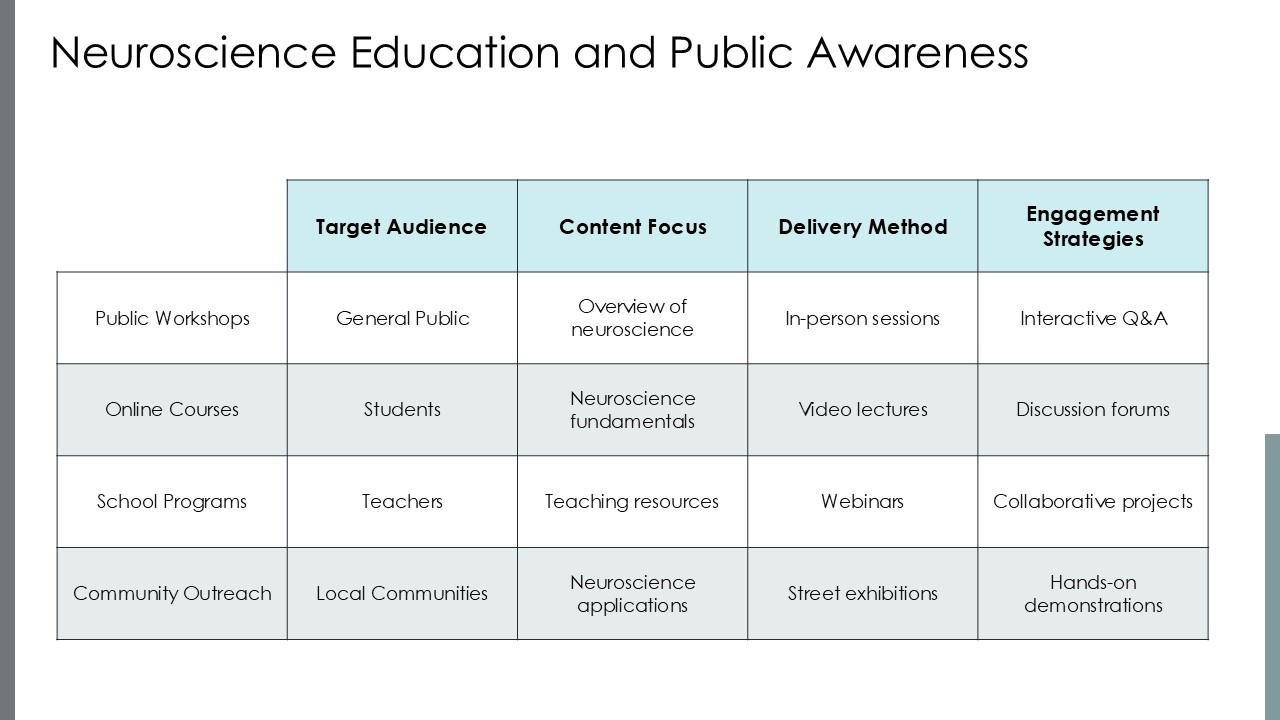
Template 10: Neuroscience Education and Public Awareness
Given the limited understanding of neuroscience in the current domain, this template enables you to develop a public awareness strategy that effectively communicates the importance of neuroscience. It offers various engagement strategies, including discussion forums and collaborative projects, for students, teachers, and other target audiences. It also emphasizes suitable delivery methods for delivering their corresponding educational content. Apply this framework to impart deep learning of neural processing to the public.
Conclusion
The slides introduced in this blog demonstrate the effectiveness of deep learning in a broader, creative context. However, its potential floats beyond just analysis, prediction, and creation. It can be a true game changer by contributing to saving energy and curing serious neurodegenerative diseases or, simply put, mental health problems. Such a promising future requires our attention and robust investment for optimized outcomes.
Apart from the templates discussed here, you can explore these must-have deep learning templates to master their fundamentals, train employees, and persuade stakeholders.
FAQs on Neural Processing
1. How does neural processing work in the human brain?
Neural processing in the human brain occurs at its most basic unit, the Neuron. Communication among neurons triggers our emotions, fixes our attention, and coordinates our actions. The neurons are composed of specialized cells called Dendrites and Axons, each of whom has different purposes. While the former functions like an antenna, receiving or catching signals from other neurons, the latter releases them.
In other words, our brain is home to complex biological neural networks, also called neural circuits. When the signal travels in these circuits, dendrites, after receiving it, send it down to the axon terminals. This process occurs only in the case of strong signals, known as action potentials, that compel humans to perform certain actions. These signals undergo synaptic processing before being released by the axon in the form of neurotransmitters, such as dopamine, GABA, and Serotonin, to coordinate specific actions or trigger emotions.
2. What is the role of neural networks in artificial intelligence?
Neural networks enable artificial intelligence to replicate the data processing that occurs inside the human brain through their machine learning algorithms. They utilize similar biological structures to those found in neurons. During this process, they utilize interconnected nodes, or artificial neurons, to input, process, and output signals, thereby communicating with one another.
This brain-computer interface enables AI to learn complex patterns, improving decision-making and Natural Language Processing (NLP), which is utilized in the development of chatbots and virtual assistants. Moreover, they allow for streamlined medical imaging and system automation. It also affects pattern recognition in AI, enabling it to perceive patterns in received data and make informed decisions, thereby optimizing the structures of speech, text, images, and audio.
3. How is neural processing used in modern technology?
Neural processing is an integral part of modern technology, as AI and other modern devices continue to integrate Neural Processing Units (NPUs) to facilitate this functionality. These units are designed with an architecture that stimulates the human brain and processes complex, raw data more efficiently yet naturally.
Artificial neural processing offers AI structures consequential advantages that traditional CPUs and GPUs cannot offer in terms of data processing, energy consumption, and overall efficiency. We have discussed this comparison in more detail here. This edge enables modern technology with accurate speech recognition used in transcriptions and call center automation. More applications include image enhancement, object detection, audio-video virtual assistance, and natural language processing.
Furthermore, brain-inspired computing reduces energy consumption by delivering maximum output.