





 0 Comment
 Customer Reviews

The intake form sits there. Sixteen pages. Half the questions don't make sense for what you actually do.
That's the thing about starting an occupational therapy practice—everyone assumes you're just another healthcare business. Fill out the standard templates. Follow the usual projections. But explaining what OT actually is? How occupational therapy services work? Why does someone need twelve weeks instead of six? The generic templates don't have a section for that.
Banks want to see revenue forecasts. Insurance companies want billing codes. Landlords want proof you can pay rent. None of them really get what happens in the room between you and a client, relearning how to button a shirt.
The occupational therapy business plan always comes first. Before you can help anyone, before you can rent space, before you can hire that second therapist you desperately need. Someone—loan officer, investor, partner—is going to ask you to justify the numbers. And somewhere in those projections, you have to translate "helps people regain independence" into something a spreadsheet understands.
Most therapy business strategy plans fail in the same place. Not the clinical stuff—therapists know their field. They fail at making the business case without sounding like they're explaining therapy to someone who's never heard of it. Too much context kills credibility. Too little makes it sound made-up.
The wrong plan gets you polite rejections. The right one gets you taken seriously from the first meeting.
That's where SlideTeam's business plan for therapists templates come in—they're built with the understanding that OT practices aren't typical healthcare businesses. Pre-designed frameworks that handle the translation between clinical expertise and business language.
Here are the templates that work when you need to sound like both a therapist and an entrepreneur.
Template 1: Occupational Therapy Business Plan Template
You need this comprehensive PPT template for occupational therapy business plan development that actually works. Pre-built SWOT analysis, financial dashboards, gap analysis, and market segmentation slides (TAM/SAM/SOM mapping, because someone finally did the math correctly) deliver actionable strategic planning tools for therapy practice owners, healthcare consultants, and management teams launching or scaling operations. These customizable OT practice template slides transform complex business frameworks into clear presentations for investor pitches, strategic reviews, and operational planning sessions. Download this pre-designed therapy marketing plan template now.
[product_image id=1776744]
Template 2: Market Needs and Opportunity Identification PPT Template
You need this pre-built Market Needs and Opportunity Identification PPT template because the data doesn't lie - aging demographics, chronic illness rates, telehealth adoption, and mental health demand create undeniable market entry logic for occupational therapy services ventures. This actionable slide transforms complex market analysis for OT into boardroom-ready strategic planning presentations. Healthcare consultants, business development managers, and investment teams can customize this PPT preset to justify funding decisions or to expand therapy business strategy. The pre-designed format eliminates guesswork while maintaining professional credibility essential for stakeholder buy-in. Download now.

Download this PowerPoint Template
Template 3: Value Proposition Canvas PPT Template
You need this pre-built Value Proposition Canvas PPT template for strategic planning sessions where therapists systematically map client gains, pains, and jobs against their services. This customizable slide provides actionable frameworks covering value mapping, pain relievers, and key partnerships, essential components for consultants and healthcare managers developing client-centered service offerings and occupational therapy business plan development. The pre-designed template eliminates guesswork (because "innovative frameworks" usually mean more confusion), letting therapy practice leaders focus on substance over slide design while strengthening their therapy business strategy. Therapists and healthcare consultants can immediately apply this structured approach to align their value propositions with actual client needs rather than assumptions, making it perfect for OT practice management. Download this proven PPT preset now.

Download this PowerPoint Template
Template 4: Competitor Analysis PPT Template
Strategic consultants and practice leaders need this pre-built competitor analysis PowerPoint slide for positioning decisions. The customizable template delivers actionable market intelligence for your occupational therapy business plan, comparing four competitors across share, growth, services, and demographics. This market analysis for OT includes strategic insights (because spreadsheets buried in email chains help nobody). Download this proven framework for competitive assessments and therapy marketing plan development.

Download this PowerPoint Template
Template 5: Understanding Market Trends in Therapy PPT
You need data-backed market intelligence, not another consultant's wishful thinking (because we've all seen those "transformational" decks that ignore actual numbers). This pre-built PowerPoint slide delivers four critical occupational therapy trends, teletherapy expansion, value-based care models, demographic shifts, and mental health prioritization, giving executives and strategic planners actionable context for therapy business strategy and service development decisions.

Download this PowerPoint Template
Template 6: Customer Behavior Insights in Therapy PPT
You need actionable customer behavior insights, not another vendor pitch deck (trust me, I've endured countless "transformative" presentations that delivered spreadsheets). This pre-designed PowerPoint slide delivers three proven patient care strategies - digital engagement via telehealth platforms, referral optimization via physician relationships, and automated patient retention systems, each with specific performance metrics. Healthcare managers, consultants, and strategic planning teams can immediately customize this PPT template for board presentations, quarterly reviews, or operational planning sessions as part of their therapy marketing plan. The pre-built framework eliminates guesswork and focuses on measurable outcomes. Download this slide now.

Download this PowerPoint Template
Template 7: Business Strategy Trade-offs Evaluation PPT
You need this pre designed pros and cons PowerPoint slide for strategic planning sessions where trade offs matter. This PPT template systematically evaluates market expansion, financial incentives, service diversity, and community engagement against competition risks, regulatory challenges, OT resource allocation constraints, and client retention concerns. The slide's pre built framework prevents the usual decision making theater (because we've all watched teams debate in circles for hours without structure). Project teams, consultants, and managers can customize this actionable PPT preset for board presentations, strategic reviews, or planning workshops incorporating therapy business strategy and market analysis for OT. Download this template to replace scattered sticky notes with organized analysis.

Download this PowerPoint Template
Template 8: Financial Analysis and Projections PPT
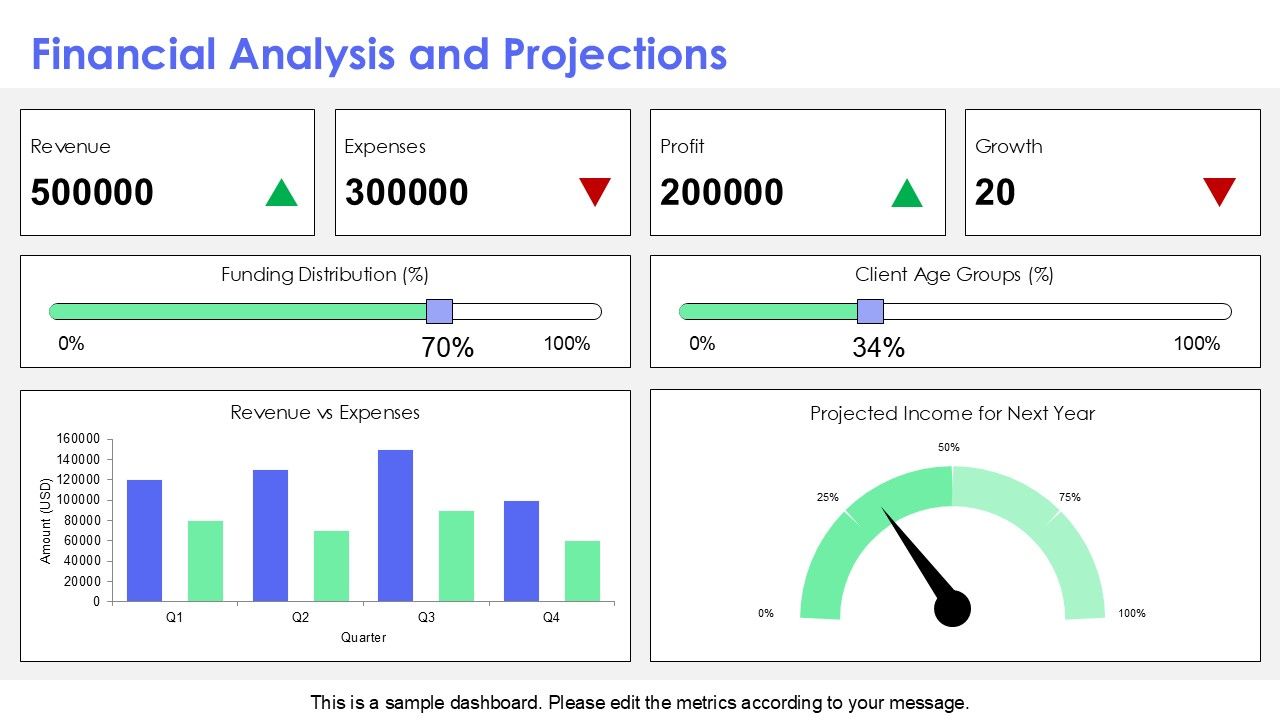
This pre-built Financial Analysis Dashboard PPT template delivers actionable insights through Revenue, Expenses, Profit, and Growth metrics that actually matter for quarterly reporting and OT financial projections. The slide includes funding distribution breakdowns, client demographics, and Revenue vs. Expenses comparisons (because executives need data, not decorative charts). Finance teams, consultants, and department heads can customize this PPT preset for board presentations, performance reviews, or the development of a comprehensive financial plan for OT practices. Download now.
Download this PowerPoint Template
Template 9: Data Interpretation Techniques in Therapy Outcomes PPT Template
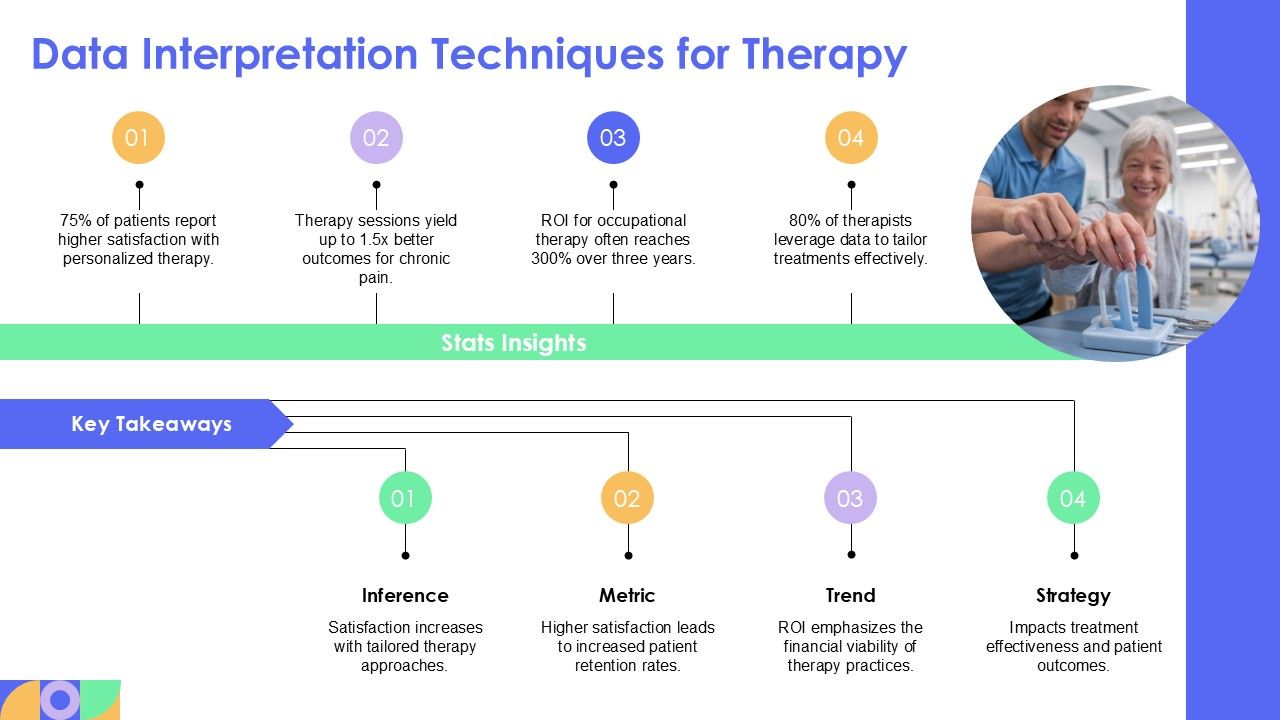
You need actionable data interpretation techniques that actually work in healthcare presentations (because "revolutionary analytics" rarely survive board scrutiny). This pre built PowerPoint slide delivers four statistical insights on therapy outcomes, patient satisfaction, treatment efficacy, ROI, and data driven practices, paired with key takeaways covering inference, metrics, trends, and therapy business strategy for evidence based decision making. Healthcare managers, consultants, and project teams can use this customizable PPT template for strategic planning, therapy practice expansion, performance reviews, and client presentations. The pre designed format transforms complex therapeutic data into digestible insights that support real business decisions and market analysis for OT. Download this proven PPT preset.
Download this PowerPoint Template
Template 10: Organizational Structure Chart for Occupational Therapy Practice PPT
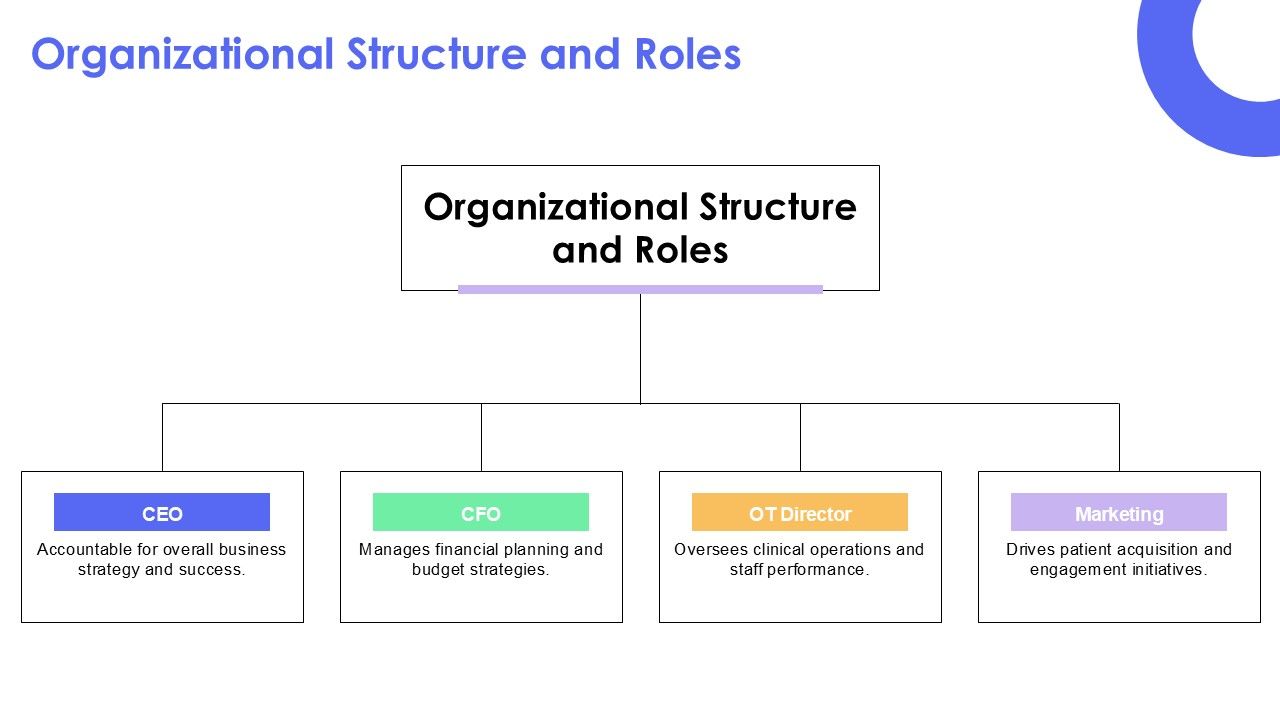
You need this pre-built organizational structure PPT template for occupational therapy business plan governance. It maps four critical roles, CEO, CFO, OT Director, and Marketing, with actionable role descriptions that eliminate hierarchy confusion (because "collaborative leadership" without clear accountability is just expensive chaos). Practice managers and healthcare consultants can customize this preset for strategic planning sessions or board presentations. Download this template to structure your OT practice management team effectively.
Download this PowerPoint Template
Transform your Occupational Therapy Business with SlideTeam
SlideTeam's PowerPoint templates are the industry's finest for occupational therapy business plan presentations. These content-ready slides provide professional structure and comprehensive coverage of essential business planning elements, including your therapy marketing plan, saving you valuable time in proposal development. Our custom-made templates ensure your therapy practice vision is communicated with clarity and credibility. Deploy these PowerPoint slides to secure funding and accelerate your occupational therapy business launch.
FAQs on Occupational Therapy Business Plan Templates
What are the essential components to include in an occupational therapy business plan template?
Include your target client groups and service types you will offer in your occupational therapy business plan. Add startup costs, monthly expenses, and revenue projections for the first year as part of your financial plan for OT. Specify your location, required licenses, and insurance needs. Create a marketing plan with referral sources like doctors and hospitals. Include staffing requirements and equipment lists for therapy sessions, considering OT practice management needs.
How can market research enhance the effectiveness of an occupational therapy business plan?
Market research identifies your target patients and their specific needs. Survey local hospitals, rehab centers, and senior facilities to understand referral patterns and service gaps. A comprehensive market analysis for OT will help analyze competitor pricing and services to position your practice competitively. Use census data to locate underserved areas with aging populations or high disability rates, then focus your services there as part of your occupational therapy business plan.
What financial projections should be considered when creating a business plan for an occupational therapy practice?
Focus on three core OT financial projections. First, estimate monthly revenue based on patient volume and session rates - typically $80-150 per session. Second, calculate fixed costs including rent, insurance, equipment, and staff salaries. Third, project cash flow for the first 18 months, accounting for insurance reimbursement delays of 30-90 days. Include a break-even analysis in your financial plan for OT showing when patient volume covers all expenses.
How can an occupational therapy business plan address regulatory compliance and licensing requirements?
Include state licensing requirements for all therapists in your occupational therapy business plan. List mandatory certifications and renewal timelines. Add compliance costs to your budget - fees, training, and documentation systems. Set up protocols for record-keeping and patient privacy laws like HIPAA. Schedule regular compliance audits and staff training sessions. Ensure your business plan for therapists addresses insurance billing for OT requirements and reimbursement procedures.
What strategies can be implemented in the business plan to attract and retain clients in occupational therapy?
Focus on three client acquisition methods for your occupational therapy business plan. First, build referral networks with doctors, hospitals, and rehabilitation centers through direct outreach. Second, create online presence with simple website and social media showing patient success stories as part of your therapy marketing plan. Third, offer free initial consultations to demonstrate value and support OT client acquisition. For retention, track patient progress with clear metrics and maintain regular follow-up communication post-treatment to ensure continued engagement.
How does one incorporate a marketing strategy into an occupational therapy business plan template?
Add three marketing sections to your occupational therapy business plan. First, define your target clients - children with developmental delays, stroke patients, or workplace injury cases. Second, list your referral sources - doctors, hospitals, schools, and insurance companies. Third, outline your outreach methods - build relationships with physicians, create patient education materials, and maintain an online presence. Focus your therapy marketing plan budget on direct physician outreach since referrals drive most occupational therapy businesses, and include market analysis for OT in your competitive research.
What role does technology play in modern occupational therapy practices, and how should it be addressed in the business plan?
Technology serves three core functions in occupational therapy today. First, use telehealth platforms for remote sessions and patient monitoring. Second, implement electronic health records to track patient progress and billing. Third, adopt assistive devices and apps that help patients practice skills at home. Address these occupational therapy trends in your occupational therapy business plan by budgeting for software licenses, staff training costs, and equipment purchases. Include projected revenue from expanded service delivery through digital channels as part of your therapy marketing plan.
How can an occupational therapy business plan outline potential partnerships with healthcare providers or organizations?
Identify local hospitals, clinics, and rehabilitation centers that refer patients. Contact medical directors and case managers to propose formal referral agreements. Establish partnerships with physicians, physical therapists, and speech therapists for joint care plans. Create contracts with insurance companies and Medicare for direct billing relationships. These partnerships generate steady patient flow and reduce marketing costs while building credible professional networks, forming a crucial component of any occupational therapy business plan and therapy business strategy.
What metrics and key performance indicators (KPIs) should be tracked to measure the success of an occupational therapy business?
Track patient outcomes through functional improvement scores and discharge success rates. Monitor financial health via monthly revenue, profit margins, and insurance reimbursement percentages as outlined in your OT financial projections. Measure operational efficiency using patient retention rates, appointment cancellation percentages, and therapist utilization hours. Review these numbers monthly to identify trends and adjust operations accordingly per your occupational therapy business plan.
How can the business plan template cater to specific niches within occupational therapy, such as pediatrics or geriatrics?
Pick one client group first - children or elderly patients. Change your service descriptions to match their needs in your occupational therapy business plan. For pediatrics, focus on school support and developmental activities. For geriatrics, emphasize home safety and daily living skills through comprehensive therapy program development. Adjust your equipment list and space requirements accordingly based on your market analysis for OT. Update marketing sections to target relevant referral sources like pediatricians or nursing homes.
What are common pitfalls to avoid when creating an occupational therapy business plan?
Avoid overestimating patient volume in year one of your occupational therapy business plan. Most practices see 30-40% fewer clients initially than projected. Skip complex service offerings at launch. Focus on 2-3 core treatments you can deliver well. Don't underbudget equipment costs - add 20% buffer to published prices in your financial plan for OT. Verify insurance reimbursement rates before writing revenue projections. Many plans fail because they use outdated payment data.
How should the service offerings be structured within the business plan to meet diverse client needs?
Structure occupational therapy services into three core areas. First, create individual therapy sessions for personalized treatment plans. Second, offer group programs for cost-effective community-based care. Third, provide specialized services like home assessments and workplace evaluations. Price each tier differently to serve various income levels. Include telehealth options for remote clients. Focus on measurable outcomes that insurance providers recognize and reimburse through strategic therapy program development within this business structure for therapy.
What are the best practices for setting competitive pricing within the occupational therapy market in the business plan?
Research local competitor rates through online searches and phone calls as part of your market analysis for OT. Set prices 10-15% below established practices initially to build clientele. Factor in overhead costs, insurance reimbursement rates, and target profit margins of 20-30% in your financial plan for OT. Include different pricing tiers for cash-pay versus insurance clients, with cash rates typically 20% higher than insurance reimbursements when developing your occupational therapy business plan.
How can a business plan template facilitate the funding process for a new occupational therapy practice?
A business plan template provides lenders with required OT financial projections and market analysis in standard format. It demonstrates your practice's revenue potential through client volume estimates and fee structures. The template includes sections for startup costs, operating expenses, and break-even analysis that banks need for loan decisions. Having organized documentation increases approval chances and speeds up the funding timeline.
What inclusions can effectively showcase the experience and qualifications of the occupational therapist in the business plan?
Include your license number and state certifications upfront when developing your occupational therapy business plan. List your clinical hours and specialization areas like pediatrics or hand therapy as part of your business plan for therapists. Add years of practice and types of facilities where you worked, incorporating market analysis for OT to demonstrate your experience. Mention any advanced certifications from AOTA or specialty boards. Include patient outcome metrics or caseload numbers if available.
How can client testimonials and case studies be integrated into the business plan for greater impact?
Include 2-3 client testimonials in your therapy marketing plan section. Place them near service descriptions to show real outcomes for OT client acquisition. Add one detailed case study that demonstrates your treatment process and results. Use specific metrics like "improved mobility by 80%" rather than vague statements. Put testimonials in sidebars or highlighted boxes for easy reading. Reference these success stories when discussing revenue projections to support your financial assumptions and market analysis for OT services.


