


 0 Comment
 Customer Reviews

Every drug or therapy represents extensive research, numerous clinical trials, stringent regulatory approvals, and substantial investment.
After all, drug development is a highly complex process focused on discovering safe and effective medicines. A new drug takes approximately 10 to 15 years to be deemed a success.
Behind a simple paracetamol tablet are thousands of drug candidates that never made it to the market. Many failed because they didn’t work as expected, while others struggled to obtain FDA approvals, meet quality assurance standards, or navigate regulatory affairs.
Despite costly and time-consuming processes, drug development feels nothing less than a miracle that gives life-saving moments to patients who had already lost hope.
This multi-year and costly process is not attainable without using Artificial Intelligence (AI), Machine Learning (ML), computational methods, and cutting-edge templates from SlideTeam.
Explaining complex drug formulations, pharmacokinetics (the interaction of drugs within the body), crafting intricate post-market surveillance programs, and even explaining intellectual property rights to professionals and team members without a science background is very challenging. That's where templates designed by SlideTeam's strategists provide an edge.
SlideTeam has engineered power-packed pharmaceutical product development templates that automate complex analyses, identify patterns, and optimize structure-based drug designs. This ultimately leads to faster drug discovery and development, as well as significantly reduced testing costs.
These PPT Tools also focus on compliance and sustainability, ensuring that manufacturing processes generate less waste and minimize their environmental impact. Additionally, these templates provide predictions on a drug's efficacy and toxicity in a particular disease, which is not possible with generic slides.
Take a closer look at industry-leading tools from SlideTeam and discover how they can accelerate the drug development process.
Template 1: Pharmaceutical Generic Product Development Process PPT Mockup
SlideTeam introduced this PPT deck to generic manufacturers aiming to develop patient-friendly solutions. It demonstrates a comprehensive generic drug development process, starting with the analysis of drugs whose patents are about to expire, followed by the formulation development phase that matches the branded version, the formulation laboratory testing phase, and bioequivalence studies comparing the brand-name drug and the new drug. It also lays the foundation for commercial production and completing regulatory dossiers for FDA review and market authorization.
[product_image id=1486906]
Template 2: Pharmaceutical Development For Generic Product PPT Guidelines AT
The development of new drugs is indeed challenging; however, with this PPT template from SlideTeam, you’ll get a precise roadmap for producing generic medicines with complete assurance of consistent quality and compliance. Despite the safety and efficacy of the active ingredients in reference drugs having already been established, the production of generic medicines remains challenging due to various factors, including the complex supra-molecular structures of reference medicines.
That's where this PPT deck proves its power. The composition of over 30 slides supports robust analytical methods, bioequivalence studies, and all requirements for formulation development. It also helps in navigating challenges that occur during the scale-up phase.
[product_image id=1470983]
Template 3: Pharmaceutical Development for Generic Products PowerPoint Presentation Slides
Once you download this resource, you’ll understand why this PPT deck from SlideTeam holds a top priority in the toolkits of leading drug manufacturers. Initiate your presentation by providing a clear and concise overview of the pharmaceutical development of new products, with the confidence that nothing important is overlooked and nothing outdated is presented.
Next, outline information on active ingredients, key aspects, and principles of physicochemical composition, and composition of the product. Furthermore, it empowers presenters to highlight key variables in a manufacturing process that significantly impact the critical quality attributes of drugs, including temperature, pH, and mixing speed, among others. Update your toolkit with this resource using the link below.
[product_image id=388497]
Template 4: Pharmaceutical Product Lifecycle And Development Of New Medicine PPT Template
SlideTeam’s experts introduced this tactical pharmaceutical product lifecycle framework to ensure successful pharmaceutical product development while avoiding critical knowledge gaps. The core focus of this PPT Slide is on drug discovery, clinical trials, testing, and post-market surveillance. It also emphasizes regulatory competence that not just helps in keeping pace but also empowers firms to set a standard in generic drug development.
[product_image id=1471478]
Template 5: Regulatory Framework for Generic Drugs
This PPT theme showcases essential elements of global regulatory requirements that together help in producing a safe, high-quality drug product. It enables business and pharmaceutical professionals to present the stringent regulations of the FDA clearly. Additionally, it emphasizes the tactical Abbreviated New Drug Application (ANDA) process, ensuring timely approvals without failure. This tool is a must-have for a generic drug professional to mitigate project risk. Grab it using the link below.

Template 6: Pre-Development Analysis and Market Research-Development
Initial research is most critical to identify which drug has the best potential for a profitable generic product launch. SlideTeam designed this PPT Slide with a clear focus on optimizing pre-development analysis. Professionals can assess the existing generic market demand, regulatory landscape, technical feasibility, and drug delivery systems and test the waters for competition before the formal process begins. Besides these benefits, the strategic framework of this resource also helps researchers save costs associated with research, as it covers key aspects and pricing strategies that ensure projects stay on track. Get this resource and lead pharmaceutical innovation.

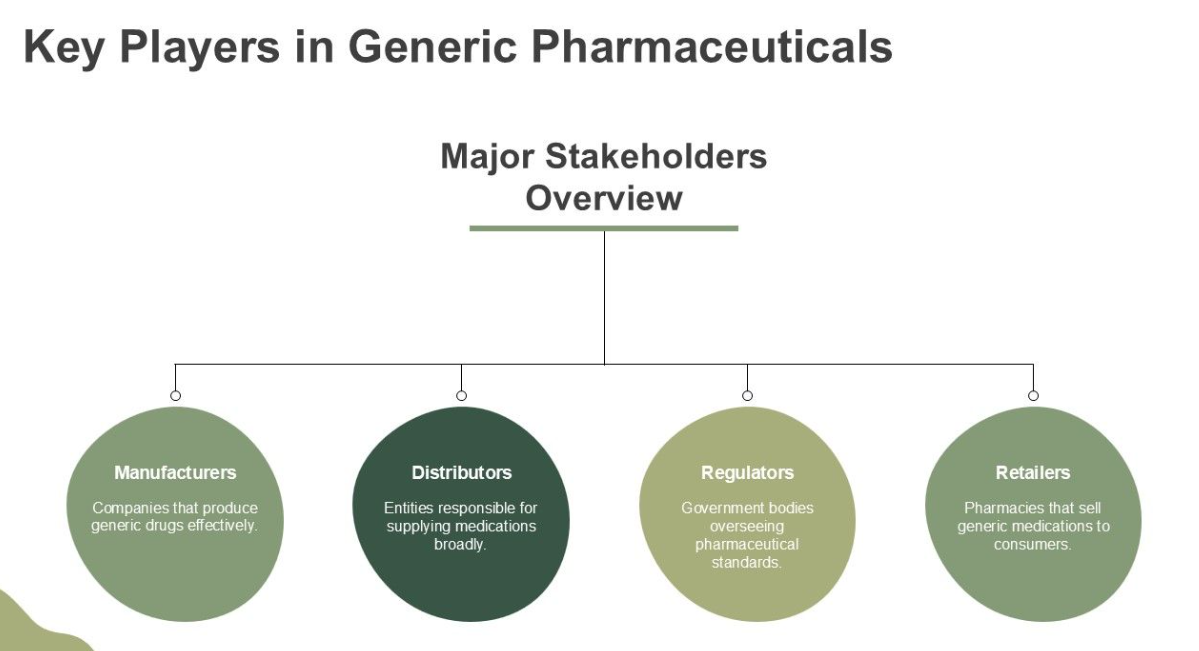
Template 7: Key Players in Generic Pharmaceuticals
SlideTeam has crafted this interactive layout to present the duties of key players in the development of a generic drug. Manufacturers, distributors, regulators, and retailers are major players spotlighted in this PPT Slide.
Manufacturers play a significant role in the production of bioequivalent medications. Their role involves proving that their products are equivalent to brand-name drugs in terms of purity and quality. Besides managing the quality of products, they also manage the Pharmaceutical supply chain. Like them, regulators manage the approval process. They also track manufacturing and distribution processes. Use dedicated sections to articulate the role and responsibilities of each player clearly.
Template 8: Formulation Development Strategies
Industry specialists perceive the increasing pressure to develop drug formulations faster and more cost-effectively. SlideTeam strategists understand that this push is critical for achieving a competitive advantage, and they have provided proven strategies to excel in this "make-or-break moment" in this PPT theme. This resource presents a tabular structure focusing on process efficiency, reducing time-to-market, compliance, and market access. Together, these strategies help businesses mitigate the risks associated with the drug development process and prevent costly late-stage failures.
Claim this resource and build medications that support patient-centric design.

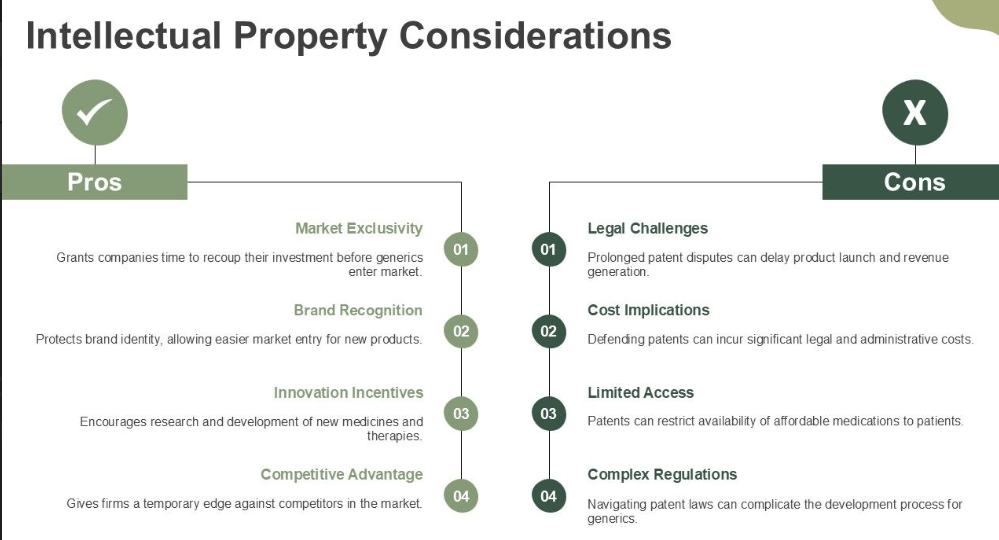
Template 9: Intellectual Property Considerations
SlideTeam introduces this tool to guide organizations about intellectual rights in the pharmaceutical industry. Intellectual property (IP) helps protect formulations through trade secrets and patents. Using this PPT Slide, you can clearly exhibit the benefits and downsides of intellectual property in new drug formulation. On the positive side, intellectual property in drug development fosters innovation and supports economic growth. On the other hand, it involves high risks and expensive legal processes. Download it using the link below to provide a transparent view of intellectual property.
Template 10: Sustainability in Pharmaceutical Development
SlideTeam curates this PPT Theme to enhance pharmaceutical manufacturing practices and minimize environmental impact. It emphasizes implementing approaches that generate less wastage, prevent pollution and emissions, increase recycling and sustainable sourcing, and others. Carbon footprint reduction became a top priority in the pharmaceutical industry, ensuring firms are well-prepared for regulatory shifts. Firms that plan to adopt green practices can use this resource to maximize their position in the competitive landscape.

Final Words
Today, pharmaceutical product development stands at a point of significant transformation. Artificial intelligence and computational methods have significantly enhanced the efficiency and speed of the drug development process. Pharmaceutical companies are also mandated to adopt green initiatives that significantly reduce their environmental impact.
Pharmaceutical innovation brings tailored treatments to patients’ specific needs.
The path ahead is clear; if pharmaceutical companies need to lead the competition, they must invest in green manufacturing practices and innovative tools. SlideTeam’s Pharmaceutical Product Development PPT Templates can help you adapt to technical and regulatory changes efficiently.
Download these templates to file your patent before your competitors do.
P.S.: Refer to this guide on pharmaceutical product launch plans to test the market demand and assess the needs for new medicines.
FAQs on Pharmaceutical Research & Innovation
Q1. What are the key stages involved in pharmaceutical product development from discovery to market launch?
SlideTeam has introduced a concise and practical pharmaceutical product development process and templates that comprise five main phases, including:
- Discovery and Development (Research)
- Preclinical Research
- Clinical Research
- FDA Review (Approval)
- Post-Market Drug Safety Monitoring (Post-Market Surveillance)
Q2. How do regulatory requirements impact the pharmaceutical product development process?
Regulatory focus is critical in drug development to ensure new drugs meet the same standards in terms of safety and quality as brand-name drugs. Following good manufacturing practices, as designed by the FDA and EMA, fosters innovation while ensuring public trust. It helps businesses meet stringent safety and efficacy standards.
Q3. What role does clinical trial design play in successful pharmaceutical product development?
The core purpose of clinical trial design is to ensure the safety and efficacy of new products. Using SlideTeam’s well-organized and tactical clinical trial design template, clinical research organizations can conduct research at a broader level, define key metrics to measure outcomes, and select the proper techniques to assemble reliable evidence, thereby improving the likelihood of FDA approval.