

 0 Comment
 Customer Reviews

When you are in the business, quality is the game. If a business can deliver high-quality products or services consistently, it establishes itself as a brand. Over time, consistent quality becomes the synonym of that brand. Customers use such brands as a milestone when comparing products or services from other brands. That's how
customers connect with the brand and become the brand ambassadors themselves.
The best example is Apple. This brand built its formidable reputation in the market based on sheer quality. We all know Apple products are all about design, performance, and amazing user experience. Today, Apple's iPhone has become a milestone for comparison with any other smartphone brand. When you command such authority in the market, you are the one who decides the pricing, the sales, and the profit margin. And the best part? Customer loyalty comes as an additional bonus!
What Happens When Brands Fail to Adhere to Quality?
Now, there have been instances where reputed brands have failed due to poor quality products or services. A well-known example of this is Lululemon Athletica. Once a leading brand in athletic apparel, this brand lost all its sheen and feel on its face. The company faced severe criticism in 2013. The company lost its reputation and stock prices tanked.
But how can brands ensure the best quality? Well, that's where our templates come in.
We have crafted multiple quality improvement strategy templates that can help companies create a performance enhancement plan. Each template is 100% editable and content-ready. So, let's take a look at them one by one.
Template 1: Strategic Sourcing and Vendor Quality Enhancement Plan PowerPoint Presentation Slides
Tired of slow sourcing and poor quality from your vendors? This deck is here to help! It helps you create a quality assurance framework where you can test your vendor’s performance. With this template in your hands, you can spot problems early and create a powerful performance enhancement plan that fixes them. The template lets you track real-time data and plan training and budgets for site visits. Result? You can improve your vendor's accountability and enhance the quality of products or services you are paying for. The template is perfect for supply chain managers, operation leads, and procurement heads. If improving the vendor's service is your end goal, this continuous quality improvement template will prove its worth.
[product_image id=645047]
Template 2: Performance Analysis of Business Suppliers
There is nothing better than a quick visual guide that gives you a brief overview of a business supplier's performance. This template does exactly that. It showcases all the important numbers like sourcing time, return rates, availability, and more on a single page. It's got a pie chart, bar graphs, and other visuals to put every piece of information in one place. Want an update on a particular segment? You won't have to dig through those boring reports. This template will give you visual information right away. You can use this template to review your business suppliers. If you are a procurement manager or a supply lead, this template was custom-built for you!

Template 3: Major Supplier Issues Faced By Company
Is your supply chain constantly missing the mark? This template can help you identify the problem. It gives a clear idea about the top 5 vendor-related issues. These issues include delays, low quality, poor communication, short-term deals, and lack of innovation. You get everything in a single, clean visual. With this template on hand, you can explain to your leadership what's causing the problem and devise a plan that actually works. You can steer the conversation during review meetings toward practical solutions and continuous quality improvement.

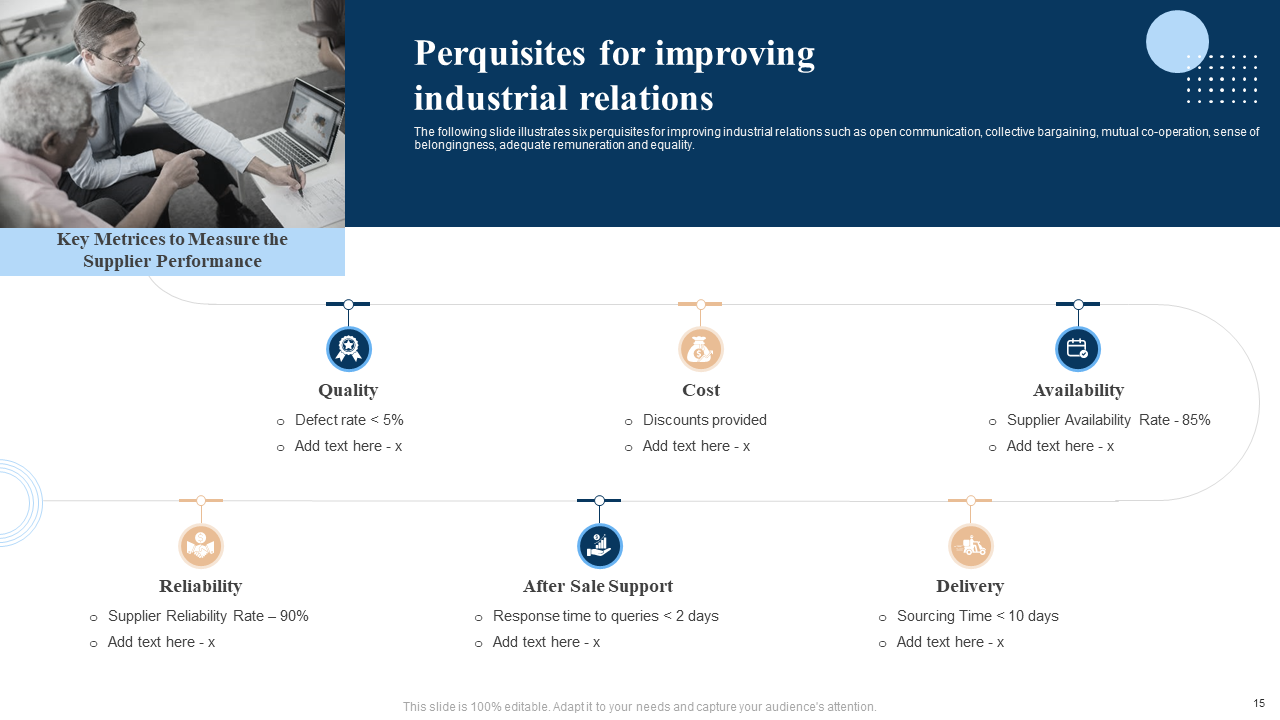
Template 4: Prerequisites for Improving Industrial Relations
When you are in the business, your suppliers' performance should meet specific standards. This template helps you devise and showcase these standards to your team and suppliers alike. The template explains the six most important metrics of a supplier: quality, cost, availability, reliability, after-sale support, and delivery. This visual template helps your supplies understand what you expect from them. With such clear communication, you can cut delays and improve services. When everyone knows the score, relationships improve, and performance follows. This template can be very useful for procurement heads and plant managers. Download this template and bring your suppliers in line with your exact requirements.
Template 5: Impact of Supplier Development Program on Business
Want to convince your leadership of a supplier development program? This template can help you with that. You can showcase the real impact of such programs with it. When an organization trains its suppliers, the organization can expect fewer complaints, faster sourcing, and better quality assurance. The template showcases the long-term impact, competitive advantage, and innovation. It also covers important elements like reduction in quality issues and improvement in supplier's performance. Each section here has ample space to add important talking points and notes. It's a perfect pick for supplier managers and operation leads. This template turns improvements into business wins everyone can see.

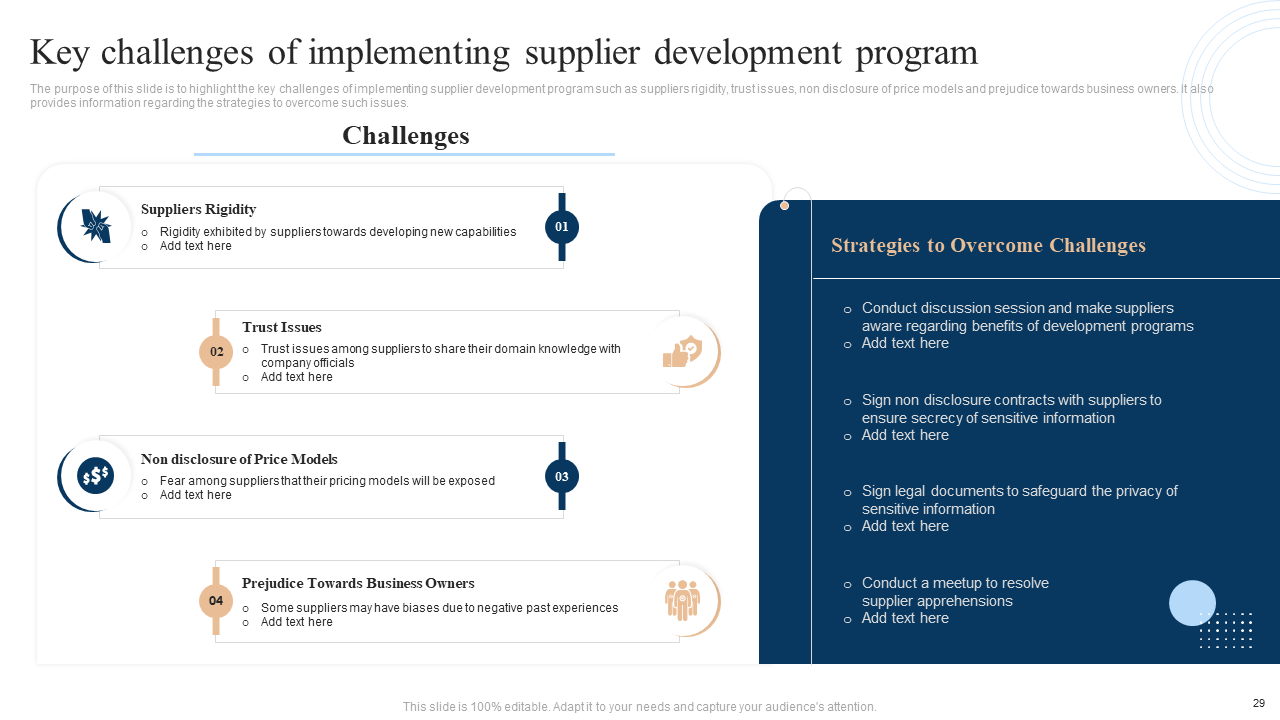
Template 6: Key Challenges of Implementing Supplier Development Program
People don't like change. So, when an organization plans for a supplier development program, it will face certain challenges. This template helps organizations take care of this friction. The template talks about supplier rigidity, trust gaps, and pricing secrecy (which is a major concern for the suppliers). Then, it also talks about bias. The best part? The template gives enough space to list out strategies to tackle these issues. So, with this template, you can work on both problems and solutions. This template is very useful for procurement teams and vendor managers. They can use this slide when they are planning a new initiative to train the suppliers.
Template 7: KPI Dashboard for Supplier Monitoring
Want a simple solution to monitor your supplies? This template can prove very useful. It pulls all your important metrics like purchase value, audit status, complaints, and more into a single view. You and your team won't have to switch between heaps of reports for the same. It also helps identify defect rates and delivery delays. You can track trends, spot red flags, and ensure they are meeting accreditation standards. If you are a supply chain head and procurement team lead, this template can help with your strategic planning for better supplier monitoring. Just plug in your data, and it instantly becomes a performance scorecard.

Template 8: Budget for Business Supplier Training
Supplier training programs begin with accurate budgeting. And this template is here to make sure there are no goof-ups! It explains where exactly every dollar your organization spends on supplier training goes. It divides the entire training cost into sections like trainer fees, learning platform, hardware, and more. So, if you are pitching an academic quality plan for suppliers via outcome-based education, this template can help you out. Your finance teams and leadership will get a clear idea of where and why they will be spending the allocated budget. This template cuts the efforts to design a training budget, saves time, and improves institutional effectiveness.

Template 9: Supplier Site Visit Plan for Manufacturing Firm Employees
When your suppliers visit your site or plant regularly, they understand how they should optimize their supply chain. Such visits help them create a performance enhancement plan. This template can help organizations map out such visits. You can use it to schedule visits and agendas and decide who will be visiting and when. This template divides the entire year's visit into 4 quarters, along with the other necessary information. It also has ample space at the bottom where you can add a visit agenda and visit overview. This template can be very useful for stakeholder engagement and improved supply chain management.

Template 10: Communication Strategy to Enhance Supplier Knowledge
This slide gives you a ready-to-use framework to manage supplier communication without things slipping through the cracks. It lays out what needs to be shared, who’s responsible, who should receive it, how to send it, and how often. Whether it's announcing a new product, updating procurement policies, or addressing part defects, everything is structured for smooth execution. It’s especially helpful for procurement leads, operations heads, or corporate comms teams working with multiple suppliers. Instead of chasing updates or relying on scattered emails, use this plan to build consistent, traceable communication with your vendor network

Wrapping Up
Quality is the sole thing that keeps a brand at the top spot. Whether you are selling a product or offering a service, quality is the key. And to deliver quality, you need reliable vendors. We hope these templates help you identify problems within your supply chain and train your vendors. The better quality you get from your vendors, the better quality you can supply to your consumers. Pick any of the above-mentioned templates and start improving your supply chain with proper assessment and evaluation.
FAQs:
1. Why is a QEP important?
It helps improve product or service quality, reduce errors, and boost customer satisfaction.
2. Who creates the QEP?
Quality managers, process improvement leads, or cross-functional teams create it.
3. How is the QEP used?
Teams use it to identify quality gaps, set improvement goals, and track results through planned actions.