





 0 Comment
 Customer Reviews

The machine stopped working Tuesday. Still down.
Not broken exactly—diagnostics show green, components test fine, everything that should work does work. But somewhere between the last successful run and now, something shifted. And nobody can point to what.
The meeting's already scheduled. Root Cause analysis. Which sounds official until you're staring at a room of people who all saw unique pieces of the same failure. Operations says it ran normal. Maintenance says nothing looked wrong. Engineering says the specs were right.
Someone's going to ask the question: so what actually happened? And the silence that follows isn't because nobody knows anything. It's because everyone knows something, and none of it connects.
The real problem isn't finding the Root Cause. Most failures leave breadcrumbs. The problem is proving it. Building a case that doesn't fall apart when someone asks "but why didn't we catch this?" or "what if it happens again?"
You can't just say the pump failed. You have to show the Failure Mode, why the backup didn't kick in, why the alarm didn't sound, why nobody noticed until production stopped. And then—this is the part that keeps people up—you have to convince everyone this won't repeat.
The wrong presentation turns analysis into blame. Makes careful investigation look like guesswork. One gap in your logic and suddenly you're defending the whole process instead of implementing proper Corrective Action.
SlideTeam's Root Cause analysis templates exist because this exact situation plays out everywhere. Pre-built frameworks that let you structure what you found without having to invent how to present it. Ready-made slides for when you need to sound systematic, not sorry.
Here are the templates that work when failure needs explanation, not excuses.
Template 1: Root Cause Analysis Strategies for Resolving Equipment Failures PPT
These href='https://www.slideteam.net/blog/top-20-root-cause-analysis-templates'>Root Cause Analysis frameworks deliver when needed. This pre-built PPT template delivers proven Failure Mode and Effects Analysis (FMEA) tables, 5 Whys methodology, failure trend analytics, effectiveness dashboards, and Corrective Action planning workflows. Operations managers, quality teams, and maintenance professionals value these customizable PPTs for equipment failure diagnosis and systematic improvement initiatives. Download now.
[product_image id=1454941]
Template 2: Root Cause Analysis of Automotive Equipment Failures
This customizable PPT preset delivers actionable flowcharts, Failure Mode and Effects Analysis (FMEA) and the 5 Whys frameworks. The other topics covered are fishbone diagrams, and Gantt chart templates for systematic Root Cause investigations. Manufacturing managers, quality engineers, and maintenance teams use this PowerPoint slides for failure analysis reporting. Team training and cross-functional problem-solving sessions are also covered with structured Corrective Action planning. Download now.
[product_image id=1543966]
Template 3: Root Cause Failure Analysis Techniques
This pre-built PPT template is of great use, when problems keep recurring despite your best firefighting efforts. This PowerPoint slide collection delivers proven Root Cause analysis tools. It also showcases fishbone diagrams, 5 Whys methodology, Pareto charts and Fault Tree Analysis (FTA) frameworks. Operations managers, quality teams, and consultants can customize these actionable PPT presets for incident reviews, Corrective Action initiatives, and client troubleshooting presentations. Download now.
[product_image id=1391413]
Template 4: Root Cause and Failure Mode Analysis
Use this PPT template to deliver Root Cause analysis, Failure Mode matrices, SWOT frameworks, stakeholder maps, and KPI dashboards. There are also strategic roadmaps for systematic problem solving and corrective action planning. Operations managers, consultants, and project teams can customize these PowerPoint slides for performance reviews. Client presentations and strategic planning sessions are also the perfect place to showcase these. The presets eliminate template hunting while providing structured frameworks for stakeholder communication. Download this template to streamline your risk analysis presentations.
[product_image id=1681359]
Template 5: Root Cause Analysis in Equipment Failures
You need actionable Root Cause analysis when equipment fails. Deliver proven fishbone diagrams, 5 Whys flowcharts, and failure data dashboards that operations managers deploy. These templates are the first-choice for maintenance teams and reliability engineers. The customizable framework transforms chaotic downtime into systematic problem-solving. Master Failure Mode and Effects Analysis (FMEA) and Preventive Maintenance solutions with this slide. Download this practical PowerPoint slide for equipment failure analysis today.
[product_image id=1607298]
Template 6: Root Cause Analysis for Audit Failures
This comprehensive template transforms complex audit failure investigations into systematic, actionable insights. The integrated dashboard delivers real time KPI monitoring while fishbone diagrams and 5 Whys methodology guide you through structured Root Cause identification. Comparative analysis frameworks reveal patterns across multiple audit scenarios, while Gantt charts streamline Corrective Action planning and execution. Trend analysis capabilities enable proactive risk management and continuous improvement tracking. Every component utilizes fully editable PowerPoint elements, ensuring seamless customization to match your organization's audit protocols and reporting standards. Perfect for creating thorough audit improvement presentations, compliance reviews, and systematic Failure Investigation Report. Transform your audit investigation presentations today. Download this comprehensive template now and unlock systematic audit excellence.
[product_image id=1674002]
Template 7: Root Cause Analysis: Identifying and Correcting Process Failures
This comprehensive template empowers you to identify and eliminate process failures through proven analytical frameworks. Dynamic KPI dashboards on the PPT provide real-time monitoring capabilities. With advanced Gantt chart integration and Failure Mode and Effects Analysis (FMEA) tools, this tool is a compelling Root Cause Analysis presentation. The aim is to enhance accountability and measurable process improvements. Download this systematic template now and unlock your analytical excellence.
[product_image id=1553678]
Template 8: Failure Analysis Services for Root Cause Identification
Quality teams need this pre-built PowerPoint slide for systematic failure analysis. The slide is needed across containment, surface, polymers, and sensitizer categories, because Root Cause identification shouldn't require reinventing classification frameworks. The customizable PPT template enables managers and quality engineers to categorize Failure Mechanism and drive actionable Corrective Action. Download now for streamlined problem solving.

Download this PowerPoint Template
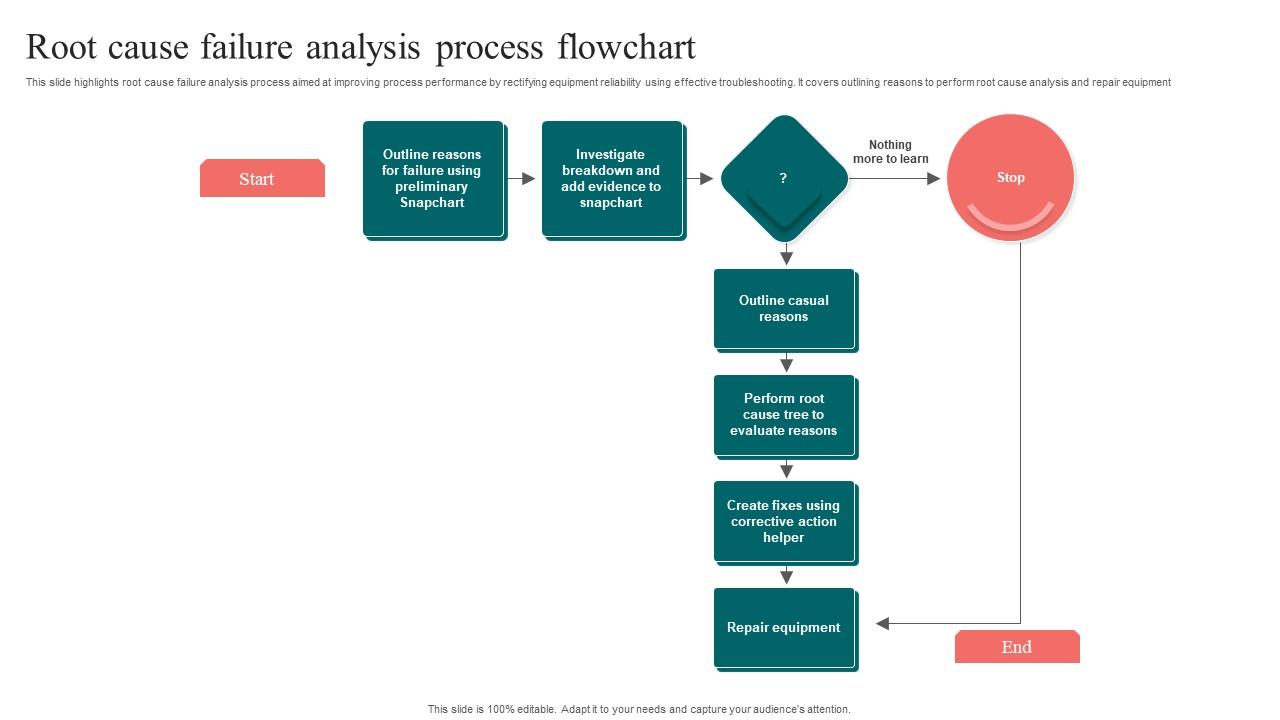
Template 9: Root Cause Failure Analysis Process Flowchart
Use this PowerPoint slide to guide maintenance teams. It is the perfect fit for operations managers and project consultants to carry out a systematic failure investigation. It covers initial problem identification to Corrective Action implementation. The customizable PPT template streamlines troubleshooting workflows across manufacturing, IT, and service environments. Equipment failures cost real money and these pre-built processes eliminate guesswork during critical downtime situations. Download this proven flowchart template for immediate use.
Template 10: Root Cause Failure Analysis Process in Product Manufacturing
You need actionable root cause analysis when manufacturing fails. This PPT template guides quality managers and production teams through systematic Root Cause investigation. The scope covers incident triggers to Corrective Action implementation. The customizable PowerPoint slides deliver structured problem-solving for manufacturing presentations and performance reviews. Strategic planning sessions make this work. Download this pre-designed template for results-driven quality improvement.

Failure Insights Spotlight Path to Success
SlideTeam's PowerPoint templates are the industry's finest for Root Cause failure analysis presentations. These content-ready slides provide frameworks that streamline your investigative process while ensuring comprehensive documentation of findings. Our custom-made templates feature proven methodologies, such as fishbone diagrams and 5-Why analysis tools for identifying Failure Mode patterns. Deploy these professional slides to accelerate problem-solving and drive operational excellence.
FAQs on root cause failure analysis
How do you define the failure mode before beginning analysis?
Define what went wrong first. Document the specific symptom or breakdown you observed. Ask three questions: What failed? When did it fail? How did the failure show itself? Write down the exact conditions when the problem occurred, including the specific Failure Mode that was observed. This creates your starting point for digging deeper into Root Cause analysis.
What data must be collected to accurately determine the failure cause?
Collect physical evidence from the failed component or system first. Document the operating conditions when failure occurred - temperature, pressure, load levels, and timing. Gather maintenance records showing previous repairs, inspections, and part replacements. Interview operators who witnessed the failure about what they observed before, during, and after the event to determine the Root Cause and prepare a comprehensive Failure Investigation Report.
How do physical inspections support RCFA?
Physical inspections reveal actual failure evidence that confirms or refutes initial theories. They expose patterns of wear and tear, crack locations, and material degradation that Condition Monitoring data alone cannot show. Focus on three areas: failed components themselves, adjacent parts for secondary damage, and operating environment conditions. Immediately record findings with photos and measurements. This direct evidence guides you toward the true Root Cause rather than assumptions based on symptoms or reports.


