




 0 Comment
 Customer Reviews

The name's already chosen. Someone decided it three months ago in a conference room.
Now it's your job to explain why it works. Why this word, this sound, this spelling. Why it'll hold up legally, culturally, competitively. Why customers will remember it, say it, trust it.
That's the part nobody prepares for. The decision gets made—sometimes carefully, sometimes not—and then someone has to build the case. Present the rationale. Walk a room full of skeptical stakeholders through why "Acme" or "Lumio" or whatever the founder loved at 11pm is actually the right call.
Brand naming isn't just a creative exercise. It's a legal question, a cultural question, a memory question. It's asking whether a string of letters will survive contact with real customers in real markets. Whether it'll clear trademark. Whether it sounds wrong in Portuguese. Whether a seven-year-old can spell it after hearing it once.
Most people don't realize how many things have to be true simultaneously for a name to work. It has to be distinctive without being weird. Short enough to stick. Wide enough to grow into. Clear enough to communicate something—but not so literal it traps the brand in one product category forever.
And then someone asks for a deck by Thursday.
That's where the real discomfort lives. Not in the naming itself, but in the presenting of it. Having to defend a name—or a shortlist of names—in front of people who all have opinions, none of whom agree, all of whom will ask "but what does it mean?" Brand naming frameworks exist because this problem is genuinely hard and companies keep running into it the same way.
SlideTeam's brand naming templates handle exactly this—the structure that turns a naming rationale into something a room can actually engage with. Pre-designed slides that cover evaluation criteria, cultural considerations, legal factors, architecture decisions, and more.
Here's what's available.
Template 1: Adapting Brand Naming Strategies to Cultural Differences PPT
Cultural mismatches in brand naming can quietly kill market entry. This deck makes cross-cultural naming analysis clear and credible for any audience. Striking visuals capture attention and hold it through complex regional comparisons. You can align every color scheme and element with your existing brand identity development guidelines. Structured layouts let you present multiple cultural contexts side by side with ease. Audience engagement stays high because the design does the heavy lifting. Use this to build compelling market-readiness arguments across diverse geographies. Transform your cross-cultural brand naming presentations today. Download this dynamic deck now and unlock confident, culturally aware brand storytelling.
[product_image id=1464737]
Template 2: Navigating Legal Considerations in Brand Naming Strategies
Legal risk is one of the most overlooked steps in the trademark selection process. This PPT template gives legal and brand teams a clear structure for presenting naming compliance reviews. Whether you're walking counsel through protectability criteria or briefing leadership on registration risks, this deck fits the conversation. It covers the ground between creative naming choices and real-world legal exposure — concisely and credibly. Check out SlideTeam's guide to brand naming strategies PPT templates for more resources on building legally sound naming presentations. The template is 100% editable and customizable.
[product_image id=1444371]
Template 3: Essential Brand Naming Criteria for Success PPT Guidelines
Brand name evaluation criteria rarely look clear on paper—until you have the right structure. This deck captures every dimension that matters: memorability, distinctiveness, cultural fit, and protectability. Bold visual hierarchy guides stakeholders through each criterion without losing them in complexity. You get a polished framework that positions you as methodical and thorough in every naming review. The pre-built layouts let you move fast while the content stays rigorous. Present brand name evaluation with the clarity that earns confidence and fast sign-off. Transform your brand naming criteria presentations today. Download this deck now and unlock a sharper, more persuasive naming review process.
[product_image id=1854756]
Template 4: Brand Naming Criteria Evaluation Sheet Rebranding
Naming decisions get stuck when there's no shared rubric in the room. This slide anchors group review with a structured evaluation sheet covering memorability, protectability, and registrability. Clear parameter rows let stakeholders compare candidate names side by side, objectively. You move discussions away from gut feel and toward documented, defensible criteria. Every column drives a specific question that filters weak names fast. This is the tool that turns naming debates into naming decisions. Transform your brand naming evaluation presentations today. Download this dynamic template now and unlock a structured path to confident brand name selection.

Download this PowerPoint Template
Template 5: Brand Naming Criteria Evaluation Sheet as Great Tool
Getting internal alignment on a brand name requires more than a shortlist—it requires a shared evaluation lens. This slide delivers a scoring framework built around memorability, protectability, and registrability in one clean layout. Stakeholders can engage with concrete parameters instead of subjective preferences, accelerating consensus. The structured grid makes every naming candidate easy to compare, challenge, and validate. Use it during rebranding workshops or new product naming reviews. It turns a messy conversation into a trackable, repeatable process. Transform your brand name evaluation presentations today. Download this essential template now and unlock faster, more confident naming decisions.

Download this PowerPoint Template
Template 6: Brand Strategy Showing Brand Discovery Workshop Brand Platform and Naming
Brand strategy work rarely fits on one slide — but the discovery-to-naming arc usually needs to. This PPT preset maps a seven-stage process from brand discovery workshop through platform definition to final naming. It gives brand consultants and in-house teams a clear visual spine for client presentations. Use it when you need to show how strategic inputs connect to creative naming outputs. The template is 100% editable and customizable.

Download this PowerPoint Template
Template 6: Brand Naming Criteria Evaluation Sheet for Busines Success
Rebranding reviews need a clear evaluation structure to move forward without second-guessing. This slide anchors those conversations with a scoring sheet built around core naming criteria — memorability, protectability, and registrability. Brand managers use it to run structured assessments of candidate names during rebranding exercises. It separates subjective preference from documented criteria fast. The template is 100% editable and customizable.

Download this PowerPoint Template
Template 8: Brand Naming Criteria Evaluation Sheet How to Rebrand without Losing Potential Audience
Rebranding without alienating an existing audience is a real operational risk, not just a creative one. This PPT template structures that challenge with a naming evaluation sheet that flags international viability and protectability alongside core memorability criteria. Brand teams use it to present candidate names with documented rationale — not just instinct. It makes the case for a new name while showing due diligence on audience retention. The template is 100% editable and customizable.

Download this PowerPoint Template
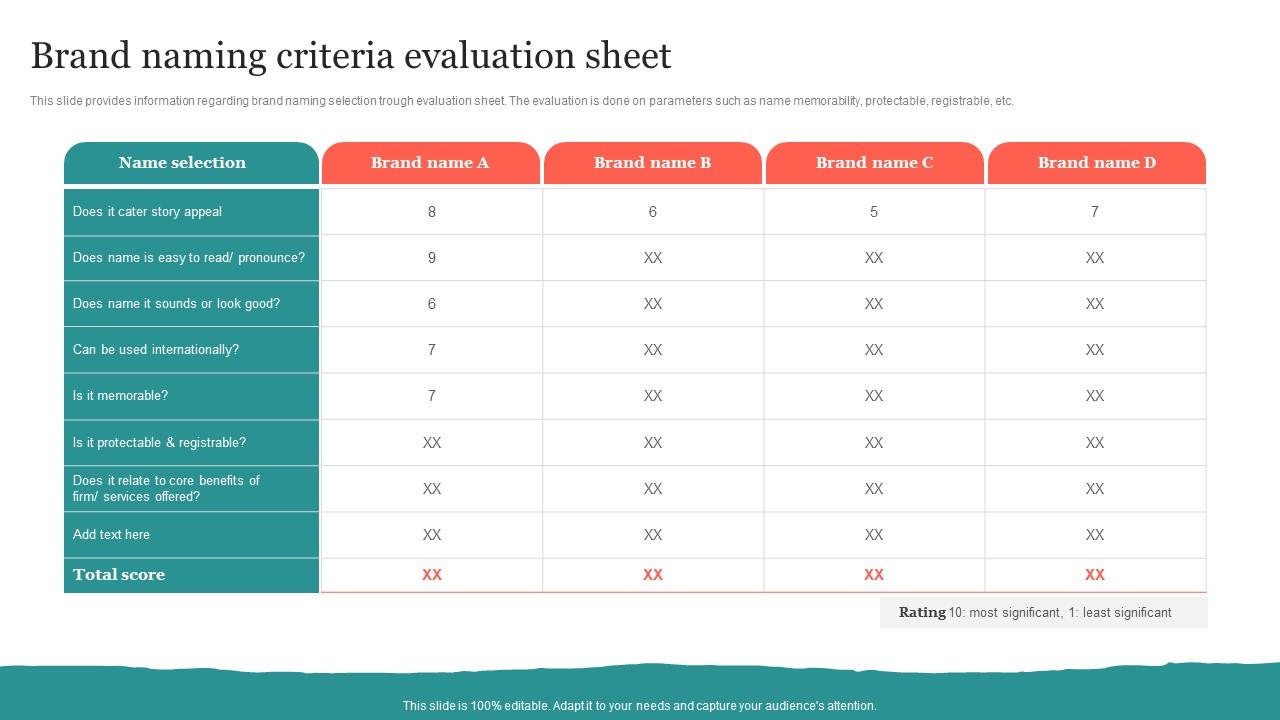
Template 9: Brand Naming Criteria Evaluation Sheet Comprehensive PPT
Naming evaluation works best when every parameter is visible at once. This slide surfaces the full criteria set — international viability, services alignment, protectability, and registrability — in one structured view. Brand managers and consultants reach for this PPT when presenting shortlist reviews to leadership. It keeps discussion grounded in specifics rather than drifting into preference debates. The template is 100% editable and customizable.
Download this PowerPoint Template
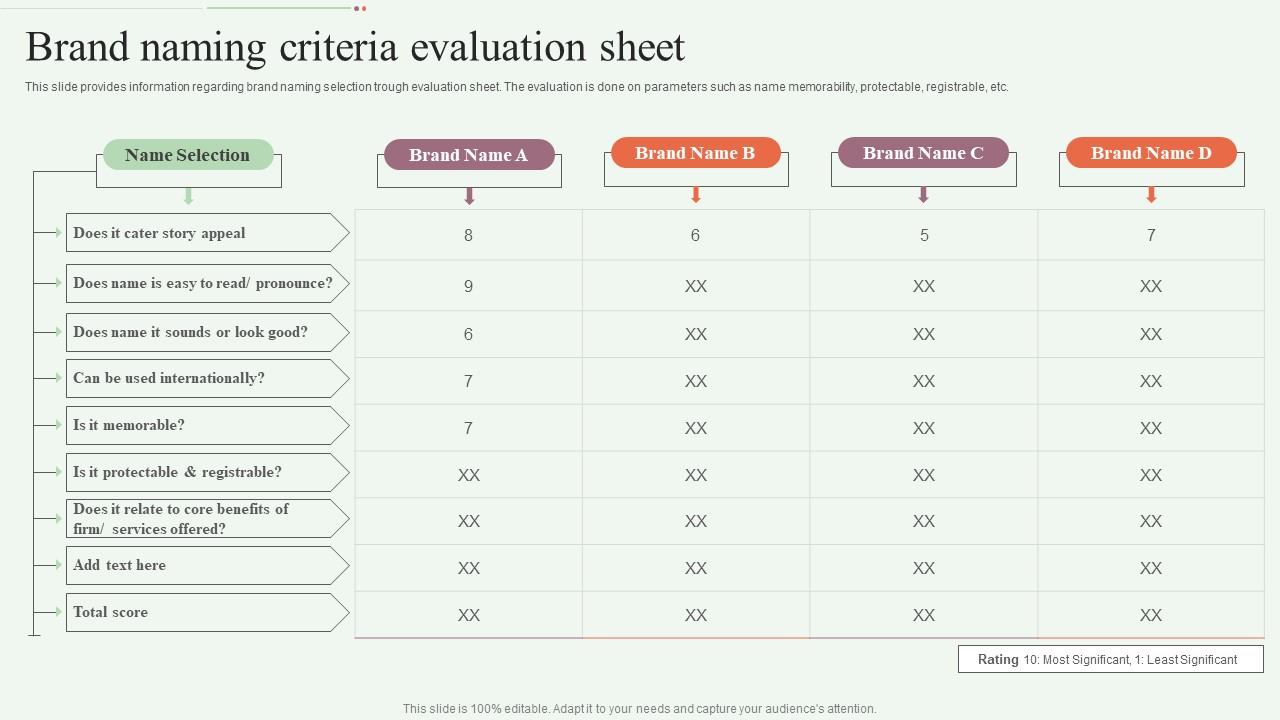
Template 10: Brand Naming Criteria Evaluation Sheet Approach for Rebranding
A step-by-step rebranding process only holds up when the naming evaluation is rigorous. This slide integrates a structured criteria sheet—covering international viability, pronounceability, and protectability—into a wider rebranding workflow. Brand leads use it to show exactly where naming fits in the broader process and how each candidate gets assessed. It's the kind of slide that makes a rebranding recommendation look earned. Transform your rebranding process presentations today. Download this dynamic template now and unlock a clear, defensible path from brand audit to final name selection.
Download this PowerPoint Template
Template 11: Company Strategies for Extending Brand Name Using Extension Strategy
Brand extension decisions carry real financial weight — licensing terms, market scope, and budget alignment all need to be visible together. This PPT preset maps five key extension approaches, including private label, product line expansion, and new market entry, in one clear framework. Business development leads and brand managers use it to present extension options with cost and ROI context intact. It keeps strategic options concrete rather than abstract. The template is 100% editable and customizable.

Download this PowerPoint Template
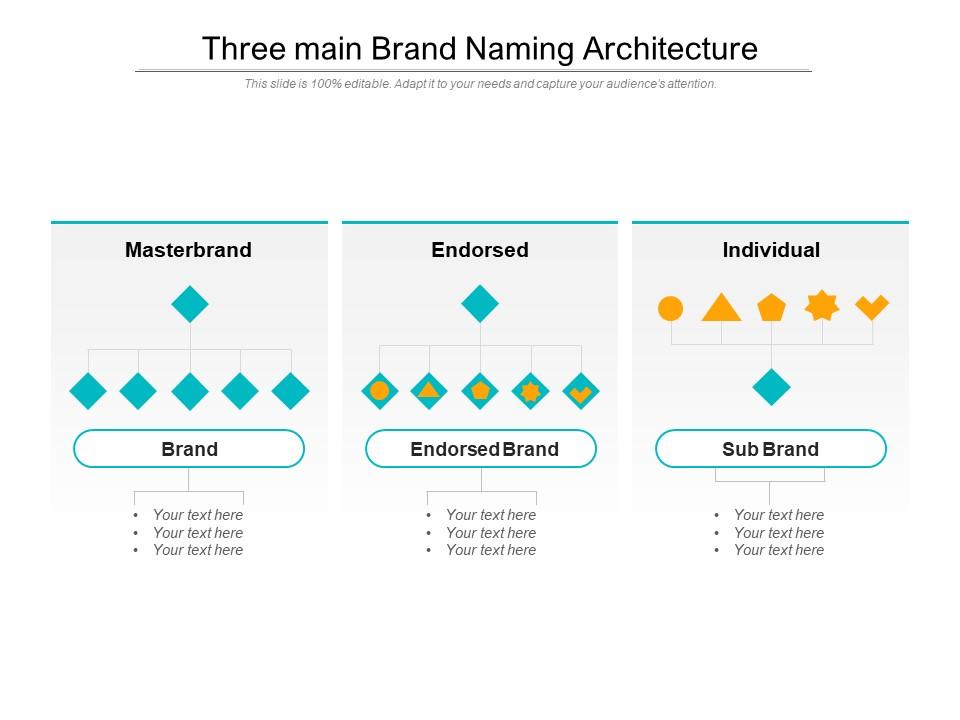
Template 12: Three Main Brand-Naming Architecture
Brand architecture decisions are easier to make when the three core models — masterbrand, endorsed brand, and individual brand — are laid out side by side. This PPT preset does exactly that in a three-stage visual structure. Brand strategists and CMOs use it to align leadership teams on which architecture fits the portfolio before naming work begins. It grounds a usually abstract conversation in a clear, visual framework. The template is 100% editable and customizable.
Download this PowerPoint Template
Template 13: A&F Co. Brief Introduction of Brands
Understanding how established multi-brand portfolios are structured helps sharpen your own brand naming and positioning decisions. This PPT slide draws on Abercrombie & Fitch Co.'s 2018 brand portfolio as a real-world reference point. Brand analysts and strategists reach for it when competitive brand analysis needs a concrete anchor. So, it works well in brand identity development sessions where benchmarking against known portfolios builds credibility. The template is 100% editable and customizable.

Download this PowerPoint Template
Template 14: Approachable Methods for Making Branding Decisions
Branding decisions aren't just business choices — they're cognitive ones. This PPT preset frames the customer decision path through three models: cognitive, experiential, and repeat purchase. It covers problem recognition, information search, choice evaluation, and buying decision in sequence. Brand strategists use it to connect naming and positioning choices to actual consumer behavior. It bridges the gap between brand naming psychology and measurable audience response. The template is 100% editable and customizable.
[product_image id=1155322]
Template 15: Brand Naming Strategy PPT Model Portfolio
Four-stage visual frameworks help brand teams present naming logic without losing the room. This PPT preset structures the brand naming strategy conversation across four clearly defined phases. Brand consultants and startup teams use it to walk stakeholders through a naming rationale with graphic clarity. It keeps complex creative reasoning grounded and easy to follow. The template is 100% editable and customizable.

Download this PowerPoint Template
Master Brand Naming Strategies with SlideTeam
SlideTeam's PowerPoint templates are the best in the industry for brand naming strategies. These content-ready slides cover every critical dimension — from trademark evaluation to cultural sensitivity — saving hours of build time without sacrificing professional quality. Use these ready-made frameworks to present naming rationale, evaluation criteria, and brand architecture decisions with clarity and confidence. Deploy these PowerPoint slides to drive faster stakeholder alignment and stronger brand equity building from day one.
FAQs on Brand Naming Strategies
What are the key differences between descriptive and invented brand names, and how does each impact consumer recall?
Descriptive names tell customers exactly what a business does — think General Motors or Facebook. They aid immediate understanding but are harder to protect legally. Invented names, like Kodak or Xerox, carry no prior meaning but earn strong recall through repeated exposure. Invented names tend to win on memorability over time because the brand owns the word entirely. Descriptive names require less education but offer less differentiation.
How does linguistic phonetics influence the memorability and emotional resonance of a brand name?
Hard consonants — K, T, B — create a perception of strength and precision. Soft sounds — L, M, S — register as warm and approachable. Short words with open vowels are easier to recall across languages. Research consistently shows that names matching the product's emotional tone perform better on trust and preference measures. Sound is not decoration — it shapes the first impression before meaning does.
What role does cultural sensitivity play when developing brand names for global markets?
A name that works in one market can carry unintended meanings in another. Cultural sensitivity means checking for negative connotations, religious associations, and phonetic clashes in each target language. Global brands routinely run names through native-speaker panels before launch. Skipping this step has caused real commercial damage — Chevrolet's Nova famously read as 'won't go' in Spanish markets. Test early, test locally.
How can a brand name effectively communicate a company's value proposition without being overly literal?
The best names suggest a benefit without spelling it out. Apple implies simplicity and accessibility without saying either word. The key is to anchor the name in a feeling or outcome, not a feature. Metaphor and association do this better than description. Pick a word that lives adjacent to your value proposition — close enough to resonate, open enough to let the brand grow beyond one product.
What are the trademark implications of choosing generic versus coined brand names?
Generic names — words already in common use — are nearly impossible to trademark. Courts won't grant exclusive rights to a word everyone needs. Coined names, invented from scratch, carry the strongest trademark protection because no one else has a prior claim. The trade-off: generic names are immediately understood; coined names require more marketing investment to build meaning. For long-term brand equity, coined names win on protectability.
How do successful brands balance brevity with meaningful communication in their naming strategy?
The most durable brand names are short — one or two syllables — but carry layered meaning. Nike references the Greek goddess of victory in four letters. Amazon signals scale and diversity in three. The discipline is in cutting every syllable that doesn't earn its place. A name should communicate a feeling, a category signal, or a promise — and stop there. Brevity without meaning is just a sound.
What psychological principles underpin the effectiveness of alliterative brand names?
Alliteration works because repeated initial sounds are easier for working memory to encode and retrieve. Coca-Cola, Krispy Kreme, and PayPal all exploit this. The rhythm also creates a mild pleasure response, which builds positive brand association over time. Practically, alliterative names tend to dominate word-of-mouth because they're easier to say. The risk is sounding gimmicky — alliteration should feel natural, not forced.
How does a brand name influence the perceived positioning of a product in a competitive market?
A brand name sets the first expectation before any product interaction occurs. Premium-sounding names — often Latinate or invented — signal quality and exclusivity. Accessible, everyday words signal approachability and value. Competitors in the same category often cluster around similar naming conventions, which is why breaking the pattern can create instant differentiation. Your name is a positioning statement — it tells customers where you sit before they read a single line of copy.