

 0 Comment
 Customer Reviews

The document exists. It's been sitting in the shared drive for two weeks.
Someone mapped out the patient flow. Someone else annotated the EHR handoffs. A third person added color-coded boxes for triage, discharge, and everything in between. All of it is there—accurate, thorough, probably correct.
And yet nobody's touched it since the last meeting.
Not because it's wrong. It's probably fine. But there's a specific discomfort that comes after the analysis is done, when someone has to stand up and actually present it. When the flowchart needs to make sense to a department head who wasn't in the room, or a hospital board that doesn't read process maps for fun.
Clinical workflow analysis isn't the hard part. The hard part is making what you found legible to people who need to act on it. Who have twelve minutes before the next thing starts. Who will not—will never—read the annotated PDF.
The gap between knowing and presenting is where most healthcare process improvement work quietly dies. The insights are real. The bottlenecks are documented. But the slide deck that follows—the one that's supposed to drive decisions—is put together the night before, with whatever blank template came preloaded on someone's laptop.
That's a problem. Because a poorly structured presentation doesn't just fail to communicate. It actively undermines the credibility of the work behind it.
This is why clinical workflow templates exist. Not because the analysis is beyond anyone—it isn't. But because the translation from findings to presentation is its own skill, and most clinicians, operations leads, and healthcare IT teams weren't trained for it. They were trained for the work, not the deck.
SlideTeam's pre-designed clinical workflow templates handle exactly this gap. Ready-made frameworks built around the actual structure of clinical operations—patient flow, triage sequences, EHR integration points, care coordination handoffs. The kind of structure you'd spend hours building from scratch.
Here's what's available.
Template 1: Clinical Workflow Analysis Template PPT Sample
Solid clinical workflow analysis starts with clear visual structure. This PowerPoint slide is built for healthcare operations leads who need to present complex process maps without losing the room. Whether you're walking a clinical team through a patient flow analysis or presenting a care coordination review to hospital leadership, this PPT holds the structure together. It supports hospital operations management conversations and clinical process mapping sessions alike. The template is 100% editable and customizable.
[product_image id=1701521]
Template 2: Client Sales Tracking Template
Sales tracking inside clinical or healthcare services teams rarely gets a clean visual framework. This PPT template is for operations managers who need to present client pipeline data clearly and without clutter. Use it to map account stages, track submission processes, and review development milestones in a single structured deck. It fits neatly into broader clinical workflow analysis reviews where sales and service touchpoints intersect. The template is 100% editable and customizable.
[product_image id=1701520]
Template 3: Clinical Workflow Automation Tools and Benefits PPT Guidelines
Healthcare workflow automation is increasingly central to clinical operations. This deck captures the tools and benefits that matter most for clinical staff. It merges structured content with a design that commands attention in both boardroom and department-level settings. The pre-designed layout accelerates your preparation, letting you focus on making the case for automation. You can build compelling clinical decision support presentations with clear visual hierarchies that drive stakeholder action. Transform your healthcare IT solutions pitch today. Download this dynamic template now and unlock your clinical workflow automation potential.
[product_image id=1733822]
Template 4: Improving Hospital Management System Clinical Workflow Resource
Hospital resource optimization depends on a clearly mapped clinical workflow. This template covers eight sequential stages—from patient registration and insurance verification through medical testing, diagnosis, treatment, and final evaluation. Each stage is structured to support clinical operations strategy discussions with department heads or executive teams. The layout drives instant clarity on where bottlenecks form across the patient journey. Use this to build persuasive hospital operations management presentations with professional precision. Transform your resource optimization reviews today. Download this template now and unlock sharper clinical workflow communication.

Download this PowerPoint Template
Template 5: Workflow Automation in Clinical Data Processes PPT Information
Clinical data management increasingly depends on well-designed automation frameworks. This deck delivers a balanced, innovation-forward layout for presenting workflow automation across data processes. The pre-designed structure saves preparation time while giving you full flexibility to align content with your department's specific needs. It drives audience engagement by making complex data process flows visually digestible and easy to follow. Build compelling clinical data presentations that make the case for process change. Transform your workflow automation briefings today. Download this template now and unlock sharper clinical data management communication.
[product_image id=1566545]
Template 6: Reducing Delays in Clinical Workflow Processes PPT Slides
Delays in clinical workflows erode patient care quality and staff efficiency. This deck provides a structured, visually engaging framework for presenting delay reduction initiatives to clinical and administrative teams. The pre-designed layout lets you focus on the content—what's causing the delay, where it sits in the process, and what the fix looks like. It supports healthcare quality improvement conversations that need to move from analysis to action fast. Build credible, action-oriented presentations that reduce pushback and accelerate decisions. Transform your delay reduction briefings today. Download this template now and unlock clearer clinical process improvement communication.
[product_image id=1667788]
Template 7: Clinical Trial Phases Flowchart with Decision Points PPT Presentation
Clinical trial phases have built-in decision complexity that most flowcharts flatten. This PPT template is for clinical research leads and regulatory teams who need to present trial phase progressions with decision points intact. It makes branching logic visible and auditable, which matters when presenting to ethics boards or sponsor teams. Use it for phase gate reviews or clinical decision support briefings where the audience needs to follow each conditional step. The template is 100% editable and customizable.
[product_image id=1723476]
Template 8: Workflow Automation for Agile Portfolio Intake PPT Outline
Agile portfolio intake has its own workflow logic—prioritization, intake gates, backlog sequencing. This PPT preset is built for program managers and IT governance teams who need to present intake processes clearly and without ambiguity. It works equally well in healthcare IT solutions reviews and broader portfolio planning sessions. The deck's structure lets the audience track which requests move forward and which don't, and why. The template is 100% editable and customizable.
[product_image id=1566544]
Template 9: Strategies for Clinical Workflow Process Improvement PPT Outline
Process improvement in clinical settings requires more than good intentions. This deck presents strategies for clinical workflow improvement in a format that holds up under scrutiny from medical staff, administrators, and operations leads alike. It structures the case for change clearly—what the current process looks like, where it fails, and what a better version achieves. Use it for healthcare process improvement reviews where the audience needs to act, not just listen. Transform your clinical process improvement presentations today. Download this template now and unlock stronger stakeholder alignment.
[product_image id=1667429]
Template 10: Clinical Process Redesign Strategies PPT Sample
Clinical process redesign requires a structured argument, not just a list of changes. This deck gives you the framework to present redesign strategies in a way that earns buy-in from clinical and administrative audiences. It captures the before-and-after logic of process change clearly, supporting medical workflow decision-making at the department or system level. The layout drives credibility by making the rationale visible at every step. Build persuasive process redesign presentations that move teams from discussion to implementation. Transform your clinical redesign briefings today. Download this template now and unlock sharper process communication.
[product_image id=1748668]
Template 11: Best Practices for Conducting Comprehensive Workflow Analysis PPT Demonstration
Workflow analysis is only useful if the methodology behind it is credible. This PPT preset is for quality leads and clinical operations managers who need to present best practices in a format that an executive or accreditation audience will trust. It structures the analysis approach clearly—what was observed, how it was measured, and what the findings mean for patient safety workflow and care delivery. Use it when the work needs to speak for itself, visually. The template is 100% editable and customizable.
[product_image id=1836584]
Template 12: Workflow Analysis for Agile Teams PPT Graphics
Agile teams doing workflow analysis need a format that matches their pace. This PPT template is compact, structured, and built for teams who present frequently and don't have time for heavy design work. It supports sprint retrospectives, clinical task management reviews, and cross-functional workflow mapping sessions equally well. The graphics communicate process logic quickly, which is the point when the audience is already mid-sprint. The template is 100% editable and customizable.
[product_image id=1768227]
Template 13: Clinical Research Analysis Data Management Process Flowchart PPT Slides
Clinical research data management has a defined process sequence that demands precision in presentation. This template maps the full data management flowchart—from blank CRF approval and annotation through document preparation, data entry, batch validation, and database setup. It gives research coordinators and data managers a professional structure for presenting process compliance to sponsors or regulatory reviewers. The layout ensures every step is visible and logically sequenced. Elevate your clinical data management presentations with structured, auditable process clarity. Transform your research data briefings today. Download this template now and unlock presentation-ready clinical research process communication.
[product_image id=1254354]
Template 14: Clinical Workflow for Resource Optimization Hospital Management System
Hospital resource workflows are easier to defend when they're mapped visually. This slide covers eight stages of clinical operations—registration, insurance verification, physician visits, diagnostics, diagnosis, treatment, and patient evaluation. It's built for healthcare operations managers presenting resource allocation plans to hospital leadership. The structure supports both point-of-care workflow reviews and broader hospital management system integration discussions. The template is 100% editable and customizable.

Download this PowerPoint Template
Template 15: Clinical Workflow for Resource Database Management Healthcare Organizations
Database management inside clinical environments sits at the intersection of IT and patient care operations. This template maps the resource workflow from registration through treatment and evaluation, giving healthcare IT and operations teams a shared visual language. Use it when presenting system integration plans or resource allocation reviews to a mixed clinical and administrative audience. It supports clear, stage-by-stage communication for teams managing clinical data at scale. Transform your resource database presentations today. Download this template now and unlock cleaner clinical operations communication.

Download this PowerPoint Template
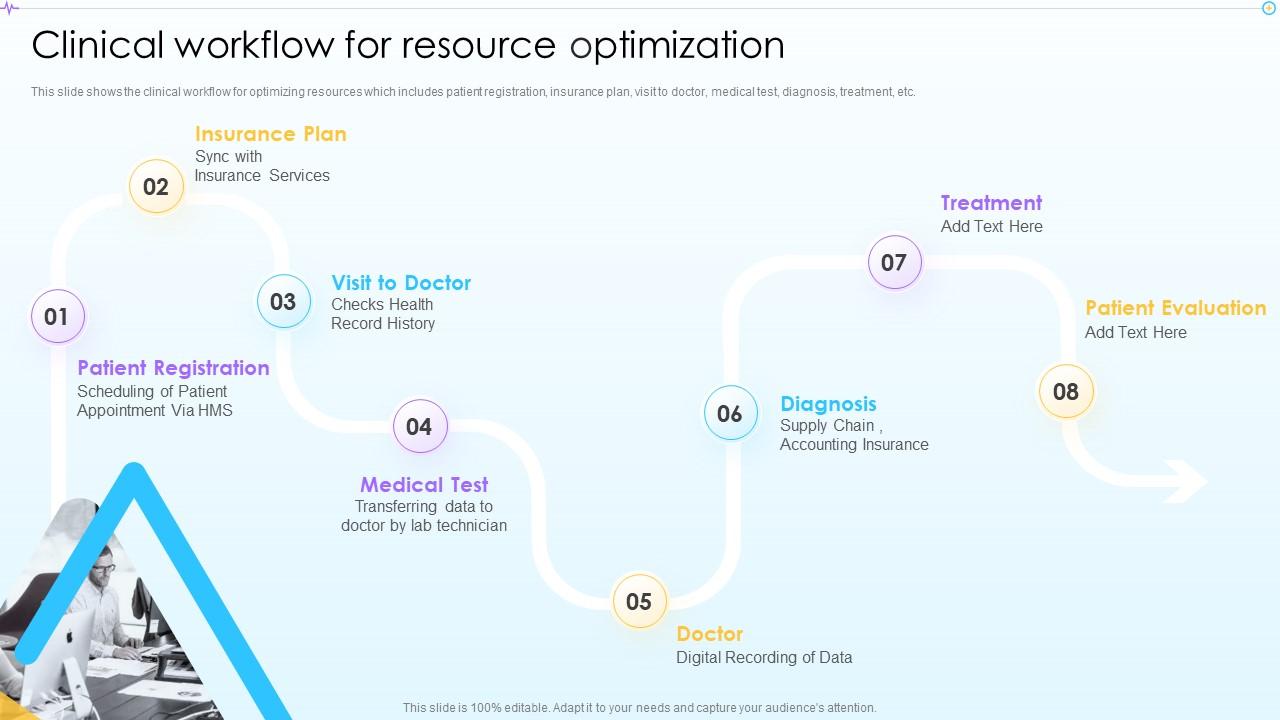
Template 16: Clinical Workflow for Resource Optimization Hospital Management System Advancement
Advancing hospital management systems requires showing how workflows change with new infrastructure. This PPT preset maps eight clinical workflow stages—from registration and insurance through evaluation—in a format that works for implementation planning and executive briefings alike. It gives hospital operations leads a clean visual structure for presenting resource optimization progress. Use it when the audience needs to see workflow advancement as a concrete, stage-by-stage process. The template is 100% editable and customizable.
Download this PowerPoint Template
Template 17: Design and Implement Hospital Clinical Workflow for Resource Optimization
Designing and implementing a hospital workflow is a cross-functional effort. This deck is built for teams who need to show how clinical resource optimization translates into actual operational stages—registration, insurance, physician visits, diagnostics—clearly and without ambiguity. It supports both design-phase presentations and post-implementation reviews with equal clarity. Use it when the audience needs to understand the full arc of implementation, not just the end state. The template is 100% editable and customizable.

Download this PowerPoint Template
Template 18: Clinical Workflow for Resource Optimization in Healthcare Inventory
Healthcare inventory management connects directly to clinical workflow efficiency. This template maps eight workflow stages—from patient registration and insurance verification through physician visits—in a structure that supports both operations planning and clinical quality improvement presentations. It gives supply chain and clinical operations teams a shared framework for discussing resource workflows. The layout ensures the sequence is clear to audiences who may not know the process end-to-end. Transform your healthcare inventory workflow presentations today. Download this template now and unlock sharper clinical operations alignment.

Download this PowerPoint Template
Template 19: Analysis of Pre and Post Automated Communication Strategies for Implementing Workflow
Comparing communication workflows before and after automation is a common ask in clinical operations reviews. This PPT preset maps the full sequence—query receipt, manager response, bot enquiry, and bot response—showing what changes when automation is introduced. It's built for operations and healthcare IT teams who need to present the case for automated communication clearly to administrators or clinical leads. The before-and-after format makes the value of change immediately visible. The template is 100% editable and customizable.

Download this PowerPoint Template
Elevate Every Clinical Workflow Presentation with SlideTeam
SlideTeam's PowerPoint templates are the best in the industry for clinical workflow analysis. These content-ready slides save hours of design work while delivering professional-grade visual structure for patient flow, process redesign, and care coordination presentations. Use these ready-made PowerPoint slides to communicate findings clearly to clinical, administrative, and executive audiences. Deploy these pre-designed templates to drive healthcare process improvement and turn analysis into action.
FAQs on Clinical Workflow Analysis
How does value stream mapping differ from traditional clinical workflow analysis in identifying bottlenecks?
Traditional workflow analysis documents steps sequentially. Value stream mapping goes further—it quantifies time, effort, and waste at each step, making delays visible as data, not just observation. It separates value-adding activities from non-value-adding ones. In clinical settings, this distinction is what makes bottlenecks actionable rather than merely identified. Traditional analysis tells you what happens; value stream mapping tells you what it costs.
What metrics are most critical when evaluating the efficiency of an emergency department triage workflow?
Focus on door-to-triage time, triage-to-physician time, and left-without-being-seen rates. These three metrics directly reflect how well the triage workflow is functioning under load. Length-of-stay by acuity level adds useful context. Track boarding time too—patients held in the ED after admission decisions—because it signals upstream flow failures, not just triage problems.
How can time-motion studies be effectively applied to reduce physician documentation burden in EHR systems?
Time-motion studies observe where physicians actually spend their time in EHR systems—logging, navigating, copying, and re-entering data. The findings typically show documentation taking 40–60% of clinical time. Armed with that data, teams can target specific EHR tasks for restructuring—pre-populated fields, voice-to-text, order sets—rather than guessing at fixes. The study converts anecdotal frustration into measurable, addressable time blocks.
What role does human factors engineering play in redesigning high-risk clinical workflows to minimize medical errors?
Human factors engineering looks at how the physical and digital environment shapes clinician behavior. In high-risk workflows, it identifies where design forces errors—confusing medication labels, poorly sequenced EHR screens, alert fatigue. The goal is to make the right action the easiest action. Applied to clinical settings, it reduces reliance on individual vigilance and builds safety into the workflow itself.
How do interdisciplinary care team dynamics impact workflow efficiency in ICU settings?
In ICU settings, role ambiguity and communication gaps between physicians, nurses, pharmacists, and respiratory therapists directly slow care decisions. Clear role delineation and structured handoff protocols—like daily goal sheets or standardized rounds formats—reduce redundant communication. When team members know their lane and the process for escalation, workflow moves faster and errors decrease. Interdisciplinary alignment is a workflow input, not just a cultural nice-to-have.
What are the key differences between synchronous and asynchronous communication workflows in hospital care coordination?
Synchronous communication—phone calls, bedside handoffs, live rounds—requires all parties available simultaneously. It's fast but creates bottlenecks when schedules don't align. Asynchronous communication—secure messaging, EHR notes, task queues—allows response on each party's timeline. In care coordination, the choice between them affects how quickly decisions get made and how often tasks fall through. Most efficient workflows use both, matched to task urgency.
What methods can be used to distinguish between a workflow inefficiency caused by technology versus human behavior?
Start by isolating the variable. If the same workflow fails consistently regardless of who performs it, the technology is likely the problem. If performance varies significantly by individual or shift, human behavior is the more probable cause. Process observation, user interviews, and system log analysis together distinguish the two. Fixing the wrong root cause wastes resources and leaves the real problem untouched.
How does patient acuity variation affect the predictability and standardization of nursing workflows?
High acuity variation makes nursing workflows harder to standardize because task demand shifts unpredictably with patient condition changes. A unit with stable acuity can build reliable task sequences and timing. A unit with frequent acuity swings requires nurses to reprioritize constantly, which breaks standardized workflows. Staffing models and flexible task protocols—rather than rigid schedules—are more practical responses in high-variation environments.