

 0 Comment
 Customer Reviews

The deck's done. The investor meeting's in two hours.
And somewhere between the product roadmap and the traction slide, someone asks the question that always lands wrong: "So what's your competitive advantage?" Not the polite version. The actual one. The one that means—why won't a bigger company just copy this in six months?
That pause. That's the real problem.
Most founders know what they do better than competitors. Some of them can even say it out loud. But turning that into a slide—something that reads as honest, specific, and defensible—that's a different thing entirely. It's not a writing problem. It's a clarity problem. You're trying to communicate a position you haven't fully stress-tested yourself.
And the format doesn't help. A blank slide with "Competitive Advantage" as the title is a trap. It invites bullet points. Generic claims. Things like "first-mover advantage" or "strong team culture" or "proprietary technology"—phrases that sound like answers but aren't.
What makes it worse is that the people across the table have heard every version of this. Investors, accelerator panels, strategic partners—they've seen the deck where a startup says "we have no real competitors" and the deck where someone lists Google as a competitor to seem ambitious. Neither lands. Neither is the thing.
Startup competitive advantage isn't a slide. It's an argument. And arguments need structure before they need polish.
That's why these templates exist—because the argument is hard enough without also figuring out layout, flow, and what goes where. SlideTeam's pre-designed competitive advantage templates give you the scaffolding. The structure is already there; you fill in the specifics that only you know.
What follows are twenty templates that handle the awkward part—so you can focus on the actual argument.
Template 1: Starbucks Competitive Advantage Overview PPT Outline
Starbucks is one of the clearest real-world examples of brand-led competitive moat building. This PowerPoint slide breaks down the Starbucks competitive advantage model for teams studying how premium positioning, loyalty programs, and supply chain control work together. It's useful for a startup competitive analysis session or a business school case presentation. The structure lets practitioners map analogous elements to their own startup differentiation work. The template is 100% editable and customizable.
[product_image id=1674017]
Template 2: Competitive Advantage to the Startup Strategical Planning for Opening a Cafeteria
Café and food-service startups face specific competitive pressures that generic frameworks don't address well. This PPT template covers the key competitive advantages for a cafeteria startup: ingredient quality, supplier relationships, and operational management. It's structured for four clear areas, making it practical for a founder presenting a startup USP development plan to early investors or partners. The slide works equally well for a business competitive analysis of local food-service entrants. The template is 100% editable and customizable.

Download this PowerPoint Template
Template 3: SWOT Analysis for Competitive Advantage in Any Industry PPT Slides
A clear SWOT analysis drives sharper startup market positioning decisions. This visually striking deck merges creative design with functional analysis frameworks for any industry. Each quadrant delivers instant visual clarity, helping your audience grasp strengths, weaknesses, opportunities, and threats at a glance. The pre-built layout saves significant preparation time without sacrificing professional quality. Use this deck to anchor competitive advantage discussions in boardrooms, client pitches, or investor reviews. Transform your business competitive analysis presentations today. Download this dynamic template now and unlock sharper strategic decision-making.
[product_image id=1593925]
Template 4: Competitive Advantage Analysis PPT Outline
Clear competitive analysis is one of the harder things to present without sounding defensive or vague. This PPT preset gives practitioners a structured outline to map competitive positions honestly and credibly. It's built for strategists and founders who need to walk a leadership team through where they stand and why it holds. The four-stage flow supports everything from Porter's Five Forces startup reviews to broader market gap assessments. The template is 100% editable and customizable.
[product_image id=1490725]
Template 5: Competitive Advantage Focus on Markets PPT Outline
Market segmentation and focus are central to niche market domination for early-stage startups. This deck is built for teams presenting a targeted competitive advantage story, one anchored in specific markets rather than broad claims. Strategy leads presenting startup market positioning to boards or investors will find the clean structure easy to adapt. For a deeper dive into pre-built competitive advantage frameworks, SlideTeam's curated guide on startup competitive advantage PPT templates covers more ready-made options. The template is 100% editable and customizable.
[product_image id=1837111]
Template 6: Competitive Advantage Building Unique Strengths in Your Industry PPT Outline
Building unique strengths requires more than listing features—it demands a compelling visual argument. This deck elevates your startup differentiation narrative with seamlessly customizable layouts that align with your brand identity. Each slide transforms abstract competitive strengths into clear, audience-ready visual stories. Flexible color schemes and pre-designed structures accelerate preparation without compromising polish. Use this deck to present sustainable competitive advantage frameworks to investors, leadership teams, or strategic partners. Transform your competitive positioning presentations today. Download this dynamic template now and unlock your startup's unique strengths story.
[product_image id=1837108]
Template 7: Pros and Cons of Investing in Startups PPT Outline
Investment decisions for startups hinge on honest risk-benefit framing, not just upside storytelling. This PPT preset is built for fund managers, accelerator teams, and founders who need to present the pros and cons of startup investing in a balanced, credible way. It's particularly useful when addressing questions about startup scalability advantage and capital efficiency in early-stage rounds. The structured layout keeps complex tradeoffs readable without oversimplifying them. The template is 100% editable and customizable.
[product_image id=1507376]
Template 8: Icon of Transient Competitive Advantage
Transient competitive advantages are often underappreciated in startup planning discussions. This deck captures the concept of a time-limited edge—useful for teams presenting technology competitive advantage arguments that are real today but will evolve. Precision icons translate abstract advantage concepts into immediate visual clarity for any audience. Extensive visual elements let you express every nuance of your differentiation story with confidence. Use this deck to anchor discussions on startup innovation and evolving competitive positions. Transform your competitive advantage presentations today. Download this dynamic template now and unlock sharper, more honest positioning.

Download this PowerPoint Template
Template 9: Competitive Advantage PPT Ideas
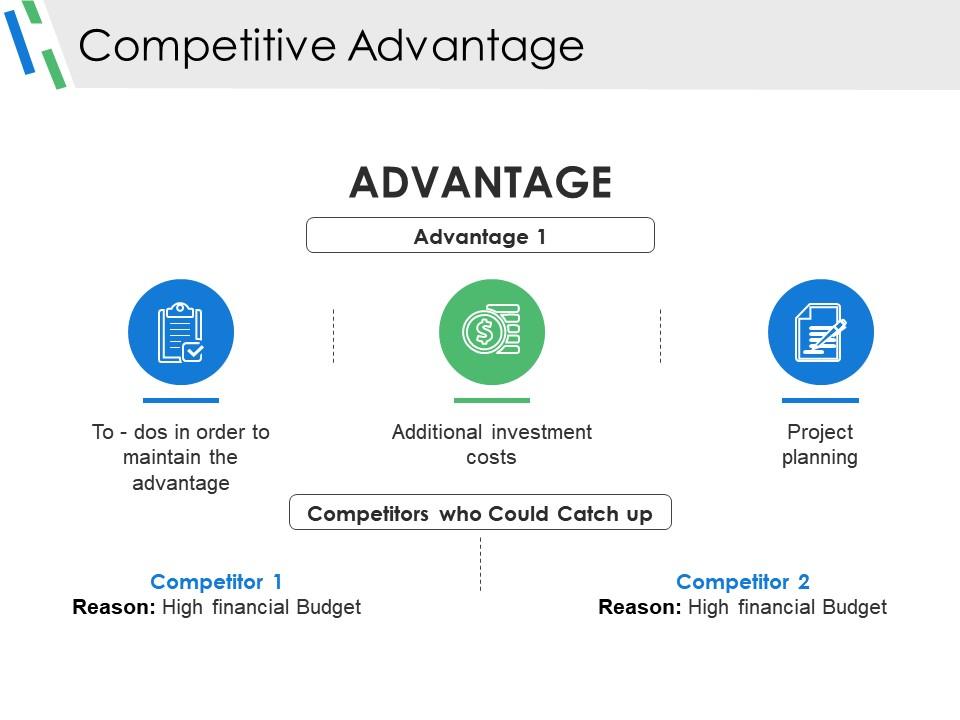
Sustaining a competitive position requires ongoing investment decisions, not just an initial insight. This PPT slide maps three core stages—maintaining advantage, managing additional costs, and project planning—giving practitioners a clear view of what it actually takes to hold ground. It's a useful framing for startup growth strategy conversations where the leadership team needs to weigh financial commitments against competitive durability. Founders and CFOs will find the structure practical for budget-linked competitive review sessions. The template is 100% editable and customizable.
Download this PowerPoint Template
Template 10: Life Cycle of Transient Competitive Advantage
Most competitive advantages don't last forever, and the best startup teams plan for that reality. This PPT template maps the full lifecycle of a transient competitive advantage across launch, exploitation, and erosion phases. It's a practical tool for strategy leads presenting to boards or investors who want to see that the founding team understands competitive durability, not just current positioning. The four-stage arc also supports data-driven competitive advantage planning conversations. The template is 100% editable and customizable.

Download this PowerPoint Template
Template 11: Benefits and Risks of Investing in Startups
Startup investment decisions look different depending on which side of the table you're on. This PPT slide breaks the analysis into two clean stages: benefits and risks, giving both founders and investors a shared vocabulary for the conversation. It's useful in pitch preparation, due diligence sessions, or accelerator workshops where startup barrier to entry questions come up early. The direct structure keeps the discussion grounded without oversimplifying inherently complex tradeoffs. The template is 100% editable and customizable.

Download this PowerPoint Template
Template 12: Competitive Advantage to the Startup Coffee Shop Business Restaurant Cafe Business Idea PPT Pictures
Food-service startup pitches often struggle to translate operational strengths into a credible competitive story. This PPT template covers the four most defensible advantages for a coffee shop startup: ingredient quality, management depth, supplier relationships, and long-term customer loyalty. It's built for founders presenting a startup USP development narrative to early backers or franchise partners. The layout is clear enough for a first pitch and detailed enough for a business plan review. The template is 100% editable and customizable.

Download this PowerPoint Template
Template 13: Business Strategy Opening Coffee Shop Competitive Advantage Startup Coffee Shop Business
Opening a coffee shop requires a clear competitive story, not just a good product. This PPT preset structures the four key business advantages—ingredient quality, management, supplier ties, and long-term relationships—into a presentation-ready format. It's practical for founders walking angel investors through a startup market positioning argument for a café concept. The four-stage layout keeps the narrative tight and the priorities visible without burying the audience in detail. The template is 100% editable and customizable.

Download this PowerPoint Template
Template 14: Model of Transient Competitive Advantage
Differentiation, service quality, and speed to market are three levers most startup teams discuss but rarely model together. This deck captures all three within a clean four-stage competitive advantage model. Striking visual design ensures each stage commands attention and communicates strategic intent immediately. The flexible layout adapts to product launch reviews, competitive positioning workshops, or investor update decks with equal ease. Use this deck to present your startup differentiation strategy with precision and credibility. Transform your competitive positioning presentations today. Download this dynamic template now and unlock a clearer model for your advantage.

Download this PowerPoint Template
Template 15: Sources of Sustainable Competitive Advantage 6 First Mover Advantage
First mover advantage is one of the most cited startup claims and one of the least well-supported in most pitch decks. This PPT template structures the real mechanics behind it: setting low pricing early, building brand loyalty, molding consumer behavior, and blocking new entrants through internal economies of scale. It's built for founders and strategists who want to make a credible first mover advantage startup argument backed by specific tactics, not just timing claims. The template is 100% editable and customizable.

Download this PowerPoint Template
Template 16: Transient Competitive Advantages vs Sustain Competitive Advantage
The distinction between a transient edge and a sustainable competitive advantage shapes how a startup should allocate capital. This PPT slide puts both concepts side by side with a clear scope comparison, making it practical for board discussions and investor Q&A sessions. Strategy leads and founders who need to address durability questions—especially around sustainable competitive advantage—will find the direct comparison format far more persuasive than abstract definitions. The template is 100% editable and customizable.

Download this PowerPoint Template
Template 17: Major Reasons for Product Repositioning Acquiring Competitive Advantage with Brand
Product repositioning decisions carry real risk, and explaining them to stakeholders requires structured reasoning. This deck captures all six key drivers—declining sales, increased competition, wrong initial positioning, future plans, evolved products, and strategic direction changes—in a clean multi-stage layout. Each driver connects directly to a brand differentiation outcome, giving your audience a logical narrative rather than a defensive justification. Pre-built structure accelerates preparation for board reviews and strategic planning sessions. Use this deck to present product repositioning arguments with clarity and confidence. Transform your startup brand differentiation presentations today. Download this dynamic template now and unlock sharper repositioning narratives.

Download this PowerPoint Template
Template 18: Source of Competitive Advantage Superior Product Benefit Perceived
Competitive advantage ultimately comes down to how customers perceive product benefits relative to alternatives. This deck structures the source-to-perception chain across four clear stages, giving practitioners a visual model that connects internal product strengths to external customer value. It's a grounded tool for startup USP development sessions and product market fit reviews. Strategy and product leads presenting to cross-functional teams will find the staged flow keeps the discussion focused. Use this deck to anchor customer-benefit positioning in any competitive review. Transform your unique value proposition presentations today. Download this dynamic template now and unlock a clearer product advantage narrative.

Download this PowerPoint Template
Template 19: Corporate Strategies for Competitive Advantage
Corporate competitive strategy comes down to four well-tested positions: cost leadership, differentiation, cost focus, and differentiation focus. This PPT template maps all four clearly, giving strategy teams a shared framework for evaluating where a business actually sits. It's practical for cost leadership strategy startup reviews, board-level planning sessions, or competitive benchmarking discussions. The clean structure makes complex strategic tradeoffs readable without oversimplifying them for non-specialist audiences. The template is 100% editable and customizable.

Download this PowerPoint Template
Template 20: Determinants of Competitive Advantage in Business
Understanding what drives competitive advantage requires a structured look at external and internal conditions together. This PPT slide covers the four core determinants: factor conditions, demand conditions, firm strategy with structure and rivalry, and related supporting industries—a framework closely aligned with Porter's Five Forces startup analysis. It's built for strategists and founders who need to present a rigorous competitive environment assessment to boards or investors. The four-stage model keeps the argument disciplined and credible. The template is 100% editable and customizable.

Download this PowerPoint Template
Win Your Market with SlideTeam's Competitive Advantage Templates
SlideTeam's PowerPoint templates are the best in the industry for building a credible startup competitive advantage narrative. These content-ready slides give you the structure to present differentiation, moat-building, and market positioning with professional clarity. Use these ready-made frameworks to turn a vague competitive claim into a sharp, defensible argument. Deploy these PPT presets to impress investors, align your team, and drive sustainable growth.
FAQs on Startup Competitive Advantage
What distinguishes a sustainable competitive advantage from a temporary market edge for early-stage startups?
A sustainable advantage holds up after competitors have had time to react. A temporary edge—say, a first-mover pricing lead—erodes once rivals match it. For early-stage startups, sustainability usually comes from network effects, proprietary data, or deeply embedded customer switching costs. Ask whether the advantage gets stronger as you grow. If yes, it's defensible. If it peaks at launch, treat it as a window, not a moat.
How can a bootstrapped startup build a defensible moat against well-funded competitors?
Focus beats spend at early stage. A bootstrapped startup builds a defensible moat by dominating a narrow niche before a funded rival considers it worth entering. Practically: lock in switching costs through deep customer integrations, accumulate proprietary data competitors can't replicate, and build a brand reputation in a specific community. None of these require large budgets. They require consistency and time—two things a patient bootstrapped team can deliver.
Which competitive advantage strategies are most effective for SaaS startups entering saturated markets?
In saturated SaaS markets, product feature parity is table stakes. The most effective advantages are workflow depth (switching cost), vertical specialization (niche market domination), and data network effects (the product improves as more customers use it). Pricing innovation—usage-based or outcome-based models—can also reframe the purchase decision entirely. Pick one lever, build it deeply, and resist the temptation to compete on every front simultaneously.
How does network effect differ from economies of scale as a competitive advantage for startups?
Economies of scale lower your cost per unit as volume grows—an internal efficiency gain. Network effects increase the value of your product for every user as total users grow—an external value gain. Scale advantages are easier for capital-heavy competitors to replicate. Network effects are harder to break once established, making them a stronger long-term moat. For most startups, network effects are rarer but far more durable.
What role does proprietary data play in creating long-term competitive barriers for tech startups?
Proprietary data creates a compounding barrier. Competitors can copy a feature but can't copy two years of behavioral data specific to your customer base. For tech startups, this matters most in AI and ML applications—models trained on unique data outperform generic ones over time. The practical move: design your product to generate data others don't have, and build your analytics capability early, before the data volume makes it obvious.
How can startups leverage first-mover advantage without overextending their limited resources?
First-mover advantage is real but time-limited. The practical rule: move fast enough to capture distribution and brand recognition, then stop expanding until the core position is locked. Overextension—entering adjacent markets before the first is defended—is how most first-mover advantages get surrendered. Prioritize building switching costs and brand loyalty in the initial market before using the first-mover window to expand.
When does a startup's unique company culture become a genuine competitive advantage?
Culture becomes a competitive advantage when it drives decisions that an outside competitor structurally can't replicate. That usually means a hiring bar competitors won't meet, a customer commitment that trades short-term margin for long-term loyalty, or a speed of iteration that a larger organization's process prevents. If your culture is just values on a wall, it's not an advantage. If it changes how you execute daily, it compounds over time.
How can a startup identify and exploit incumbent weaknesses to carve out a defensible market position?
Start by mapping what incumbents can't do quickly—not what they do badly. Large players are typically slow on niche customization, unresponsive to small-segment feedback, and structurally unable to price for micro-markets. Enter at the point of their organizational friction, not their product gap. Build distribution in the segment they ignore, accumulate customer data they don't collect, and set switching costs before they notice you're worth competing with.