

 0 Comment
 Customer Reviews

The quarterly review deck is three slides deep. Someone says “competitive landscape,” and you realize nobody’s mentioned Intel yet.
Not an oversight. Intel’s there—obviously, perpetually—taking up space in every semiconductor conversation whether you want them to or not. Even companies pitching disruption still measure themselves against what Intel built. Years later, the comparison hasn’t gone away.
That’s usually the moment the Intel SWOT analysis slide appears.
There’s something uniquely uncomfortable about presenting your company’s weaknesses to the people responsible for fixing them. Or defending them. Or explaining them to shareholders who don’t care about manufacturing complexity—only manufacturing results.
But knowing Intel’s position and presenting it are different problems.
Anyone following the industry understands the broad picture: decades of R&D strength, enterprise relationships that run deep, and the x86 architecture that still anchors much of the computing world. The weaknesses aren’t mysteries either—manufacturing delays, pressure from AMD, missed opportunities in mobile and the accelerating AI race.
The SWOT framework sounds simple—strengths, weaknesses, opportunities, threats. Yet organizing those realities into something decision-makers can act on is where most presentations struggle. The wrong SWOT slide reads like Wikipedia: disconnected facts, vague bullet points, and insights that feel obvious rather than useful.
Good Intel SWOT analysis does the opposite. It turns familiar industry narratives into structured competitive insight—clarifying where Intel wins, where it struggles, and where the next strategic opportunities and threats may emerge.
SlideTeam’s Intel SWOT templates exist for exactly this moment. Pre-designed frameworks that organize competitive analysis into clear, executive-ready slides—so you can focus on the strategy instead of formatting the story.
Here are the templates that work when Intel’s competitive position needs to be explained clearly, convincingly, and without starting from a blank slide.
Template 1: Intel Corporation SWOT Analysis
Strategic teams need pre-built SWOT analysis PPT templates that actually work during planning sessions. This PowerPoint slide delivers actionable four-column grids with visual hierarchy that cuts through analytical complexity (unlike those "revolutionary" dashboard nightmares). Consultants and managers get customizable preset formatting with intel SWOT matrix capabilities for client presentations. Download this proven template.

Download this PowerPoint Template
Template 2: SWOT Analysis Weakness Intel Company Profile PPT Sample
This innovative template elevates SWOT analysis with a powerful hub-centered design that instantly visualizes strategic interconnections. The circular core connects seamlessly to four comprehensive quadrant panels, creating a visual flow that captures audience attention and enhances understanding. Modular scalability makes customization easy, while balanced geometry keeps a professional look across any presentation. Clean typography and distinctive circular badges deliver immediate visual clarity, transforming complex strategic data into compelling insights. Perfect for building strategic planning presentations, competitive intelligence analysis reports, and executive decision-making frameworks that command boardroom attention. Transform your strategic analysis presentations today by exploring dynamic templates that unlock powerful visual storytelling that drives results.

Download this PowerPoint Template
Template 3: SWOT Analysis Strength Intel Company Profile PPT Rules
This innovative radial SWOT template revolutionizes strategic analysis through its distinctive central hub design that creates intuitive visual connections across all four quadrants. The elegant tabbed callout panels with subtle circular elements streamline complex data presentation while enhancing audience comprehension. Strategic node markers and connecting lines guide viewers naturally through your analysis, ensuring key insights capture attention immediately. The sophisticated multi-column footer establishes a clear information hierarchy that elevates your strategic presentations beyond conventional grid formats. Perfect for creating compelling intel SWOT matrix assessments, intel competitive analysis reports, and intel strategic planning presentations with professional visual impact. Transform your strategic analysis presentations today. Download this dynamic template now and unlock powerful visual storytelling for your business insights.

Download this PowerPoint Template
Template 4: SWOT Analysis Opportunities Intel Company Profile PPT Diagrams
This pre-built SWOT PowerPoint slide connects analysis components through a central hub design, featuring an expandable Opportunities section for intel strategic planning sessions. Managers and consultants can customize this PowerPoint Layout to deliver actionable insights with clean visuals (because nobody needs another cluttered framework that looks impressive but delivers nothing). Download this practical preset today.

Download this PowerPoint Template
Template 5: SWOT Analysis Threats Intel Company Profile PPT Clipart
If you need actionable SWOT analysis that works in real boardrooms, not design contests (because executives care about insights, not Instagram-worthy slides), then this is the PPT for you. This pre-built PowerPoint template delivers strategic planning clarity through its radial layout, connecting four analysis panels with detailed factor breakdowns. The customizable three-column strip enables granular examination while maintaining professional aesthetics. Perfect for consultants and project managers conducting competitive intelligence analysis or strategic reviews. Download this PPT preset now.

Download this PowerPoint Template
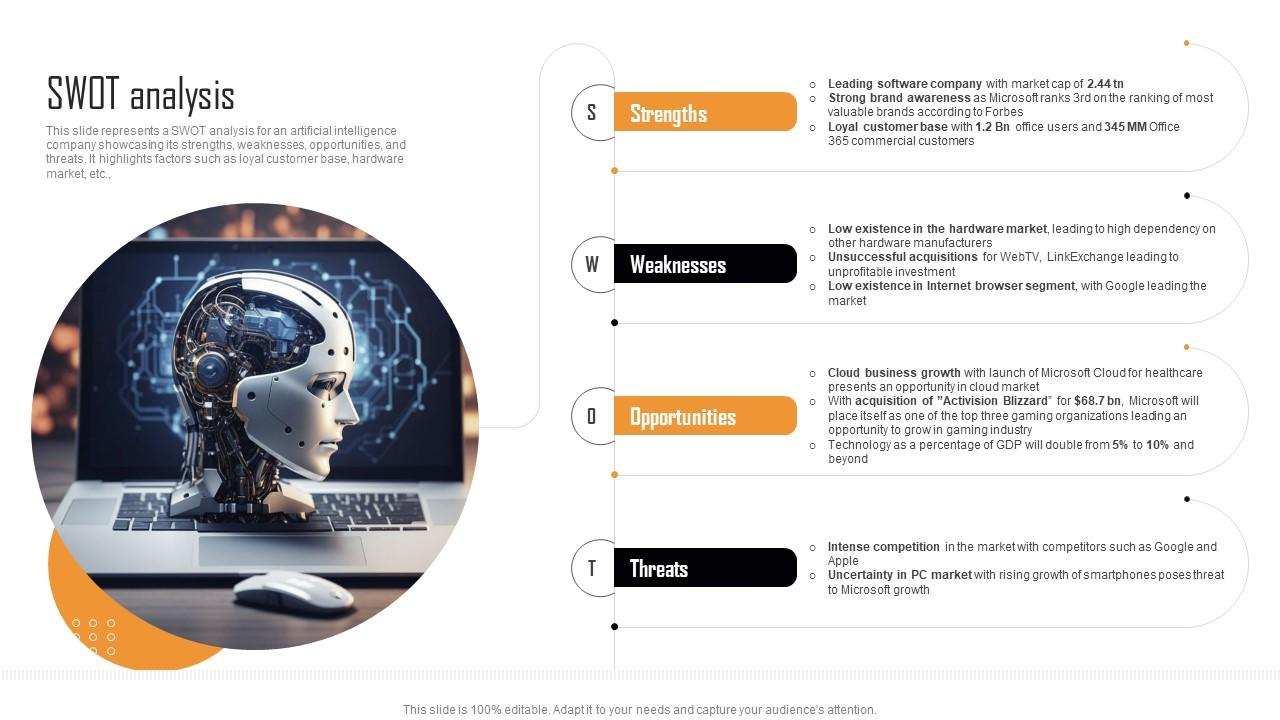
Template 6: Artificial Intelligence Company Profile SWOT Analysis
Strategic consultants and project managers can use this pre-designed PowerPoint slide to deliver Intel-style SWOT matrix presentations that actually hold attention (because circular layouts beat boring quadrants every time). The customizable pill-style format transforms traditional strategic planning into flowing visual narratives. Download now.
Download this PowerPoint Template
Transform Your Strategy with Intel SWOT Analysis and SlideTeam
SlideTeam's PowerPoint templates are the industry's finest for conducting comprehensive Intel SWOT analysis presentations. These content-ready slides provide structured frameworks that save hours of preparation time while ensuring professional-quality strategic assessments. Our custom-made templates feature pre-designed matrices and analytical tools specifically tailored for intel competitive analysis and intel growth strategies in technology sector evaluations. Deploy these ready-made presentations to deliver compelling strategic insights and secure executive buy-in.
FAQs on Intel SWOT Analysis
What are the key strengths of Intel that contribute to its competitive advantage in the semiconductor industry?
Intel's key strengths include its leading manufacturing capabilities, significant investments in research and development, strong brand recognition, a robust portfolio of intellectual property, and strategic partnerships with major technology companies. These competitive advantages, as outlined in Intel's SWOT analysis, enable the company to maintain its technological leadership while effectively addressing its strengths and weaknesses in the market. Ultimately, these factors position Intel as a dominant player in the increasingly competitive semiconductor industry.
How does Intel's extensive R&D investment influence its ability to innovate and develop new technologies?
Intel's substantial investment in research and development (R&D) fosters continuous innovation by advancing processor architectures, manufacturing processes, and emerging technologies such as AI chips and quantum computing. This innovation strategy helps Intel maintain its technological leadership, accelerate time-to-market for groundbreaking solutions, and provide competitive advantages across sectors, from data centers to autonomous vehicles. Ultimately, this strengthens Intel's market position.
What weaknesses does Intel face in the current marketplace, and how might these impact its future growth potential?
Intel faces several significant challenges, including a heavy reliance on the x86 architecture, delays in manufacturing advanced chip nodes, intense competition from AMD and ARM-based processors, and a slower adaptation to mobile and AI markets. Nevertheless, Intel's competitive analysis identifies opportunities in emerging technologies such as quantum computing and edge AI processing, which could help mitigate these challenges. These issues affect Intel's ability to retain market share, as many technology companies are increasingly turning to competitors' solutions for data centers and consumer devices. This trend may limit Intel's revenue growth and weaken its competitive position in emerging semiconductor segments.
How does Intel's market positioning compare to its closest competitors such as AMD and NVIDIA?
Intel has a strong position in the CPU and data center markets, while AMD competes aggressively in the processor segment, and NVIDIA leads in GPUs and AI accelerators. An analysis of Intel's competitive landscape shows that these dynamics create opportunities for strategic differentiation. Intel leverages its manufacturing capabilities and enterprise relationships, AMD emphasizes performance-per-dollar advantages, and NVIDIA capitalizes on the growing demand for AI technology. Together, these companies deliver unique value propositions within the evolving semiconductor markets.
What opportunities exist in emerging markets for Intel to expand its product offerings and increase market share?
Intel has the opportunity to capitalize on emerging markets by expanding semiconductor demand in sectors such as automotive, IoT devices, data centers, and mobile infrastructure. Additionally, the company can take advantage of the growing digitalization across healthcare, education, and financial services. These markets offer significant opportunities for Intel to introduce specialized chips, collaborate with local manufacturers, and establish regional research facilities. A thorough market analysis highlights Intel's competitive advantages in rapidly developing economies that seek technological advancement. Moreover, Intel's growth strategies are designed to address potential threats and seize opportunities in these dynamic regions.
In what ways can Intel mitigate threats from supply chain disruptions and geopolitical tensions affecting its operations?
Intel can address supply chain and geopolitical challenges by diversifying its manufacturing locations, forming strategic partnerships with regional suppliers, and investing more in domestic production capabilities. By establishing fabrication plants in various countries and developing alternative sourcing networks, Intel can enhance its operational resilience and decrease reliance on a single region. Additionally, using government incentives for semiconductor manufacturing, based on a thorough competitive analysis, helps Intel achieve greater supply chain stability and gain a competitive edge.
How has Intel adapted its business model in response to changes in consumer preferences for mobile and cloud computing?
Intel has adapted by diversifying beyond traditional CPUs, expanding into data center processors, AI accelerators, edge computing solutions, and cloud infrastructure technologies. Through strategic acquisitions, such as Mobileye and Altera, and increased investment in foundry services, Intel now produces specialized chips for autonomous vehicles, IoT devices, and cloud workloads. This strategic shift positions Intel for growth in mobile-first and cloud-native markets.
What role does strategic partnerships and collaborations play in enhancing Intel’s market presence?
Strategic partnerships and collaborations allow Intel to broaden its market reach, accelerate innovation, access new technologies, share development costs, and leverage complementary expertise across various sectors. By partnering with cloud providers, automotive manufacturers, and technology companies, Intel strengthens its strategy and position in markets like AI and autonomous vehicles. This approach ultimately leads to greater market penetration and sustained growth.
How does Intel's commitment to sustainability impact its brand image and customer loyalty?
Intel's commitment to sustainability greatly improves its brand image by showcasing environmental responsibility. This approach attracts eco-conscious consumers and addresses corporate social responsibility expectations that increasingly influence purchasing decisions. Supported by thorough brand analysis and customer insights, Intel's strategy enhances customer loyalty, especially among enterprise clients and environmentally aware consumers. Additionally, it helps the company compete in markets where sustainability credentials build partnerships, which support long-term brand value and customer retention.
What challenges does Intel encounter in maintaining its edge in manufacturing techniques and technology scales?
Intel is facing increasing competition from TSMC and Samsung in advanced node manufacturing. The rising costs of fabrication are requiring billions in investments, and there are technical challenges associated with scaling down to processes smaller than 7 nm. While these issues necessitate significant capital allocation and a strong focus on research and development, Intel's innovation strategy also offers opportunities for the company to stand out. By leveraging innovative packaging technologies and specialized manufacturing capabilities, Intel can achieve competitive advantages in an ever-evolving semiconductor landscape.