0 Comment
 Customer Reviews

The form's been sitting in the shared drive for two weeks.
Someone started it. Put in the club name, maybe a one-line mission statement. Then stopped. Because the next section asks for a governance structure, a funding breakdown, an alignment statement with institutional values—and suddenly it's not a form anymore. It's a project.
Student organization proposals are like that. The idea is usually clear. The enthusiasm is definitely there. What's missing is the structure—the part that makes a faculty advisor actually read past the first paragraph, that makes a student affairs office say yes instead of "we'll circle back."
And it's not because the idea is bad. Most of the time the idea is genuinely good. It's that there's a gap between knowing what the club should be and putting it on paper in a way that makes institutional sense. The proposal has to speak two languages at once: the students' and the administration's. That's harder than it sounds.
The administration wants to see fiscal responsibility. Governance clarity. Risk awareness. A reason this club is different from the three that already exist. Students want to convey energy, purpose, community. Neither side is wrong. But finding the slide that holds both? That's where most proposals fall apart.
The wrong structure doesn't just get rejected. It gets tabled. And tabled means the club doesn't happen this semester, probably not next semester either, and whoever started the process has graduated by the time anyone follows up.
Templates exist because this problem is old. Every campus has had versions of it. Someone, at some point, figured out that a pre-built framework—one that already accounts for budget slides, timeline layouts, governance breakdowns—cuts the confusion in half. The structure is already there. You're just filling in what you know.
SlideTeam's student organization proposal templates were built for exactly this situation. Pre-designed, content-ready slides that handle the scaffolding so the people putting together the proposal can focus on the argument, not the formatting.
Here's what's in the collection.
Template 1: Student Organization Event Proposal PowerPoint Presentation Slides
Event planning for a student organization demands clear, professional communication from the first pitch. This PowerPoint slide is built for student leaders who need to present a full event proposal without starting from scratch. It covers everything from event objectives to logistics, giving reviewers a complete, organized picture. Faculty advisors and student affairs offices can follow the argument without guessing. For more resources on building strong proposals, explore SlideTeam's guide to student organization proposal templates with samples and examples. The template is 100% editable and customizable.
[product_image id=279765]
Template 2: Roadmap for Student Organization Event Proposal PPT Infographics
Mapping out an event proposal across five clear stages instantly signals organizational maturity. This five-stage roadmap drives your student organization proposal from concept to execution with precision. Each stage delivers a structured checkpoint, ensuring your planning logic is visible and compelling. Faculty reviewers can follow the progression without guessing at your intent. The timeline-forward layout anchors your campus organization proposal in credibility and professionalism. You can build persuasive club formation proposals and academic club applications with confidence. Transform your student organization presentations today. Download this dynamic template now and unlock your proposal's full potential.

Download this PowerPoint Template
Template 3: Timeline for Student Organization Event Proposal PPT
Deadlines matter more than timelines in any college club proposal — but only if the audience can actually see them. This PPT template lays out a six-stage timeline that makes the sequence of an event proposal immediately readable. Student affairs reviewers and faculty sponsors can track milestones at a glance. It works equally well for a new student group application or a club establishment proposal where pacing needs to be justified. The template is 100% editable and customizable.

Download this PowerPoint Template
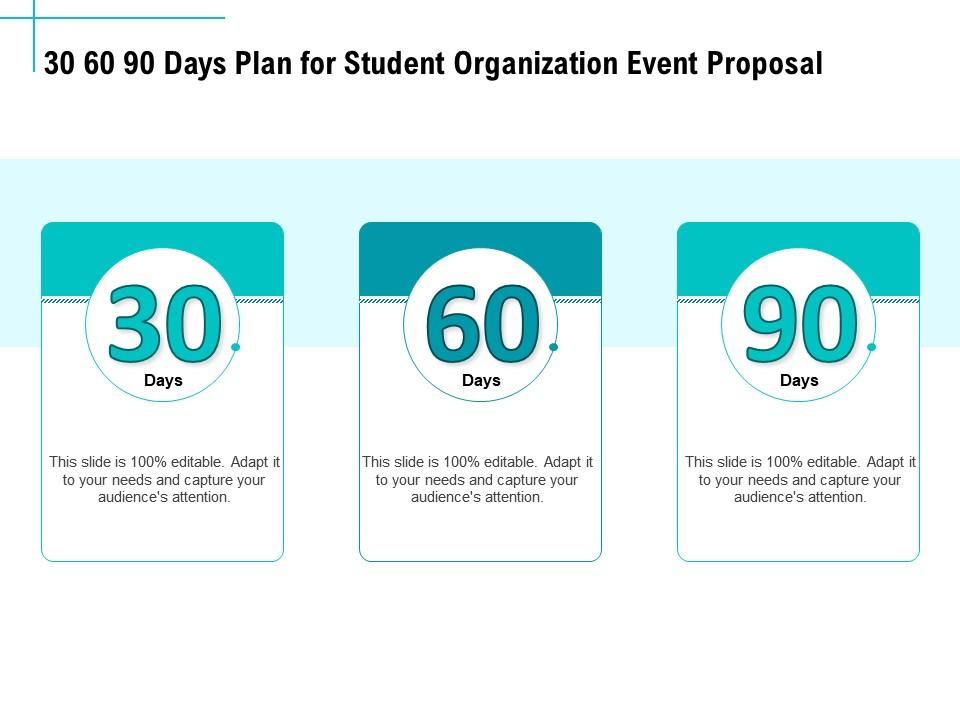
Template 4: 30 60 90 Days Plan for Student Organization Event Proposal PPT Clipart
Short-term thinking is the fastest way to lose a campus organization proposal review. This PPT preset structures a 30-60-90 day plan that shows administrators exactly how a student group moves from approval to action. It signals accountability and forward planning — two things student affairs offices look for in any university club proposal. Use it to map onboarding, first events, and early membership targets across a logical three-phase arc. The template is 100% editable and customizable.
Download this PowerPoint Template
Template 5: Budget for Student Organization Event Services PPT Ideas
Budget slides rarely get enough attention in a student organization funding proposal — until they sink the whole application. This PPT slide gives student leaders a clear framework for presenting event service costs, line by line, in a format administrators can actually evaluate. It removes the guesswork from financial planning conversations and makes fiscal responsibility visible without requiring an accounting background. For student government proposals or academic club applications where funding approval is the hurdle, this deck does the heavy lifting. The template is 100% editable and customizable.

Download this PowerPoint Template
Template 6: Icon Slide for Student Organization Event Proposal PPT Example File
Visual clarity across a student organization proposal depends heavily on consistent, purposeful iconography. This PPT template gives presenters a dedicated icon set built specifically for student organization event contexts. Icons reduce reading fatigue and help reviewers navigate complex slides faster. Whether the proposal covers a student association charter, a club formation outline, or a campus club application, strong visuals make the structure easier to follow at every stage. The template is 100% editable and customizable.

Download this PowerPoint Template
Template 7: Why Us for Student Organization Event Services
Winning approval for a new student organization often comes down to one question: why should this club exist here? This differentiation-focused layout empowers your student body proposal to answer that question head-on. The structured format drives a persuasive comparison between your club's unique value and existing campus offerings. Every element captures your student organization's distinct mission and delivers it with instant credibility. You can build compelling extracurricular organization proposals and student group applications effortlessly. Transform your campus organization presentations today. Download this dynamic template now and unlock your proposal's competitive advantage.

Download this PowerPoint Template
Win Approvals Faster with SlideTeam
SlideTeam's PowerPoint templates are the best in the industry for student organization proposals. These content-ready slides save hours of formatting work while delivering the professional structure that academic administrators expect. From budget breakdowns to governance timelines, these ready-made frameworks cover every section a compelling student organization proposal needs. Grab these PowerPoint slides to present your campus club vision with confidence and drive faster approvals.
FAQs on Student Organization Proposal
What are the essential components that make a student organization proposal compelling to academic administrators?
A compelling proposal needs a clear mission statement, defined membership criteria, a governance structure, and a realistic budget. Administrators want to see how the club fills a gap, not duplicates existing groups. Include an advisor commitment and a short-term activity plan. Show that the organization can sustain itself beyond its founding members. Keep the language plain and the objectives specific.
How should a student organization proposal address potential conflicts with existing campus clubs or groups?
Research existing clubs before writing the proposal. Identify any overlap and explicitly address it — explain what your group does differently or serves a distinct segment of students. Offer to collaborate rather than compete. Administrators are more likely to approve a club that positions itself as complementary. A brief comparison table showing differentiation can make this argument quickly and clearly.
What financial planning elements must be included in a student organization proposal to demonstrate fiscal responsibility?
Include a projected annual budget with line items: events, materials, membership dues, and any funding sources. Show where the money comes from — institutional grants, dues, or fundraising — and how it will be tracked. Name a treasurer role with clear responsibilities. Administrators need to see accountability before they approve funding access. Avoid vague estimates; use real figures from comparable clubs where possible.
How can a student organization proposal effectively communicate its alignment with the institution's mission and values?
Pull the institution's mission statement and quote it directly in the proposal. Then map each of your club's stated goals to a specific phrase or value from that statement. Don't paraphrase — make the connection explicit. Concrete programs or events that support academic outcomes or community engagement work better than abstract claims. One or two well-chosen examples land harder than a full page of general alignment language.
What governance structure should a student organization proposal outline to ensure long-term sustainability?
Outline at minimum four roles: President, Vice President, Treasurer, and Secretary. Define how each is elected, how long terms last, and how vacancies are filled. Include a quorum rule for decisions and a process for amending the constitution. Administrators look for succession planning — they want to know the club survives after its founders leave. A one-page governance chart communicates this faster than paragraphs.
How does a well-structured student organization proposal differ between undergraduate and graduate-level institutions?
Undergraduate proposals typically emphasize social engagement, peer development, and campus integration. Graduate-level proposals need to justify professional relevance — research alignment, industry networking, or academic support functions. Graduate schools also expect tighter budgets and more formal governance language. The core structure is the same, but the framing shifts: undergrad sells community, graduate sells career and scholarly utility.
What risk management strategies should be addressed within a student organization proposal?
Address three main areas: event safety, financial controls, and conflict resolution. For events, note who holds liability and what approval steps are required. For finances, name who signs off on expenditures and how records are kept. For internal disputes, outline a basic mediation process. Keep it brief — two to three sentences per area. Administrators want to see that you've thought about problems before they happen.
How can a student organization proposal demonstrate measurable impact on student engagement and academic outcomes?
Set two or three measurable goals at the start — membership targets, events per semester, or retention rates. Tie at least one goal to an academic outcome, such as GPA support sessions attended or career workshops held. Commit to an end-of-year report. Administrators respond to accountability; showing how you'll measure success is often more persuasive than describing the vision itself.