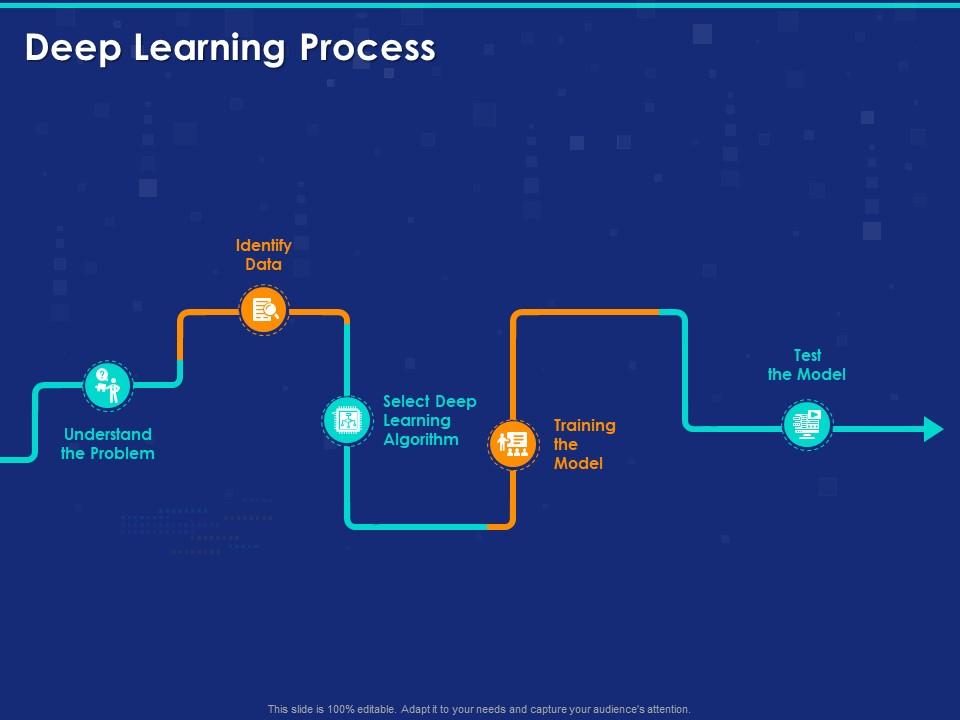
Deep learning process data ppt powerpoint presentation professional summary
Try Before you Buy Download Free Sample Product
Audience
Editable
of Time
Our Deep Learning Process Data Ppt Powerpoint Presentation Professional Summary are explicit and effective. They combine clarity and concise expression.
People who downloaded this PowerPoint presentation also viewed the following :
Deep learning process data ppt powerpoint presentation professional summary with all 2 slides:
Give your audience a fulfilling experience. They will find our Deep Learning Process Data Ppt Powerpoint Presentation Professional Summary elevating.
FAQs for Deep learning process data ppt powerpoint
The primary stages of the deep learning process include data collection and preprocessing, model architecture design, training with optimization algorithms, validation and testing, and deployment with monitoring. These stages work together by ensuring quality datasets, selecting appropriate neural network structures, and iterating through training cycles, with many organizations finding that systematic execution across all stages delivers more accurate predictions and reliable business applications.
Data preprocessing significantly impacts deep learning model performance by cleaning datasets, normalizing features, handling missing values, reducing dimensionality, and augmenting training samples. Through strategic preprocessing, organizations in healthcare, finance, and retail enhance model accuracy, reduce training time, and minimize overfitting, with many finding that quality preprocessing delivers more performance gains than complex architectures.
Feature selection serves as a crucial preprocessing step in deep learning, helping identify the most relevant input variables, reducing computational complexity, improving model interpretability, and minimizing overfitting risks. While deep neural networks can automatically learn feature representations, strategic feature selection enhances training efficiency, accelerates convergence, and delivers better generalization performance, with many organizations finding that thoughtful input curation significantly improves their model outcomes.
Model selection significantly influences deep learning outcomes by determining accuracy, computational efficiency, training time, and deployment feasibility through architecture choice, hyperparameter optimization, and resource allocation. The right model enables organizations to achieve superior performance in applications like medical imaging, financial forecasting, and autonomous systems, while poor selection leads to suboptimal results, ultimately delivering competitive advantage when strategically implemented.
Best practices for training deep learning models include proper data preprocessing, strategic architecture selection, regularization techniques, learning rate optimization, and systematic hyperparameter tuning. These approaches streamline model development by preventing overfitting, accelerating convergence, and ensuring robust performance, with organizations in healthcare, finance, and manufacturing finding that structured training protocols ultimately deliver more accurate predictions and competitive advantages.
Overfitting in deep learning can be mitigated through regularization techniques like dropout and L2 regularization, data augmentation, early stopping, and cross-validation methods. These approaches work by preventing models from memorizing training data, with many organizations in healthcare and finance finding that strategic regularization delivers more robust predictions and better generalization to new datasets.
**INPUT**: What techniques are commonly used for hyperparameter tuning in deep learning? **OUTPUT**: Hyperparameter tuning techniques include grid search, random search, Bayesian optimization, evolutionary algorithms, and automated machine learning platforms. These approaches streamline model optimization by systematically testing parameter combinations, reducing training time, and maximizing performance accuracy, with many organizations finding that strategic tuning delivers significantly improved results and competitive advantage. [Word count: 52 words]
Activation function choice significantly impacts neural network performance by determining how neurons process and transmit information, affecting learning speed, gradient flow, and output quality. Different functions like ReLU, sigmoid, and tanh serve specific purposes, with ReLU often preferred for hidden layers due to computational efficiency, while softmax excels in classification tasks, ultimately enabling networks to solve complex problems across healthcare diagnostics, financial modeling, and autonomous systems.
Transfer learning enhances deep learning model development by leveraging pre-trained models, reducing training time, and minimizing computational resources required for new applications. Through this approach, organizations can adapt existing neural networks for specific tasks like medical imaging or financial fraud detection, ultimately delivering faster deployment and improved accuracy while significantly reducing development costs.
**INPUT**: What metrics are most effective for evaluating deep learning models? **OUTPUT**: Effective deep learning evaluation metrics include accuracy, precision, recall, F1-score, AUC-ROC, and mean squared error, depending on the specific task and data characteristics. These metrics enable organizations to assess model performance comprehensively, with financial institutions using precision for fraud detection and healthcare providers leveraging recall for diagnostic accuracy, ultimately delivering reliable AI systems and competitive advantage.
Deep learning models can be made interpretable through techniques like attention mechanisms, feature importance scoring, LIME explanations, SHAP values, and gradient-based visualization methods. These approaches enable organizations, particularly in healthcare, finance, and regulatory sectors, to understand model decisions, build stakeholder trust, and meet compliance requirements, ultimately delivering transparency while maintaining the competitive advantage of advanced AI capabilities.
Ethical considerations include data privacy protection, algorithmic bias mitigation, transparency in decision-making processes, accountability frameworks, and consent management. These principles help organizations streamline responsible AI deployment by ensuring fairness, protecting user rights, and maintaining regulatory compliance, with many financial services and healthcare institutions finding that proactive ethical frameworks ultimately deliver competitive advantage and stakeholder trust.
Deep learning revolutionizes healthcare and finance by enabling pattern recognition, predictive analytics, and automated decision-making across complex datasets. In healthcare, hospitals leverage deep learning for medical imaging diagnosis and drug discovery, while financial institutions use it for fraud detection, algorithmic trading, and loan approvals, ultimately delivering faster services and enhanced accuracy.
GPU acceleration, specialized AI chips like TPUs, high-bandwidth memory systems, distributed computing frameworks, and quantum computing research have revolutionized deep learning capabilities. These hardware innovations enable faster model training, support for larger neural networks, and more complex computations, with tech companies and research institutions finding that advanced processors reduce training time from months to days, ultimately delivering competitive advantages in AI development and deployment.
Deep learning processes differ significantly between structured and unstructured data through preprocessing requirements, architectural choices, and feature extraction methods. Structured data, like financial records or customer databases, uses traditional neural networks with minimal preprocessing, while unstructured data, such as images or text, requires specialized architectures like CNNs or RNNs, ultimately delivering enhanced pattern recognition across diverse business applications.
No Reviews