Employee Onboarding Process Task Assignment Chart

Rating:
90%
Employee Onboarding Process Task Assignment Chart
Slide 1 of 6
Favourites Favourites

Try Before you Buy Download Free Sample Product

Audience Impress Your
Audience
Editable 100%
Editable
Time Save Hours
of Time
The Biggest Sale is ending soon in
0
0
:
0
0
:
0
0
Rating:
90%
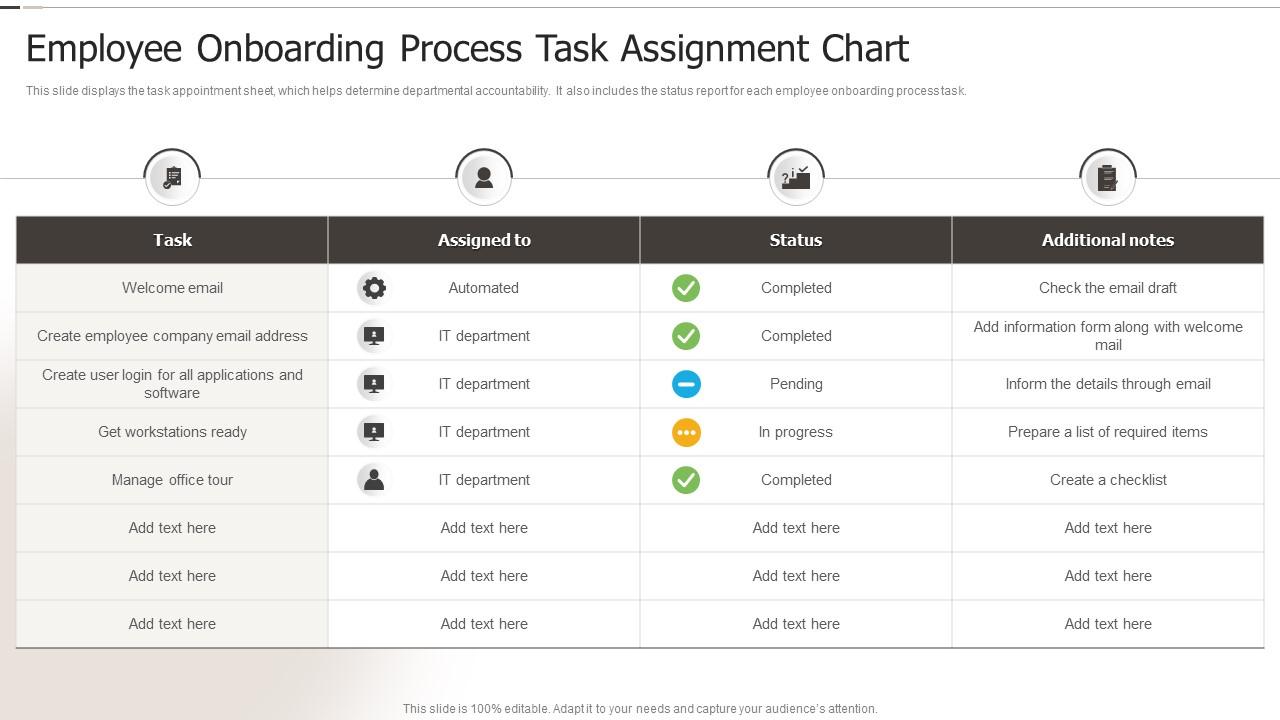
This slide displays the task appointment sheet, which helps determine departmental accountability. It also includes the status report for each employee onboarding process task. Presenting our well structured Employee Onboarding Process Task Assignment Chart. The topics discussed in this slide are Employee Company, Employee Onboarding Process, Task Assignment Chart. This is an instantly available PowerPoint presentation that can be edited conveniently. Download it right away and captivate your audience.

People who downloaded this PowerPoint presentation also viewed the following :

FAQs for Employee Onboarding Process

Effective employee onboarding programs include structured orientation sessions, role-specific training modules, mentorship assignments, cultural integration activities, and systematic feedback checkpoints. These components work together by accelerating productivity, reducing early turnover, and enhancing job satisfaction, with many organizations finding that comprehensive onboarding delivers stronger employee engagement and faster time-to-competency across departments.

Employee onboarding significantly impacts retention and satisfaction by establishing clear expectations, accelerating productivity, and building strong organizational connections from day one. Effective onboarding programs reduce turnover by up to 82%, with companies like Google and Microsoft finding that structured integration processes enhance job satisfaction, improve performance outcomes, and ultimately deliver stronger employee engagement and long-term organizational loyalty.

Company culture serves as the foundation for effective onboarding, shaping how new employees understand organizational values, communication styles, workplace expectations, and team dynamics. Organizations with strong cultural integration during onboarding see significantly higher retention rates, faster productivity ramp-up, and better employee engagement, with many companies finding that culture-focused onboarding creates lasting connections between employees and organizational mission.

Remote onboarding can be tailored through virtual welcome sessions, digital documentation platforms, online mentorship programs, interactive video training modules, and cloud-based collaboration tools. These approaches streamline integration by delivering personalized learning paths, facilitating real-time communication with team members, and providing accessible resource libraries, ultimately ensuring remote employees feel connected and productive from day one.

Key onboarding metrics include time-to-productivity, first-year retention rates, employee engagement scores, training completion rates, and manager satisfaction assessments. These measurements enable organizations to streamline their programs by identifying bottlenecks, enhancing new hire experiences, and reducing turnover costs, with many companies finding that comprehensive tracking ultimately delivers faster integration and improved long-term performance.

Technology enhances onboarding through automated workflows, digital document management, virtual reality training, AI-powered chatbots, and mobile learning platforms. These solutions streamline administrative tasks, provide personalized learning paths, and enable remote onboarding capabilities, with many organizations finding that digital onboarding reduces time-to-productivity while delivering more engaging, consistent experiences for new hires.

Common onboarding challenges include inconsistent processes, information overload, lack of clear expectations, insufficient manager involvement, and poor integration with company culture. These obstacles can lead to decreased productivity, longer adjustment periods, and higher early turnover rates, with many organizations finding that streamlined, structured approaches significantly enhance new hire retention and engagement.

Onboarding programs promote diversity and inclusion by incorporating bias awareness training, establishing mentorship networks with diverse leaders, creating inclusive welcome materials reflecting varied backgrounds, and implementing structured feedback systems. These approaches streamline cultural integration while enhancing employee experiences across different demographics, with many organizations finding that strategic onboarding ultimately delivers stronger retention rates and competitive advantage.

Effective relationship-building strategies include structured buddy systems, cross-departmental introductions, team lunch programs, collaborative project assignments, and informal coffee chats with key stakeholders. These approaches streamline social integration by creating natural touchpoints, facilitating knowledge transfer, and establishing communication channels, with many organizations finding that intentional relationship-building significantly enhances retention and accelerates productivity.

Feedback during onboarding is crucial for identifying gaps, improving experiences, and ensuring new hires feel supported throughout their integration. Organizations should collect feedback through structured surveys, one-on-one check-ins, and informal conversations at key milestones, with many companies finding that regular feedback loops enhance retention rates, accelerate productivity, and create stronger employee engagement from day one.

Training resources should include comprehensive role-specific materials, company policy documentation, technology tutorials, mentorship programs, and interactive learning modules covering procedures and cultural integration. These resources streamline new employee adaptation by providing structured guidance, reducing time-to-productivity, and ensuring consistent knowledge transfer, with many organizations finding that well-designed onboarding resources significantly enhance retention rates and accelerate performance outcomes.

Mentorship programs integrate into onboarding by pairing new hires with experienced employees, establishing structured check-ins, and creating development pathways that extend beyond initial training periods. This strategic combination accelerates knowledge transfer, enhances cultural integration, and builds lasting professional relationships, with many organizations finding that mentored employees demonstrate higher retention rates and faster productivity gains.

Best practices for creating a structured onboarding timeline include establishing pre-boarding preparation, setting clear 30-60-90 day milestones, defining role-specific training modules, scheduling regular check-ins with managers, and integrating social connections with team members. These structured approaches streamline the integration process by reducing time-to-productivity, enhancing employee confidence, and improving retention rates, with many organizations finding that systematic timelines deliver stronger performance outcomes and faster cultural alignment.

Effective onboarding accelerates employee productivity by providing structured training, clear role expectations, comprehensive resource access, and meaningful mentor relationships from day one. Through systematic orientation programs, new hires integrate faster into company culture, master essential tools and processes more efficiently, and reach full productivity benchmarks significantly sooner, ultimately reducing time-to-competency and enhancing overall organizational performance.

Employee onboarding should cover workplace safety regulations, anti-discrimination and harassment policies, data privacy and confidentiality requirements, employment law basics, and industry-specific compliance standards. These legal frameworks protect both organizations and employees by establishing clear expectations, minimizing liability risks, and ensuring regulatory adherence, with many companies finding that comprehensive compliance training ultimately reduces legal issues and enhances workplace culture.

Ratings and Reviews

90% of 100
Review Form
Write a review
Most Relevant Reviews
  1. 100%

    by Domenic Spencer

    “Immediate response, professional support, and effective solutions that were customized and immediately provided. Well done- Thank you!”
  2. 80%

    by Edgardo Chapman

    The pricing page of this website is very sorted. I felt no pain while buying the PPTs.

2 Item(s)

per page: