Micro environment factors media needs ppt powerpoint presentation diagram

Rating:
87%
Micro environment factors media needs ppt powerpoint presentation diagram
Slide 1 of 2
Favourites Favourites

Try Before you Buy Download Free Sample Product

Audience Impress Your
Audience
Editable 100%
Editable
Time Save Hours
of Time
The Biggest Sale is ending soon in
0
0
:
0
0
:
0
0
Rating:
87%
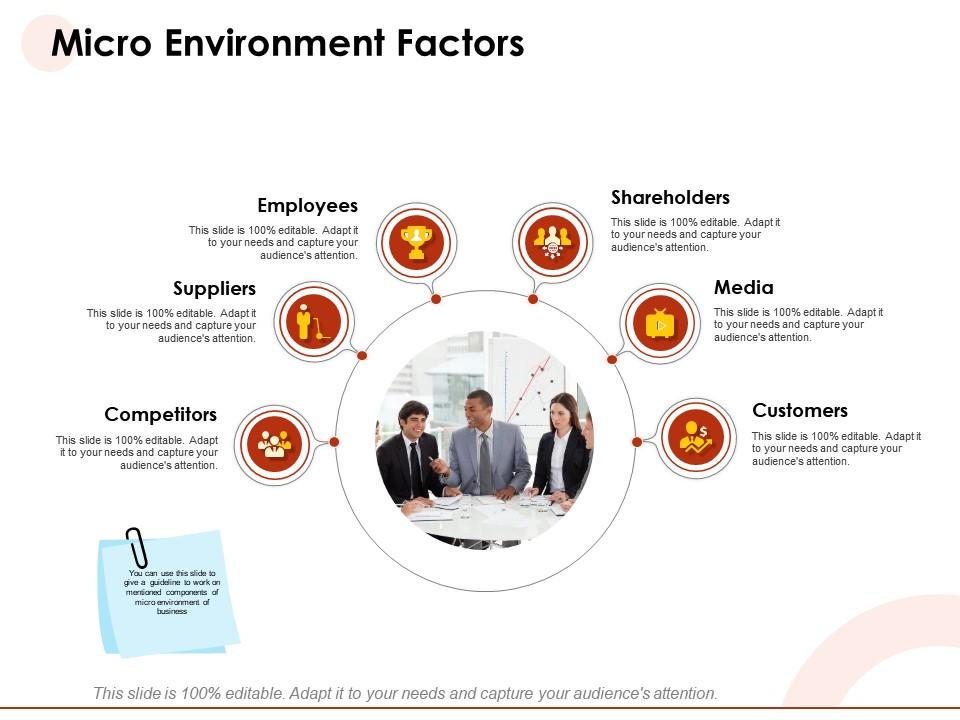
Presenting this set of slides with name Micro Environment Factors Media Needs Ppt Powerpoint Presentation Diagram. This is a six stage process. The stages in this process are Competitors, Suppliers, Employees, Shareholders, Media. This is a completely editable PowerPoint presentation and is available for immediate download. Download now and impress your audience.

FAQs for Micro environment factors media needs ppt

Key microenvironment components include customers, suppliers, competitors, intermediaries, and stakeholders, each directly influencing daily business operations through market demand, resource availability, and competitive pressures. These elements impact operations by determining pricing strategies, supply chain efficiency, and customer acquisition costs, with many organizations finding that strategic management of these relationships ultimately delivers enhanced operational flexibility and sustainable competitive advantage.

Customer preferences within a microenvironment directly influence product positioning, pricing strategies, promotional messaging, and distribution channels by providing real-time feedback on consumer behaviors, purchasing patterns, and brand perceptions. Companies leverage customer data analytics, social media insights, and market research to adapt their marketing mix, with retail brands increasingly personalizing campaigns and financial services customizing offerings, ultimately delivering enhanced customer experiences and competitive advantage.

Local competitors influence a company's microenvironment through pricing pressures, market share competition, customer acquisition battles, and innovation demands. These competitive forces drive companies to differentiate their offerings, enhance customer service quality, and streamline operations, with many businesses finding that strategic positioning against local rivals ultimately delivers improved efficiency and stronger market presence.

Businesses can analyze their microenvironment by conducting comprehensive stakeholder mapping, competitor benchmarking, supplier relationship audits, customer behavior analysis, and distributor performance reviews. Through regular market intelligence gathering and stakeholder feedback sessions, companies across sectors like retail and financial services identify emerging partnerships, competitive gaps, and supply chain vulnerabilities, ultimately enabling strategic positioning and proactive risk management.

Suppliers provide essential resources, materials, and services that directly impact production costs, quality standards, delivery timelines, and overall operational efficiency. Strategic supplier relationships can be optimized through long-term partnerships, regular performance evaluations, diversified sourcing strategies, and collaborative planning, with many organizations finding that strong supplier integration ultimately delivers competitive pricing, innovation opportunities, and enhanced supply chain resilience.

Regulatory and governmental factors within a microenvironment directly impact business compliance through licensing requirements, industry-specific regulations, local ordinances, and compliance reporting standards. These factors influence operational procedures, resource allocation, and strategic planning, with many organizations finding that proactive compliance management streamlines operations, minimizes legal risks, and ultimately delivers competitive advantage in regulated industries.

Geographical location significantly impacts a business's microenvironment by influencing supplier accessibility, customer demographics, local competition intensity, and regulatory requirements. Through strategic location selection, companies can optimize distribution costs, access skilled labor pools, and align with target market preferences, with many retail and manufacturing businesses finding that proximity to key suppliers and customers ultimately delivers competitive advantages and operational efficiency.

Social and cultural factors within a microenvironment significantly influence consumer behavior by shaping preferences, purchasing decisions, and brand loyalty through community values, peer influences, and local traditions. These factors enable businesses to tailor marketing strategies, product offerings, and customer experiences to specific demographics, with retail chains and hospitality companies finding that localized approaches ultimately deliver higher engagement and competitive advantage.

Businesses can adapt to microenvironmental changes through continuous market research, flexible supply chain management, proactive competitor analysis, enhanced customer relationship building, and strategic stakeholder engagement. These approaches enable organizations to anticipate shifts, adjust pricing strategies, diversify supplier networks, and strengthen partnerships, with many companies finding that agile adaptation ultimately delivers sustained competitive advantage and operational resilience.

Employee engagement within a microenvironment significantly impacts business performance by enhancing productivity, reducing turnover costs, and improving customer service quality. Engaged employees deliver higher output rates, foster innovation through collaborative problem-solving, and create positive workplace cultures, with many organizations finding that strong internal engagement translates directly into improved customer satisfaction and competitive advantage.

Technology as a microenvironment factor significantly impacts business operations, customer interactions, competitive positioning, and operational efficiency in today's marketplace. It enables companies to streamline processes, enhance customer experiences, automate routine tasks, and deliver faster services, with many organizations across retail, banking, and manufacturing finding that strategic technology adoption ultimately provides sustainable competitive advantage and scalable growth opportunities.

Businesses can leverage microenvironment insights by analyzing customer feedback for product development, studying competitor strategies for differentiation opportunities, collaborating with suppliers for process improvements, and monitoring industry trends. Through customer co-creation, competitive intelligence, and strategic partnerships, organizations enhance innovation pipelines, accelerate time-to-market, and deliver targeted solutions, ultimately gaining competitive advantage in increasingly dynamic markets.

SWOT analysis, Porter's Five Forces, stakeholder mapping, competitor analysis matrices, and customer segmentation tools effectively assess microenvironmental factors. These frameworks enable organizations to systematically evaluate supplier relationships, competitive positioning, and customer dynamics, with many companies finding that regular microenvironmental audits enhance strategic decision-making and competitive advantage.

Distribution channels significantly influence a company's microenvironment by determining product reach, customer relationships, and market penetration through retailers, wholesalers, direct sales, and digital platforms. These channels enable companies to optimize inventory management, reduce operational costs, and enhance customer experiences, with many retail and manufacturing organizations finding that strategic distribution partnerships ultimately deliver competitive advantage and expanded market access.

Environmental sustainability within a microenvironment significantly influences brand reputation by enhancing consumer trust, attracting environmentally conscious customers, and differentiating companies from competitors. Through sustainable practices like reducing waste, using renewable energy, and ethical sourcing, organizations strengthen stakeholder relationships, improve market positioning, and ultimately deliver enhanced customer loyalty and competitive advantage in an increasingly sustainability-focused marketplace.

Ratings and Reviews

87% of 100
Review Form
Write a review
Most Relevant Reviews
  1. 80%

    by Donovan Cunningham

    Qualitative and comprehensive slides.
  2. 100%

    by Dino Grant

    Appreciate the research and its presentable format.
  3. 80%

    by Edwardo Wheeler

    Qualitative and comprehensive slides.

3 Item(s)

per page: