Supply chain management cycle with sourcing and logistics

Supply chain management cycle with sourcing and logistics
Slide 1 of 5
Favourites Favourites

Try Before you Buy Download Free Sample Product

Audience Impress Your
Audience
Editable 100%
Editable
Time Save Hours
of Time
The Biggest Sale is ending soon in
0
0
:
0
0
:
0
0
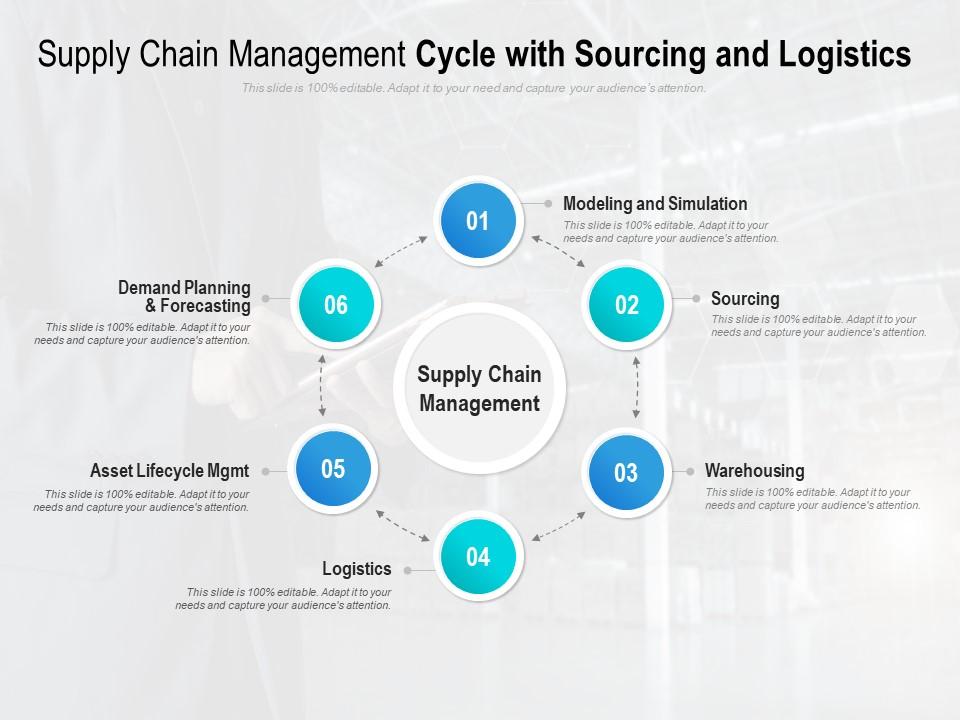
Presenting this set of slides with name Supply Chain Management Cycle With Sourcing And Logistics. This is a seven stage process. The stages in this process are Supply Chain Cycle, Performance Evaluation, Planning And Procurement. This is a completely editable PowerPoint presentation and is available for immediate download. Download now and impress your audience.

People who downloaded this PowerPoint presentation also viewed the following :

FAQs for Supply chain management cycle with

Key components of an effective supply chain management strategy include demand forecasting, supplier relationship management, inventory optimization, logistics coordination, and performance analytics. These elements work together by streamlining operations, reducing costs, and enhancing customer satisfaction, with many organizations finding that strategic integration across procurement, manufacturing, and distribution ultimately delivers competitive advantage and operational resilience.

AI and IoT enhance supply chain efficiency by enabling real-time tracking, predictive analytics, automated inventory management, and demand forecasting. These technologies streamline operations through smart sensors monitoring shipments, machine learning algorithms optimizing routes and warehouse operations, and automated systems reducing manual errors, with many manufacturers and retailers finding significantly lower costs and faster delivery times.

Sustainability drives modern supply chain practices through carbon footprint reduction, circular economy adoption, ethical sourcing standards, waste minimization, and renewable energy integration. These approaches enable organizations to meet regulatory requirements, reduce operational costs, and enhance brand reputation, with many manufacturers and retailers finding that sustainable practices ultimately deliver competitive advantage while addressing increasingly conscious consumer expectations.

Global events like pandemics or political unrest significantly disrupt supply chain resilience by exposing vulnerabilities in single-sourcing strategies, creating transportation bottlenecks, and triggering demand volatility across industries. These disruptions compel organizations to diversify suppliers, enhance digital visibility, and build buffer inventory, with many companies finding that strategic redundancy and real-time monitoring ultimately deliver greater operational stability and competitive advantage.

Businesses should track key metrics including on-time delivery rates, inventory turnover, order accuracy, supplier performance scores, and total supply chain costs. These metrics enable organizations to identify bottlenecks, optimize inventory levels, and enhance customer satisfaction, with many companies finding that comprehensive tracking delivers improved operational efficiency and competitive advantage.

Companies can effectively manage supplier relationships through strategic partnerships, regular performance evaluations, clear communication protocols, collaborative planning, and technology integration for real-time visibility. These approaches streamline operations by fostering transparency, reducing lead times, and enabling proactive issue resolution, with many organizations finding that strong supplier partnerships ultimately deliver cost efficiencies and enhanced supply chain resilience.

**INPUT**: What are the main challenges faced in logistics and distribution within supply chains? **OUTPUT**: Main logistics and distribution challenges include inventory management complexities, transportation cost volatility, last-mile delivery inefficiencies, warehouse capacity constraints, and demand forecasting accuracy. These operational hurdles significantly impact customer satisfaction and profit margins, with many retailers and manufacturers finding that strategic technology integration and data analytics streamline processes while delivering enhanced visibility and competitive advantage. [Word count: 55 words]

Risk mitigation strategies include supplier diversification, demand forecasting, safety stock management, real-time monitoring systems, and strategic partnerships. These approaches streamline operations by reducing dependency vulnerabilities, enhancing visibility across networks, and enabling rapid response capabilities, with many manufacturing and retail organizations finding that diversified supplier bases and predictive analytics ultimately deliver greater resilience and competitive advantage.

Inventory management significantly influences supply chain effectiveness by optimizing stock levels, reducing carrying costs, and ensuring product availability across distribution networks. Strategic inventory control enables manufacturers and retailers to minimize waste, accelerate order fulfillment, and enhance customer satisfaction, while reducing operational expenses and improving cash flow, ultimately delivering competitive advantage in increasingly complex markets.

Data analytics transforms supply chain decision-making by enabling predictive forecasting, real-time visibility, demand pattern analysis, risk assessment, and performance optimization. Through advanced analytics platforms, organizations streamline inventory management, enhance supplier relationships, and minimize disruptions, with many manufacturing and retail companies finding that data-driven insights deliver significantly faster response times and improved operational efficiency.

Consumer demand forecasting significantly impacts supply chain planning by enabling accurate inventory management, optimized production scheduling, and strategic resource allocation across distribution networks. Through predictive analytics and market data analysis, retailers and manufacturers can minimize stockouts, reduce carrying costs, and enhance customer satisfaction, while ultimately delivering improved operational efficiency and competitive advantage in an increasingly dynamic marketplace.

Supply chain collaboration improves through real-time data sharing, joint planning processes, integrated technology platforms, standardized communication protocols, and shared performance metrics. These practices enable partners to coordinate inventory levels, synchronize production schedules, and respond to disruptions more effectively, with many organizations finding that enhanced visibility ultimately delivers reduced costs and improved customer satisfaction.

Businesses balance cost reduction with quality improvement by implementing strategic supplier partnerships, leveraging technology for predictive analytics, and adopting lean manufacturing principles that eliminate waste while maintaining standards. Through automation and data-driven decision making, organizations streamline operations, reduce inventory costs, and enhance product consistency, with many finding that long-term supplier relationships ultimately deliver both competitive pricing and superior quality outcomes.

E-commerce growth significantly disrupts traditional supply chain models by demanding faster fulfillment, direct-to-consumer capabilities, enhanced inventory visibility, and flexible logistics networks. While this presents challenges in warehouse redesign and cost management, it also creates opportunities for companies to streamline operations, reduce intermediaries, and deliver superior customer experiences, ultimately providing competitive advantage in an increasingly digital marketplace.

Small businesses can optimize supply chain processes through strategic vendor partnerships, inventory management software, demand forecasting tools, and process automation technologies. These approaches streamline operations by reducing carrying costs, minimizing stockouts, and enhancing supplier relationships, with many small retailers and manufacturers finding that focused investments in digital tools and collaborative partnerships ultimately deliver competitive advantages without requiring substantial capital expenditure.

Ratings and Reviews

0% of 100
Write a review
Most Relevant Reviews

No Reviews