


0314 financial reports and presentations




Try Before you Buy Download Free Sample Product
 Impress Your
 Audience
 100%
100% Editable
 Save Hours
 of Time


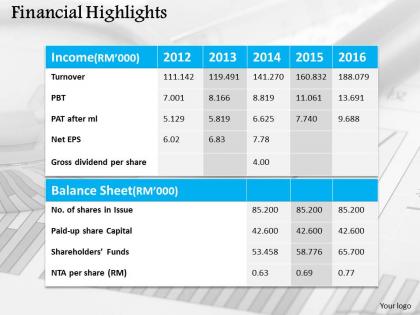
Let your audience pay attention towards the key business statistics with financial reports and presentations design. The PowerPoint diagram enables you to highlight the important business numbers among the stakeholders, outsourcing partners, team members etc. This PPT deck is perfect for the executives working in the finance industry as the balance sheet and business income details can be easily shared with this design. The timeline shown in the income section assist you to present the yearly finance data that is what numbers has been achieved by you as an organization. The presentation clipart gives you an access to show the vital data related to the corporate facts and figures in the organized manner. The PPT template is amendable and the data can be replaced easily with your business statistics. The presentation layout assist you to make an impact on the audience. So download it as soon as possible and then use it to communicate the business facts with your team. Serve up your thoughts in a pleasant way. Dish them out on our 0314 Financial Reports And Presentations.
People who downloaded this PowerPoint presentation also viewed the following :
0314 financial reports and presentations with all 5 slides:
Feel almost arrogant with our 0314 Financial Reports And Presentations. They allow you to freely air your beliefs.




FAQs for 0314 financial
Key components of a comprehensive financial report include income statements, balance sheets, cash flow statements, statement of equity changes, and detailed notes to financial statements. These elements work together by providing stakeholders with complete financial transparency, enabling informed decision-making across investment evaluation, credit assessments, and strategic planning, ultimately delivering enhanced business credibility and competitive advantage.
Public companies must follow strict SEC reporting requirements including quarterly 10-Qs, annual 10-Ks, and detailed disclosures, while private companies have greater flexibility in reporting formats and frequency. These differences impact transparency levels, compliance costs, and stakeholder communication strategies, with many organizations finding that understanding these distinctions helps optimize their financial reporting approach and resource allocation.
Financial reports serve as the foundation for investor decision-making by providing comprehensive insights into a company's profitability, liquidity, debt levels, cash flow patterns, and operational efficiency. These documents enable investors to assess risk, compare performance across similar companies, and identify growth potential, with institutional investors and analysts increasingly relying on quarterly earnings, balance sheet strength, and cash flow statements to make informed investment decisions that ultimately deliver superior portfolio returns.
Businesses should produce quarterly financial reports for stakeholders, with annual comprehensive reports providing detailed analysis, while monthly internal reports help track performance trends. This reporting cadence enables stakeholders to monitor progress, make informed investment decisions, and assess strategic direction, with many organizations finding that consistent quarterly communication builds investor confidence and enhances transparency.
Common mistakes when creating financial reports include inaccurate data entry, inconsistent formatting, missing supporting documentation, unclear labeling, and failure to reconcile accounts properly. These errors can mislead stakeholders and damage credibility, with many organizations finding that implementing standardized templates, regular review processes, and automated validation checks significantly enhances accuracy and delivers more reliable financial insights.
Small businesses can effectively utilize financial reports for growth by analyzing cash flow patterns, identifying profitable products or services, tracking key performance indicators, and benchmarking against industry standards. Through regular review of income statements and balance sheets, entrepreneurs can optimize resource allocation, secure better financing terms, and make data-driven expansion decisions, ultimately delivering improved operational efficiency and competitive positioning in increasingly dynamic markets.
Cash flow statements reveal actual cash movements into and out of businesses, providing crucial insights into liquidity, operational efficiency, and financial health that income statements cannot capture. They enable investors, creditors, and management to assess payment capabilities, investment potential, and operational sustainability, with many financial analysts finding that cash flow analysis often provides more reliable indicators of company performance than profit-based metrics alone.
Financial reports help identify cost reduction opportunities by analyzing expense patterns, comparing costs across departments and time periods, and revealing inefficiencies in resource allocation. Through detailed variance analysis and budget comparisons, organizations can pinpoint areas like excessive operational spending, underperforming investments, and redundant processes, ultimately enabling strategic cost optimization and improved profitability.
Non-adherence to financial reporting standards can result in regulatory penalties, investor distrust, legal consequences, audit complications, and damaged market reputation. These violations often lead to increased scrutiny from regulators, higher compliance costs, and reduced access to capital markets, with many organizations finding that standardized reporting ultimately delivers greater transparency and competitive credibility.
Technology enhances financial reporting accuracy and efficiency through automated data collection, real-time analytics, AI-powered error detection, cloud-based collaboration platforms, and integrated reporting systems. These solutions streamline processes by eliminating manual entry errors, accelerating month-end closes, and enabling continuous monitoring, with many financial institutions finding that automation reduces reporting time by 60% while improving data integrity.
Best practices for presenting financial reports to non-financial stakeholders include using visual charts and graphs, simplifying complex terminology, focusing on key performance indicators, providing executive summaries, and connecting financial data to business outcomes. These approaches enhance comprehension by translating numbers into strategic insights, with many organizations finding that clear visual storytelling and contextual explanations enable better decision-making and stakeholder engagement.
Financial reports enhance corporate governance by providing transparent oversight of management decisions, regulatory compliance, and resource allocation to boards and stakeholders. Through standardized disclosures and performance metrics, organizations enable informed decision-making, minimize risk exposure, and demonstrate accountability to investors, with many public companies finding that comprehensive reporting ultimately delivers stronger stakeholder confidence and competitive market positioning.
Current trends in financial reporting include enhanced ESG disclosures, real-time data integration, predictive analytics, automated compliance reporting, and increased stakeholder transparency requirements. These developments streamline reporting processes by reducing manual errors, accelerating disclosure timelines, and improving data accuracy, with many organizations finding that embracing these trends delivers competitive advantages through better investor relations and regulatory compliance.
Companies use financial reports to benchmark against industry standards by comparing key metrics like profitability ratios, liquidity measures, debt levels, and operational efficiency indicators with sector averages and competitor data. Through systematic analysis of these benchmarks, organizations identify performance gaps, strategic opportunities, and areas for improvement, while investors and stakeholders gain valuable insights into competitive positioning, ultimately enabling data-driven decisions that enhance market competitiveness.
Non-profit organizations face unique challenges including restricted fund accounting, demonstrating program effectiveness versus administrative costs, compliance with donor stipulations, and transparently reporting mission impact rather than profit margins. These organizations must balance financial stewardship with storytelling, presenting complex fund categories and grant restrictions to diverse stakeholders, while ultimately delivering accountability that builds donor trust and regulatory compliance.
-
Good research work and creative work done on every template.
-
Wonderful templates design to use in business meetings.