

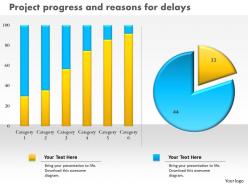
0414 project progress with column and pie chart powerpoint graph





Try Before you Buy Download Free Sample Product
 Impress Your
Audience
 100%
Editable
 Save Hours
of Time


Every company strives to progress in its respective field but measuring progress can be difficult at times but with our 0414 project progress with column and pie chart PowerPoint graph, the projection game is bound to change for better. By using project progress pie chart PPT design, measuring progress becomes and exciting and productive task. The bars within our project progress with column and pie chart PowerPoint template is enough to display the measure of progress and along with this, they can further be used to show the reasons for delays as well. There is a pie chart within the PowerPoint presentation which signifies collective progress thus providing a broader view to the audience. Our project progress with column and pie chart graph Presentation design contains interesting color schemes which help in retaining the attention of the viewers. Hurry and download the project progress PPT template and stay ahead of the game. Good expression is guaranteed with our 0414 Project Progress With Column And Pie Chart Powerpoint Graph. Communication becomes explicitly clear.
People who downloaded this PowerPoint presentation also viewed the following :
0414 project progress with column and pie chart powerpoint graph with all 3 slides:
Douse the audience with your thoughts. Our 0414 Project Progress With Column And Pie Chart Powerpoint Graph will set their brains alight.


FAQs for 0414 project progress with column and pie
Key milestones achieved in the 0414 project include initial requirements gathering, stakeholder alignment sessions, technical architecture design, resource allocation planning, and baseline establishment phases. These foundational components streamline project execution by ensuring clear objectives, defined deliverables, and structured timelines, with many organizations finding that early milestone completion significantly enhances overall project success rates and delivery efficiency.
Project timelines typically shift due to scope changes, resource constraints, stakeholder feedback, technical challenges, and evolving requirements throughout development phases. These adjustments enable organizations to respond to market conditions, incorporate user insights, and address unforeseen complications, with many project teams finding that strategic timeline modifications ultimately deliver better outcomes and stronger competitive positioning.
**INPUT**: What challenges have been encountered during the 0414 project execution? **OUTPUT**: Project 0414 execution has encountered challenges including resource allocation conflicts, timeline coordination issues, stakeholder alignment gaps, and technical integration complexities. These obstacles, while presenting operational hurdles, have enabled teams to streamline communication protocols, enhance project management frameworks, and ultimately deliver more robust solutions with improved stakeholder engagement and strategic outcomes. [Word count: 54 words]
Key stakeholders impacted by the 0414 project progress include project sponsors, end users, development teams, quality assurance personnel, and budget administrators. These groups experience varying degrees of influence through timeline adjustments, resource allocation changes, and deliverable modifications, with many organizations finding that transparent communication across all stakeholder levels ultimately delivers better project outcomes and sustained engagement.
Project teams typically measure 0414 project success through key performance indicators like milestone completion rates, budget adherence, timeline accuracy, stakeholder satisfaction scores, and deliverable quality metrics. These measurement frameworks enable organizations to track progress systematically, identify potential risks early, and make data-driven adjustments, with many teams finding that regular performance reviews ultimately deliver improved project outcomes and enhanced stakeholder confidence.
Resources allocated for the 0414 project typically include dedicated project teams, budget allocations for technology and infrastructure, specialized software tools, and stakeholder communication frameworks. These strategic resource combinations streamline project execution by ensuring adequate staffing, maintaining technological requirements, and facilitating seamless coordination, with many organizations finding that comprehensive resource planning ultimately delivers accelerated timelines and enhanced project outcomes.
Stakeholder feedback has significantly shaped the 0414 project through revised timelines, enhanced feature prioritization, adjusted resource allocation, and refined deliverable specifications. This collaborative input enables project managers to streamline development processes, minimize potential risks, and ultimately deliver solutions that better align with business objectives, with many organizations finding that stakeholder-driven adjustments enhance project success rates and stakeholder satisfaction.
The 0414 project utilizes Agile methodologies, Gantt charts, Kanban boards, risk management frameworks, and milestone tracking systems for comprehensive project oversight. These integrated approaches streamline workflow coordination, enhance team collaboration, and enable real-time progress monitoring, with many organizations finding that this strategic combination delivers improved resource allocation, faster decision-making, and ultimately stronger project outcomes.
The 0414 project aligns with organizational strategic goals by advancing operational efficiency, supporting digital transformation initiatives, and enhancing competitive positioning through streamlined processes and resource optimization. This strategic combination enables organizations to accelerate growth objectives, improve stakeholder value delivery, and strengthen market presence, with many enterprises finding that such aligned projects ultimately drive sustainable competitive advantage.
The projected outcomes for the 0414 project's next phase include enhanced system integration, streamlined operational workflows, improved data analytics capabilities, reduced processing times, and strengthened user experience protocols. These deliverables enable organizations to achieve greater operational efficiency, minimize resource allocation gaps, and accelerate decision-making processes, ultimately delivering competitive advantage and scalable performance improvements.
Risk management throughout the 0414 project lifecycle involves continuous monitoring, proactive mitigation strategies, stakeholder communication protocols, and adaptive response frameworks. These approaches streamline decision-making by identifying potential issues early, implementing preventive measures, and maintaining transparent reporting channels, with many organizations finding that integrated risk assessment ultimately delivers enhanced project predictability and operational efficiency.
Communication serves as the cornerstone for maintaining 0414 project momentum by ensuring alignment across teams, facilitating rapid problem resolution, and keeping stakeholders informed of progress milestones. Regular updates through structured channels enable project managers to identify bottlenecks early, coordinate resource allocation effectively, and sustain team engagement, ultimately delivering consistent progress and preventing costly delays that derail project timelines.
Lessons learned from the 0414 project can be applied to future initiatives through systematic documentation of best practices, risk mitigation strategies, resource allocation insights, and stakeholder engagement approaches. These learnings enable organizations to streamline project timelines, enhance decision-making processes, and improve team collaboration, with many companies finding that structured knowledge transfer ultimately delivers higher success rates and reduced operational costs across subsequent projects.
Anticipated challenges in the 0414 project's next stages typically include resource allocation conflicts, technical integration complexities, stakeholder alignment issues, timeline compression pressures, and quality assurance bottlenecks. These challenges often emerge during scaling phases, with many project teams finding that proactive risk mitigation, cross-functional collaboration, and adaptive planning strategies ultimately deliver smoother transitions and sustained momentum.
Teams typically adapt to unforeseen project changes through flexible planning, enhanced communication protocols, resource reallocation, and rapid decision-making frameworks. These adaptive strategies enable organizations to maintain momentum while pivoting approaches, with many project managers finding that cross-functional collaboration and regular stakeholder updates ultimately deliver improved outcomes and stronger team resilience.
-
Unique design & color.
-
Unique research projects to present in meeting.