

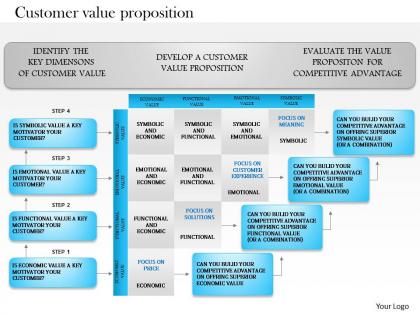
0514 customer value proposition powerpoint presentation




Try Before you Buy Download Free Sample Product
 Impress Your
 Audience
 100%
100% Editable
 Save Hours
 of Time


Disregard discouragement with our 0514 Customer Value Proposition Powerpoint Presentation. Feel greatly enthused and further encouraged.
People who downloaded this PowerPoint presentation also viewed the following :
0514 customer value proposition powerpoint presentation with all 5 slides:
Our 0514 Customer Value Proposition Powerpoint Presentation facilitate asset creation. Build bigger and better facilities.
FAQs for 0514 customer value
**INPUT**: What are the key components of an effective customer value proposition in the context of presentation templates? **OUTPUT**: Key components include customizable design elements, professional visual consistency, time-saving pre-built layouts, industry-specific content frameworks, and seamless brand integration capabilities. These elements streamline presentation development by reducing design time, enhancing visual impact, and ensuring message clarity, with many organizations finding that strategic template libraries ultimately deliver faster turnaround times and improved stakeholder engagement.
Businesses can tailor their customer value proposition by conducting segment-specific research, identifying unique pain points, customizing messaging and benefits, adjusting pricing strategies, and leveraging targeted communication channels. Through data analytics and customer feedback, companies like Netflix create differentiated offerings for families versus professionals, while financial services firms develop separate value propositions for millennials and retirees, ultimately delivering personalized experiences that enhance customer acquisition and retention.
Market research identifies customer pain points, preferences, design trends, and competitive gaps that inform template development strategies. Through surveys, user analytics, and industry analysis, companies can create templates that address specific audience needs, incorporate trending visual elements, and differentiate from competitors, ultimately delivering more relevant solutions and stronger market positioning.
Unique design elements enhance perceived value propositions by creating visual differentiation, establishing brand credibility, and communicating professionalism through strategic color schemes, typography, and layout consistency. These design components enable businesses to present complex information more compellingly, with many organizations finding that professionally designed templates increase stakeholder engagement and ultimately deliver stronger competitive positioning in client presentations.
Common mistakes include creating generic propositions without differentiation, focusing on features rather than customer benefits, failing to understand target audience needs, making unsubstantiated claims, and copying competitors' approaches. These missteps often result from insufficient market research, internal bias toward product capabilities, and lack of customer feedback integration, with many organizations finding that successful propositions require continuous refinement based on actual customer experiences and measurable outcomes.
Storytelling strengthens customer value propositions in presentation templates by creating emotional connections, demonstrating real-world applications, and transforming abstract benefits into relatable narratives that resonate with specific audience pain points. Through compelling case studies, customer success journeys, and problem-solution frameworks, businesses can illustrate tangible outcomes like increased efficiency or cost savings, ultimately making their value propositions more memorable and persuasive.
Customer value proposition success can be measured through customer acquisition cost, retention rates, Net Promoter Score, conversion rates, and customer lifetime value metrics. These measurements enable organizations to track engagement effectiveness, revenue impact, and competitive positioning, with many companies finding that strong value propositions significantly reduce acquisition costs while enhancing customer loyalty and market differentiation.
Cultural differences significantly influence customer value proposition formulation in presentation design through varying communication styles, visual preferences, color symbolism, hierarchy expectations, and decision-making processes. While Western audiences often favor minimalist, direct approaches, Asian markets may prefer detailed, relationship-focused designs, with many global organizations finding that culturally-adapted presentations deliver higher engagement and conversion rates.
Competitive analysis is critically important in shaping value propositions, enabling businesses to identify market gaps, differentiate their offerings, and position unique benefits that competitors cannot match. Through comprehensive market research, companies in sectors like consulting, marketing, and corporate training can highlight distinctive features, superior customization options, and exclusive design elements, ultimately delivering stronger market positioning and enhanced customer acquisition in increasingly competitive template markets.
Customer feedback can be integrated through surveys, focus groups, social media monitoring, customer interviews, and behavioral analytics to identify gaps between perceived and delivered value. These insights enable businesses to refine messaging, adjust product features, and realign service offerings with actual customer priorities, ultimately strengthening market positioning and competitive advantage.
A strong customer value proposition significantly enhances customer loyalty and retention by clearly communicating unique benefits, addressing specific pain points, and differentiating from competitors through targeted messaging. For presentation template businesses, this translates into higher repeat purchases, reduced churn rates, and increased customer lifetime value, with many companies finding that clear value communication builds emotional connections and trust that keep customers returning consistently.
Pricing strategy significantly influences customer value proposition by balancing affordability with perceived quality, enabling businesses to position templates as premium solutions or accessible tools depending on target markets. Strategic pricing models like subscription tiers, volume discounts, and freemium options enhance accessibility while demonstrating value, with many organizations finding that transparent pricing builds trust and accelerates purchase decisions.
A brand's mission and values are reflected through authentic messaging, purpose-driven product features, ethical business practices, and community engagement initiatives that directly address market-specific customer needs. Companies like Patagonia and Ben & Jerry's successfully integrate environmental values into their propositions, while financial services firms emphasize trust and transparency, ultimately creating deeper customer connections and competitive differentiation.
A well-defined customer value proposition in the presentation template industry enables targeted messaging, streamlined content creation, clearer competitive differentiation, and enhanced customer acquisition strategies. These strategic advantages help companies communicate specific benefits like time savings, professional design quality, and industry customization, while sales teams can focus on qualified prospects who value efficiency and visual impact, ultimately delivering faster conversion rates and stronger market positioning.
Technology trends significantly reshape customer value propositions for presentation templates by enabling AI-powered design automation, real-time collaborative editing, and personalized content recommendations. These innovations allow template providers to deliver faster customization, seamless team workflows, and data-driven design suggestions, with many organizations finding that modern templates ultimately enhance productivity while reducing design costs and presentation development time.
-
Topic best represented with attractive design.
-
Innovative and attractive designs.