


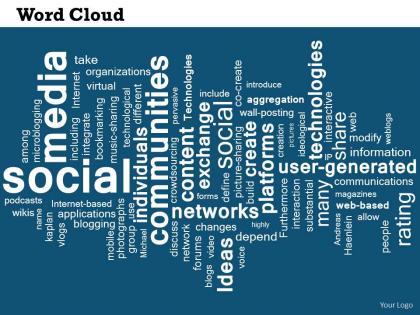
0514 social media word cloud powerpoint slide template




Try Before you Buy Download Free Sample Product
 Impress Your
 Audience
 100%
100% Editable
 Save Hours
 of Time


Our world is becoming an interconnected web of technologies, with social media at its center. Finding PPT inspiration is a tough ask in this world of ever changing and evolving web. Engaging target audience by static, non-responsive Presentation slides is very difficult and not sustainable. Are you in search of a better PPT sample but are frustrated by the dearth of availability of professional PPT sample presentations? Our website publishes numerous such presentation tools for every line of work, especially business and entrepreneurship. One such example of PPT for your specific purpose is the social media word cloud PowerPoint guide. Use this PPT example file for numerous scenarios like startup fairs, motivational lectures, university or college recruitment and more. This PPT design can also be used as a generic slide for starting off a bigger presentation. Our designers have made sure that available space is used precisely and apt PPT icons are placed in a way that is functionally useful. Convince the hard core with our 0514 Social Media Word Cloud Powerpoint Slide Template. Gain the admiration of those in charge.
People who downloaded this PowerPoint presentation also viewed the following :
0514 social media word cloud powerpoint slide template with all 3 slides:
Engender consensus with our 0514 Social Media Word Cloud Powerpoint Slide Template. Heads will bob in complete agreement.
FAQs for 0514 social media word cloud
Social media significantly influences public opinion through rapid information dissemination, viral content amplification, algorithmic content curation, peer-to-peer discussions, and influencer endorsements. These platforms enable organizations, political campaigns, and brands to reach targeted audiences instantly, while user-generated content and social proof mechanisms create cascading opinion shifts, ultimately delivering unprecedented influence over consumer behavior and democratic processes.
Different demographics engage with social media through varying platform preferences, content consumption patterns, sharing behaviors, and interaction styles. Younger users gravitate toward visual platforms like TikTok and Instagram for entertainment, while professionals leverage LinkedIn for networking, and older demographics favor Facebook for community connections, ultimately enabling businesses to tailor targeted strategies across generations.
Social media usage presents both cognitive and emotional impacts across age groups, including increased anxiety, FOMO, reduced attention spans, social comparison behaviors, and altered sleep patterns. While younger users often experience heightened peer pressure and identity formation challenges, older demographics frequently report enhanced connectivity and reduced isolation, with many organizations finding that balanced usage policies and digital wellness programs ultimately deliver improved employee wellbeing and productivity.
Businesses leverage social media for brand building by developing consistent visual identity, creating engaging content that reflects brand values, actively responding to customer interactions, and collaborating with relevant influencers. Through strategic posting across platforms like Instagram, LinkedIn, and Facebook, companies enhance brand awareness, build customer loyalty, and drive meaningful engagement, ultimately delivering stronger market presence and competitive advantage.
Common social media pitfalls include inconsistent posting schedules, lack of clear brand voice, ignoring customer comments, posting without strategic planning, and failing to measure engagement metrics. These challenges often result from insufficient resource allocation and unclear social media policies, with many organizations finding that streamlined content strategies and dedicated community management ultimately enhance brand reputation and customer relationships.
Social media algorithms influence content by analyzing user behavior, engagement patterns, and preferences to curate personalized feeds that maximize time spent on platforms. These sophisticated systems prioritize posts from close connections, trending topics, and content similar to previous interactions, while many businesses and content creators find that understanding algorithm preferences enables more strategic audience engagement and improved organic reach.
Social media serves as a powerful platform for social change through rapid information dissemination, grassroots movement organization, global awareness campaigns, petition mobilization, and direct engagement with policymakers and corporations. These digital tools enable activists to bypass traditional media gatekeepers, coordinate protests seamlessly, and amplify marginalized voices, with many organizations finding that strategic social media campaigns deliver measurable policy changes and increased public support.
Individuals can maintain healthy social media relationships through time boundaries, curated content consumption, regular digital detoxes, mindful engagement practices, and privacy settings management. These strategies streamline mental well-being by reducing comparison triggers, enhancing authentic connections, and minimizing information overload, with many users finding that structured social media usage ultimately delivers improved focus, better sleep quality, and stronger real-world relationships.
Businesses can measure social media campaign success through engagement rates, reach and impressions, conversion tracking, click-through rates, and return on investment analysis. Through analytics platforms like Facebook Insights and Google Analytics, companies streamline performance monitoring, identify high-performing content, and optimize targeting strategies, ultimately delivering improved customer acquisition costs and measurable revenue growth.
Ethical considerations in social media marketing include data privacy protection, transparent advertising disclosure, authentic content creation, responsible targeting practices, and respectful community engagement. These guidelines help brands build genuine customer relationships while avoiding misleading promotions or invasive data collection, with many companies finding that ethical approaches ultimately deliver stronger brand loyalty, reduced regulatory risks, and sustainable competitive advantage in increasingly conscious markets.
Privacy concerns significantly impact social media engagement by reducing content sharing, limiting personal information disclosure, and decreasing platform trust, leading many users to adjust privacy settings, share less frequently, or avoid certain platforms entirely. However, platforms addressing these concerns through transparent data practices and enhanced security features often see improved user retention and deeper engagement, with users in sectors like healthcare and finance particularly valuing privacy-focused social platforms that enable professional networking while protecting sensitive information.
Emerging social media trends include AI-powered personalization, social commerce integration, short-form video content, augmented reality experiences, and community-driven platforms. These developments enable brands to enhance customer engagement, streamline purchasing processes, and deliver more interactive experiences, with many organizations finding that early adoption of these trends delivers significant competitive advantages.
Social media enables effective crisis communication by providing real-time updates, direct audience engagement, and transparent information sharing across multiple platforms simultaneously. Organizations can quickly address concerns, correct misinformation, and maintain stakeholder trust through immediate responses, while monitoring sentiment and feedback to adapt their messaging strategy for optimal crisis resolution.
User-generated content serves as authentic brand advocacy, social proof, cost-effective content creation, community building, and enhanced engagement in social media marketing. Through customer reviews, photos, videos, and testimonials, brands like Nike and Starbucks leverage UGC to build trust, reduce content production costs, and create deeper emotional connections, ultimately delivering higher conversion rates and stronger brand loyalty.
Influencers impact consumer behavior by building authentic relationships with audiences, showcasing products through storytelling, and leveraging trust to drive purchasing decisions. Through strategic partnerships with brands, influencers in fashion, beauty, and lifestyle sectors create aspirational content that translates followers into customers, ultimately delivering higher engagement rates and measurable sales conversions for businesses.
-
Designs have enough space to add content.
-
Very well designed and informative templates.