


0614 action potential medical images for powerpoint




Try Before you Buy Download Free Sample Product
 Impress Your
 Audience
 100%
100% Editable
 Save Hours
 of Time


Boost their appetite with our 0614 Action Potential Medical Images For PowerPoint. They will keep coming back for more.
People who downloaded this PowerPoint presentation also viewed the following :
0614 action potential medical images for powerpoint with all 8 slides:
Are you bored with all those dull preparations that do nothing except make meeting participants sleep? If this is you then our 0614 Action Potential Medical Images For PowerPoint are exactly what you need to wake them up.


FAQs for 0614 action potential medical
Ion channels serve as selective gateways that control sodium and potassium flow across neuronal membranes, enabling rapid depolarization and repolarization phases essential for signal transmission. These specialized proteins facilitate precise electrical communication by opening and closing in response to voltage changes, ultimately delivering faster neural processing and enhanced cellular coordination, with many biological systems finding that coordinated channel activity enables efficient information transfer.
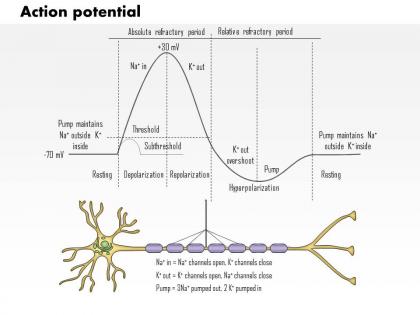
The resting membrane potential maintains a stable negative charge around -70mV through sodium-potassium pumps, while action potentials create rapid voltage spikes reaching +30mV through coordinated ion channel openings. These electrical mechanisms enable neurons to transmit information efficiently across neural networks, with many healthcare organizations finding that understanding these differences enhances diagnostic accuracy and treatment protocols.
Action potential phases include resting potential, depolarization, repolarization, and hyperpolarization, each involving specific ion movements across cell membranes. These phases enable rapid signal transmission in neurons and muscle cells by systematically opening and closing sodium and potassium channels, ultimately delivering precise cellular communication and coordinated responses throughout biological systems.
Myelinated axons conduct action potentials significantly faster than unmyelinated ones through saltatory conduction, where electrical signals jump between nodes of Ranvier rather than traveling continuously along the membrane. This myelin sheath enhancement enables nerve impulses to reach speeds of 120 m/s compared to 2 m/s in unmyelinated fibers, ultimately delivering faster neural communication and more efficient signal transmission throughout biological systems.
Threshold potential determines whether a neuron fires by establishing the critical voltage level needed to trigger an action potential, typically around -55mV. This mechanism ensures reliable signal transmission by preventing weak stimuli from causing firing, while strong enough inputs consistently generate responses, ultimately enabling precise neural communication and information processing across complex networks.
The sodium-potassium pump maintains the resting potential by actively transporting three sodium ions out and two potassium ions in, creating the electrochemical gradient essential for action potentials. This ATP-driven mechanism enables rapid neural signaling in organisms, particularly critical for nervous system function in complex organisms, ultimately delivering efficient communication pathways and responsive neurological processes.
Neurotransmitters facilitate action potential transmission across synapses by binding to receptor channels on postsynaptic neurons, triggering depolarization or hyperpolarization. These chemical messengers enable neural communication between cells, with dopamine, serotonin, and acetylcholine playing crucial roles in converting electrical signals into chemical signals, ultimately ensuring seamless information flow throughout nervous systems.
Temperature and ion concentrations significantly influence action potential speed by affecting membrane permeability, voltage-gated channel kinetics, and electrochemical gradients across neural membranes. Higher temperatures accelerate channel opening and closing rates, while optimal sodium and potassium concentrations ensure faster depolarization and repolarization phases, ultimately enabling more efficient neural transmission and enhanced cellular communication throughout biological systems.
Action potentials are all-or-nothing electrical signals that propagate along neurons without diminishing, while graded potentials are variable-strength, localized responses that decrease over distance. These distinct mechanisms enable neural networks to process information through graded integration at synapses and reliable long-distance transmission via action potentials, ultimately delivering precise cellular communication and coordinated physiological responses.
Action potentials enable neurons to transmit electrical signals across synapses by triggering neurotransmitter release, facilitating rapid information transfer throughout neural networks. These electrical impulses streamline communication between brain regions, spinal cord pathways, and peripheral systems, ultimately delivering coordinated responses, memory formation, and cognitive processing that enhance overall neurological function and behavioral adaptation.
Refractory periods are recovery phases following action potentials when neurons cannot generate new signals normally, including absolute periods preventing any stimulation and relative periods requiring stronger stimuli. These mechanisms ensure unidirectional signal propagation and prevent excessive neural firing, with many neurological systems finding that controlled refractory timing enables precise communication, ultimately delivering coordinated responses and optimal neural efficiency.
Abnormalities in action potential generation disrupt neural communication through faulty ion channel function, altered membrane permeability, and impaired signal transmission. These disruptions manifest in conditions like epilepsy, where excessive neuronal firing occurs, multiple sclerosis with demyelination affecting conduction speed, and neuropathies involving damaged axons, ultimately compromising cognitive function and motor control.
Experimental techniques for studying neuronal action potentials include patch-clamp electrophysiology, voltage-clamp recordings, intracellular microelectrodes, fluorescent voltage indicators, and multi-electrode arrays. These methods enable researchers to measure membrane potential changes, ion channel dynamics, and network activity patterns, with neuroscience laboratories and pharmaceutical companies finding that these approaches accelerate drug discovery and enhance understanding of neurological disorders.
The all-or-nothing principle means action potentials fire at full strength or not at all, with threshold stimulation triggering complete depolarization regardless of stimulus intensity above threshold. This mechanism ensures reliable signal transmission in neurons, enabling consistent communication in neural networks across the brain, spinal cord, and peripheral nervous system, ultimately delivering precise control over bodily functions and cognitive processes.
Action potentials trigger muscle contraction by traveling along muscle fiber membranes and releasing calcium ions from the sarcoplasmic reticulum, enabling actin-myosin interactions. This electrical signaling process streamlines neuromuscular coordination, enhances athletic performance assessment, and delivers precise timing control, with many sports medicine and rehabilitation professionals finding that understanding these mechanisms ultimately improves training protocols and injury prevention strategies.
-
Illustrative design with editable content. Exceptional value for money. Highly pleased with the product.
-
Wonderful templates design to use in business meetings.