


0614 business ppt diagram forming storming norming performing powerpoint template




Try Before you Buy Download Free Sample Product
 Impress Your
 Audience
 100%
100% Editable
 Save Hours
 of Time


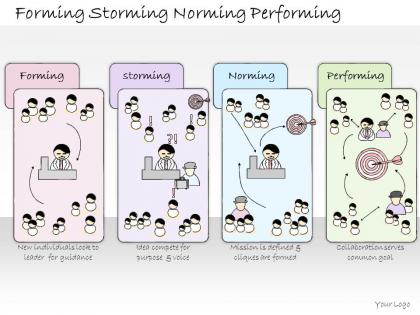
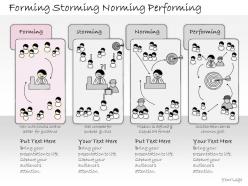
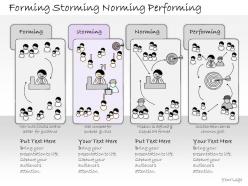
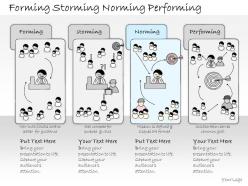
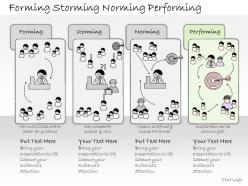
Download this impressive presentation design to share the concept of team development in the business industry. Team building is one of the most crucial aspects of the business success. The stages shown in the process are storming, performing, norming, forming. These stages are stepped in a four different section with the vector of business team. The PowerPoint slide illustrates the business team development information in the organized manner. Along with business growth, the group development is also critical as the team members are the one that assist you to take the business to the next level, The PPT sample design has been crafted by our professional designers after understanding the team development concept. Team building is a communal word for numerous types of undertakings which are used to improve social relations and define roles within groups, usually involving cooperative tasks. This PowerPoint layout is easily editable and you can make changes with it according to the corporate requisite. Download it for your next presentation. Use all the tools at your disposal. High end 0614 Business Ppt Diagram Forming Storming Norming Performing Powerpoint Template design are on hand to give your presentations an edge.
People who downloaded this PowerPoint presentation also viewed the following :
0614 business ppt diagram forming storming norming performing powerpoint template with all 11 slides:
Formality has many degrees. Our 0614 Business Ppt Diagram Forming Storming Norming Performing Powerpoint Template are amenable to all.
FAQs for 0614 business ppt diagram forming storming norming
The key stages of team development include forming, storming, norming, performing, and adjourning, each requiring distinct facilitation approaches. Effective facilitation involves establishing clear expectations during forming, managing conflicts constructively in storming, and building collaborative processes in norming, with many organizations finding that structured interventions accelerate progression to high-performing teams.
Team dynamics significantly influence productivity and creativity through communication patterns, trust levels, role clarity, psychological safety, and shared decision-making processes. Effective dynamics enable teams to leverage diverse perspectives, reduce conflicts, and accelerate problem-solving, with many organizations finding that well-functioning teams deliver faster innovation cycles, higher quality outcomes, and enhanced competitive advantage in collaborative projects.
Strategies include establishing clear communication protocols, defining roles and responsibilities, implementing conflict resolution frameworks, fostering psychological safety, and creating structured feedback mechanisms. These approaches streamline team dynamics by minimizing misunderstandings, accelerating trust-building, and enhancing collaborative efficiency, with many organizations finding that systematic development processes ultimately deliver stronger performance outcomes and sustained competitive advantage.
Effective communication serves as the foundation for successful progression through forming, storming, norming, performing, and adjourning stages, enabling clarity of roles, conflict resolution, and shared understanding. Teams with strong communication protocols navigate transitions more smoothly, establish trust faster, and ultimately achieve higher performance levels, with many organizations finding that structured communication frameworks significantly accelerate team maturity and productivity.
Leadership serves as the navigating force that adapts management style, communication approach, and support level to match each team development stage, from providing clear direction during forming to facilitating collaboration during storming and norming. Effective leaders recognize developmental cues, adjust their involvement accordingly, and create psychological safety that accelerates progression, ultimately delivering higher team performance and stronger organizational outcomes.
Cultural diversity strengthens team development by bringing varied perspectives, problem-solving approaches, creative solutions, and market insights that enhance innovation and decision-making. Teams with diverse cultural backgrounds deliver more comprehensive strategies, better serve global customers, and adapt more effectively to changing markets, with many organizations finding that diverse teams outperform homogeneous ones significantly.
Team effectiveness assessment tools include 360-degree feedback systems, team diagnostic surveys, performance metrics dashboards, behavioral assessment frameworks, and peer evaluation platforms. These frameworks enhance team development by identifying skill gaps, measuring collaboration effectiveness, and tracking progress over time, with many organizations finding that regular assessments ultimately deliver improved productivity and stronger team cohesion.
Feedback loops can be established through regular one-on-ones, structured retrospectives, peer review systems, real-time project check-ins, and 360-degree assessments. These mechanisms streamline communication, identify improvement opportunities, and accelerate skill development, with many organizations finding that consistent feedback cycles ultimately deliver higher team performance and enhanced collaboration across departments.
Team size significantly influences development speed, communication patterns, decision-making efficiency, and role specialization, with smaller teams typically fostering faster consensus and stronger relationships while larger teams enable diverse expertise and resource depth. Organizations across sectors find that teams of 5-8 members often deliver optimal functionality by balancing collaborative intimacy with sufficient skill diversity, ultimately enhancing both innovation capacity and operational effectiveness.
Remote teams effectively navigate development through structured virtual onboarding, regular video check-ins, collaborative digital tools, clear communication protocols, and intentional relationship-building activities. These approaches streamline team formation by establishing trust early, maintaining consistent feedback loops, and creating shared accountability systems, with many distributed organizations finding that deliberate virtual team rituals ultimately deliver stronger cohesion and performance outcomes.
Best practices for establishing trust and rapport include open communication, consistent follow-through on commitments, active listening, transparency in decision-making, and creating psychological safety for sharing ideas. These approaches enhance team dynamics by encouraging collaboration, reducing conflict, and fostering mutual respect, with many organizations finding that structured team-building activities and regular feedback sessions ultimately deliver stronger performance and higher employee engagement.
Positive conflict management transforms disagreements into growth opportunities by establishing clear communication protocols, encouraging diverse perspectives, and focusing discussions on solutions rather than blame. Through structured dialogue and mediation techniques, teams in organizations like consulting firms and project-based companies find that managed conflict enhances innovation, strengthens relationships, and ultimately delivers improved decision-making capabilities.
Team development metrics should include communication effectiveness, collaboration frequency, decision-making speed, conflict resolution time, goal achievement rates, and individual skill progression. These measurements enable organizations to track evolving team dynamics, identify development bottlenecks, and optimize performance outcomes, with many companies finding that regular assessment accelerates team maturity and delivers sustained competitive advantage.
Individual roles and responsibilities evolve from unclear, overlapping functions in forming stages to clearly defined, specialized positions during norming and performing phases. Through structured team development, members transition from general contributors to strategic specialists, with many organizations finding that this evolution enhances operational efficiency, reduces conflicts, and ultimately delivers stronger collaborative outcomes and competitive advantage.
Team-building activities enhance development by improving communication skills, building trust among members, identifying individual strengths, fostering collaborative problem-solving, and creating stronger interpersonal relationships. These activities enable teams to work more cohesively on projects, streamline decision-making processes, and ultimately deliver better results, with many organizations finding that structured team experiences significantly boost both morale and productivity.
-
Great product with effective design. Helped a lot in our corporate presentations. Easy to edit and stunning visuals.
-
Out of the box and creative design.