

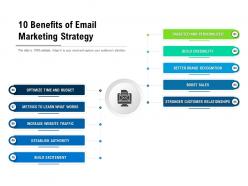
10 Benefits Of Email Marketing Strategy





Try Before you Buy Download Free Sample Product
 Impress Your
Audience
 100%
Editable
 Save Hours
of Time


Our 10 Benefits Of Email Marketing Strategy are topically designed to provide an attractive backdrop to any subject. Use them to look like a presentation pro.
People who downloaded this PowerPoint presentation also viewed the following :
10 Benefits Of Email Marketing Strategy with all 2 slides:
Use our 10 Benefits Of Email Marketing Strategy to effectively help you save your valuable time. They are readymade to fit into any presentation structure.

FAQs for 10 Benefits Of
Effective email marketing strategies include targeted audience segmentation, compelling subject lines, personalized content, mobile optimization, and automated workflows. These components work together by increasing open rates, driving engagement, and nurturing leads through strategic touchpoints, with many retailers and service providers finding that personalized automation delivers higher conversion rates and customer retention.
Segmentation improves email campaign effectiveness by enabling personalized messaging, targeted content delivery, and strategic timing based on subscriber demographics, behaviors, and preferences. Through segmented campaigns, businesses achieve higher open rates, increased click-through rates, and improved conversion rates, with many retailers and service providers finding that targeted messaging delivers significantly better ROI than generic broadcasts.
Businesses should track open rates, click-through rates, conversion rates, unsubscribe rates, and revenue per email to measure email marketing success. These metrics enable organizations to optimize campaign performance, improve audience engagement, and maximize ROI, with many companies finding that tracking deliverability and list growth rates ultimately delivers better customer relationships and increased sales.
Personalization enhances user engagement by delivering targeted content based on individual preferences, purchase history, demographics, and behavioral patterns, creating more relevant messaging experiences. Through advanced segmentation and dynamic content, businesses streamline customer interactions while significantly increasing open rates, click-through rates, and conversions, ultimately delivering stronger customer relationships and improved campaign ROI.
A/B testing enables marketers to systematically compare different email elements like subject lines, content formats, call-to-action buttons, and send times to determine which variations generate higher engagement rates. Through strategic testing of headlines, personalization approaches, and visual layouts, organizations can optimize open rates, click-through performance, and conversion outcomes, ultimately delivering more targeted campaigns and measurable ROI improvements.
Mobile-friendly email templates require responsive design, single-column layouts, large touch-friendly buttons, concise subject lines, and optimized images that load quickly across devices. These practices enhance user engagement by ensuring seamless readability, faster load times, and improved click-through rates, with retailers and service providers finding that mobile-optimized campaigns deliver significantly higher conversion rates and customer satisfaction.
Businesses build healthy email subscriber lists by offering valuable lead magnets, implementing double opt-in processes, segmenting audiences based on preferences, and regularly cleaning inactive subscribers. Through strategic content marketing, targeted landing pages, and social media integration, organizations enhance engagement rates, reduce spam complaints, and improve deliverability, ultimately delivering higher conversion rates and stronger customer relationships.
Key email marketing regulations include GDPR, CAN-SPAM Act, CASL, CCPA, and industry-specific compliance requirements that govern consent, data protection, and unsubscribe mechanisms. These frameworks streamline customer trust by requiring transparent opt-in processes, clear sender identification, and robust data handling, with many organizations finding that proactive compliance ultimately delivers enhanced deliverability and stronger customer relationships.
Businesses should send marketing emails 1-2 times weekly for most industries, though frequency depends on audience preferences, content value, and business type. E-commerce companies often succeed with daily promotional emails during peak seasons, while B2B service providers typically find weekly newsletters more effective, with many organizations discovering that consistent, valuable content maintains engagement better than sporadic campaigns.
High-performing email content includes personalized product recommendations, educational newsletters, exclusive offers, customer testimonials, and behind-the-scenes stories that build authentic connections. These content types enhance engagement by delivering targeted value, fostering trust, and creating urgency, with many businesses finding that segmented, story-driven campaigns ultimately drive higher open rates and conversions.
Automation tools enhance email marketing efficiency by streamlining campaign scheduling, personalizing content delivery, and segmenting audiences based on behavioral triggers and preferences. These technologies enable marketers to deliver targeted messages at optimal times, track engagement metrics in real-time, and nurture leads automatically, ultimately reducing manual workload while improving conversion rates and customer experiences.
Common email marketing mistakes include sending irrelevant content, overwhelming subscribers with excessive frequency, neglecting mobile optimization, using generic subject lines, and ignoring segmentation strategies. These pitfalls significantly reduce engagement rates and deliverability, with many organizations finding that personalized, targeted campaigns generate 25% higher open rates and ultimately deliver better customer retention and conversion outcomes.
Storytelling in email campaigns builds brand loyalty by creating emotional connections, sharing authentic brand values, and featuring relatable customer journeys that resonate with subscribers. Through narrative-driven content, companies like Patagonia and Airbnb transform routine promotional emails into compelling experiences, ultimately fostering deeper customer relationships and increasing long-term retention rates.
Effective subject line strategies include personalization with recipient names, creating urgency through time-sensitive language, asking compelling questions, using numbers and statistics, and keeping length under 50 characters for mobile optimization. These approaches streamline email engagement by increasing curiosity, relevance, and immediate value perception, with many businesses finding that A/B testing different strategies ultimately delivers 20-30% higher open rates.
Integrating social media enhances email marketing by expanding reach through cross-platform promotion, enabling list growth via social sign-ups, and creating cohesive brand messaging across channels. Through strategic combination of platforms, businesses streamline customer engagement, increase email open rates through social proof, and deliver personalized experiences, with many organizations finding that unified campaigns generate significantly higher conversion rates and stronger customer relationships.
-
Topic best represented with attractive design.