


100 days plan establish visions and targets




Try Before you Buy Download Free Sample Product
 Impress Your
 Audience
 100%
100% Editable
 Save Hours
 of Time


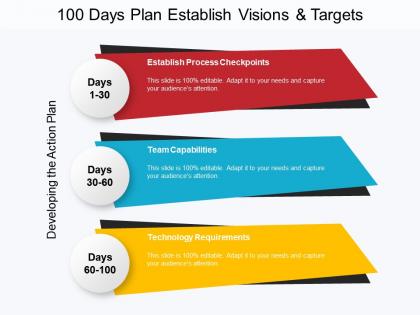
We present our new 100 Days plan establish visions and targets PowerPoint slides. This business template assists you in generating 100 day long plans for your business purposes. The PPT is a three-stage process and the stages are 100 day plan, 100 day action plan and 100 day strategy. All your plans are going to be successful once you form your plans using our 100 Days Plan Establish Vision and Targets PowerPoint Presentation. The PowerPoint template lets you develop the action plan by establishing process checkpoints in the first 30 days, measuring the team capabilities in the next 30 days and then measure the technology requirements in the next 40 days. So, this makes 100 days in total. You can also edit the plans formed to make them congenial. The illustrations used in the slideshow are very attractive. You just have to enter the data in a pre-designed format and present it. Get folks to believe they have a good bargain with our 100 Days Plan Establish Visions And Targets. They actually end up buying.
People who downloaded this PowerPoint presentation also viewed the following :
100 days plan establish visions and targets with all 5 slides:
Go and achieve with our 100 Days Plan Establish Visions And Targets. Accomplish all that you desire to.


FAQs for 100 days plan establish
A successful 100 Days Plan includes clear objectives, prioritized milestones, stakeholder engagement strategies, resource allocation frameworks, and performance metrics. These components work together by establishing focused direction, enabling systematic progress tracking, and ensuring accountability across teams, with many organizations finding that this structured approach delivers accelerated results and enhanced operational efficiency.
A 100 Days Plan can be tailored by aligning specific milestones with organizational priorities, whether focusing on revenue growth, operational efficiency, cultural transformation, or market expansion. Through strategic customization, companies streamline implementation by adapting timelines, resource allocation, and success metrics to their unique context, with many organizations finding that sector-specific approaches ultimately deliver faster results and measurable competitive advantage.
Key metrics for measuring 100 Days Plan success include milestone completion rates, budget adherence, stakeholder engagement scores, deliverable quality assessments, and timeline accuracy. These measurements enable organizations to track progress systematically, identify bottlenecks early, and demonstrate tangible value to leadership, with many companies finding that regular metric reviews ultimately drive accountability and sustainable momentum.
A 100 Days Plan should be reviewed weekly for progress tracking and adjusted bi-weekly or monthly based on evolving priorities and market conditions. This strategic cadence enables organizations to maintain momentum while adapting to new opportunities, with many companies finding that regular reviews enhance accountability, streamline resource allocation, and ultimately deliver better outcomes.
Common pitfalls include setting unrealistic expectations, lacking stakeholder buy-in, insufficient resource allocation, poor progress tracking mechanisms, and failing to build in flexibility for adjustments. These challenges can derail implementation across organizations, with many finding that successful plans balance ambitious goals with practical timelines, while maintaining regular communication channels and adaptive frameworks that enable course corrections without losing strategic momentum.
Team engagement during a 100 Days Plan implementation can be fostered through clear communication of goals, regular progress updates, collaborative milestone celebrations, and transparent feedback mechanisms. These approaches streamline team alignment by creating shared accountability, recognizing individual contributions, and maintaining momentum, with many organizations finding that frequent touchpoints and visible progress tracking ultimately deliver higher participation rates and sustained motivation throughout the critical first quarter.
Leadership drives 100 Days Plan success by setting clear vision, maintaining accountability, securing resources, and fostering cross-functional collaboration throughout the organization. Effective leaders streamline decision-making processes, remove implementation barriers, and communicate progress transparently, with many organizations finding that strong executive sponsorship ultimately delivers faster project completion and higher team engagement rates.
Feedback loops can be integrated through weekly check-ins, milestone assessments, stakeholder surveys, performance metrics tracking, and regular team retrospectives throughout the plan's duration. These mechanisms enable organizations to identify bottlenecks, adjust strategies, and optimize resource allocation in real-time, with many companies finding that structured feedback cycles ultimately deliver faster goal achievement and enhanced operational efficiency.
Best practices for communicating 100 Days Plans include establishing clear messaging frameworks, creating multi-channel communication strategies, scheduling regular progress updates, developing stakeholder-specific presentations, and maintaining transparent feedback loops. These approaches enhance stakeholder buy-in by delivering consistent information, addressing concerns proactively, and demonstrating measurable progress, with many organizations finding that structured communication ultimately accelerates plan execution and builds leadership credibility.
A 100 Days Plan enhances organizational agility by establishing rapid decision-making frameworks, streamlining communication channels, implementing quick feedback loops, and prioritizing high-impact initiatives with measurable outcomes. This strategic approach enables organizations to pivot swiftly during market changes, reduce response times to customer needs, and build adaptive capabilities, with many companies finding that focused short-term planning ultimately delivers sustained competitive advantage.
Visual presentation tools enhance 100 Days Plan communication through interactive timelines, milestone dashboards, progress tracking charts, and stakeholder alignment matrices. These tools streamline complex project phases by consolidating objectives, deliverables, and accountability measures into digestible formats, with many organizations finding that visual storytelling accelerates team buy-in and executive approval while ensuring consistent progress monitoring.
Innovative collaboration strategies for 100 Days Plan execution include cross-functional sprint teams, digital collaboration hubs, real-time progress dashboards, peer mentoring networks, and gamified milestone tracking. These approaches streamline communication, enhance accountability, and accelerate decision-making by creating transparent workflows, fostering knowledge sharing, and maintaining momentum, with many organizations finding that structured collaboration frameworks ultimately deliver faster results and stronger team alignment.
A 100 Days Plan drives cultural change by establishing clear behavioral expectations, implementing targeted communication strategies, and creating early wins that demonstrate new values in action. Through focused initiatives like leadership modeling, employee engagement programs, and recognition systems, organizations can shift mindsets, build momentum for sustained transformation, and ultimately embed desired cultural elements into daily operations.
Setting short-term goals creates immediate momentum and measurable progress milestones, while long-term goals provide strategic direction and sustainable vision alignment within your 100 Days Plan. This balanced approach enables organizations to deliver quick wins that build confidence and stakeholder buy-in, while simultaneously advancing toward broader objectives, with many finding that this dual focus accelerates overall achievement rates.
Lessons learned from previous 100 Days Plans inform future initiatives by identifying successful strategies, common implementation challenges, and resource allocation patterns that drive results. These insights enable organizations to refine their planning processes, streamline goal-setting methodologies, and enhance stakeholder engagement approaches, with many companies finding that documented learnings significantly improve subsequent plan success rates and organizational readiness.
No Reviews