

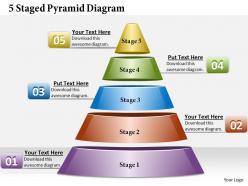
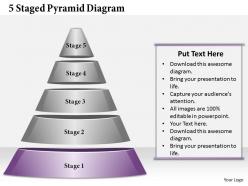
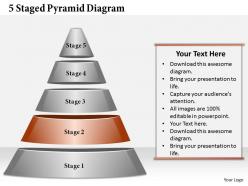
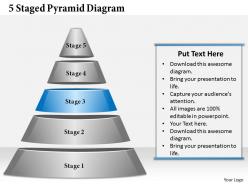
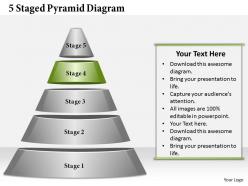
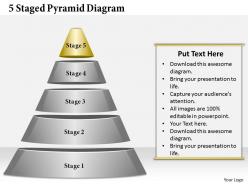
1013 business ppt diagram 5 staged pyramid diagram powerpoint template





Try Before you Buy Download Free Sample Product
 Impress Your
 Audience
 100%
100% Editable
 Save Hours
 of Time


There's no need to be a killer presenter or to have design skills. Our readymade 1013 Business Ppt diagram 5 Staged Pyramid Diagram Powerpoint Template are ready to use anytime you want it.
People who downloaded this PowerPoint presentation also viewed the following :
1013 business ppt diagram 5 staged pyramid diagram powerpoint template with all 10 slides:
Fill in the blanks with our 1013 Business Ppt diagram 5 Staged Pyramid Diagram Powerpoint Template. Solve the puzzle with your clever ideas.
FAQs for 1013 business ppt diagram 5 staged pyramid
A 5-staged pyramid diagram helps presenters structure complex information hierarchically, enhance visual comprehension, demonstrate clear progression through processes, and create memorable content that audiences can easily follow. This visualization tool streamlines communication by breaking down strategic initiatives into digestible levels, with many organizations finding that pyramid structures significantly improve stakeholder understanding and decision-making during presentations.
The 5 staged pyramid diagram enhances complex information clarity by breaking down intricate concepts into five manageable, hierarchical levels, creating visual flow from broad foundations to specific details, and establishing logical connections between interconnected elements. This structured approach enables teams across sectors like consulting, healthcare, and project management to communicate multi-layered strategies more effectively, ultimately delivering improved stakeholder understanding and faster decision-making processes.
**INPUT**: What industries or fields most commonly utilize 5 staged pyramid diagrams? **OUTPUT**: Industries utilizing 5 staged pyramid diagrams include healthcare, manufacturing, consulting, education, and financial services for strategic planning and process visualization. These sectors leverage pyramids to streamline organizational hierarchies, quality frameworks, and operational workflows, with many organizations finding that structured visual representation enhances decision-making efficiency and stakeholder communication.
Best practices for designing effective 5 staged pyramid diagrams include using hierarchical sizing with the largest base stage, maintaining consistent color schemes, ensuring clear labeling for each level, applying logical flow from foundation to apex, and incorporating adequate white space for readability. These design principles streamline complex information by creating visual emphasis, enhancing comprehension through structured progression, and delivering professional presentations, with many organizations finding that well-designed pyramids significantly improve stakeholder understanding and decision-making processes.
Color theory enhances 5 staged pyramid diagrams through strategic gradient progression, complementary accent colors, and psychological associations that guide visual flow from base to apex. Financial services firms and healthcare organizations increasingly use warm-to-cool transitions or monochromatic schemes with varying intensities, creating intuitive hierarchies that improve comprehension rates and audience retention while reinforcing brand messaging.
**INPUT**: What types of data or concepts are best represented using a 5 staged pyramid diagram? **OUTPUT**: Five-staged pyramid diagrams excel at representing hierarchical data including organizational structures, priority frameworks, skill development levels, market segmentation tiers, and process maturity models. These visual frameworks streamline complex business concepts by demonstrating clear progression paths, resource allocation strategies, and strategic dependencies, with many organizations finding that pyramid structures enhance stakeholder understanding while delivering improved decision-making and operational clarity. **Word count: 58 words**
The 5 staged pyramid diagram emphasizes hierarchical relationships and progressive levels, while flowcharts showcase sequential processes and Venn diagrams illustrate overlapping relationships between different sets. While flowcharts excel at mapping workflows and Venn diagrams effectively demonstrate intersections, pyramid diagrams uniquely deliver structured priority visualization, enabling organizations to communicate foundational concepts, strategic layers, and escalating complexity with exceptional clarity.
Key design elements for a 5 staged pyramid diagram include hierarchical proportions, clear stage delineation, consistent color coding, readable typography, and strategic spacing between levels. These visual components work together by establishing clear information flow, maintaining visual balance, and ensuring audience comprehension, with many organizations finding that proper contrast and alignment ultimately enhance presentation impact and message retention.
A 5 staged pyramid diagram's layout significantly influences perception through its hierarchical structure, visual flow, and emphasis on foundational elements, creating natural reading patterns from base to apex. This structured approach enables audiences to grasp complex information sequentially, understand priority relationships between stages, and retain key concepts more effectively, with many organizations finding that pyramid layouts enhance comprehension and strategic messaging impact.
Common mistakes include overcrowding stages with excessive text, using inconsistent visual hierarchy, poor color choices that reduce readability, misaligning the logical flow between levels, and failing to maintain proportional stage sizing. These design flaws can confuse audiences and dilute your message's impact, with many organizations finding that clear, balanced pyramid structures enhance comprehension and retention, ultimately delivering more effective presentations and strategic communications.
Storytelling transforms a 5 staged pyramid diagram by creating narrative flow between levels, using character journeys that progress through each stage, and incorporating conflict-resolution arcs that mirror the pyramid's structure. Through strategic narrative elements, organizations can enhance audience engagement, improve information retention, and deliver more compelling presentations, with many finding that story-driven pyramids ultimately create stronger emotional connections and drive better decision-making outcomes.
Digital tools and templates streamline 5 staged pyramid diagram creation through automated formatting, drag-and-drop functionality, pre-designed layouts, collaborative editing features, and instant customization options. These platforms enable teams to rapidly build professional presentations by eliminating manual design work, ensuring consistent branding, and facilitating real-time collaboration, ultimately delivering faster project completion and enhanced visual communication across organizations.
Hierarchy establishes clear organizational structure in 5 staged pyramid diagrams by defining relationships between foundational elements, intermediate processes, and strategic outcomes. This structured approach enables organizations to communicate complex workflows, decision-making chains, and resource allocation effectively, with many businesses finding that hierarchical visualization streamlines understanding and enhances strategic planning across departments.
Presenters can use a 5 staged pyramid diagram to facilitate audience participation by encouraging input at each level, assigning breakout groups to analyze different stages, and creating interactive discussions around stage progressions. This structured approach enables audiences to contribute specific insights, collaborate on solutions across pyramid levels, and engage in meaningful dialogue, ultimately delivering enhanced learning experiences and stronger presentation outcomes.
Successful case studies include Toyota's lean manufacturing hierarchy, McKinsey's problem-solving frameworks, healthcare quality improvement initiatives, financial services risk management protocols, and organizational change management programs. These pyramid structures streamline complex information by establishing clear hierarchical relationships, enabling stakeholders to quickly grasp priorities and dependencies, while ultimately delivering enhanced decision-making speed and improved cross-functional collaboration across diverse business environments.
-
Great designs, Easily Editable.
-
Unique research projects to present in meeting.