


12 Month Budget Plan For Marketing Expense





Try Before you Buy Download Free Sample Product
 Impress Your
Audience
 100%
Editable
 Save Hours
of Time


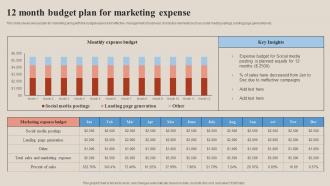
This slide shows annual plan for marketing along with the budget expense for effective management of business. It includes elements such as social media postings, landing page generation etc.
People who downloaded this PowerPoint presentation also viewed the following :
12 Month Budget Plan For Marketing Expense with all 7 slides:
Use our 12 Month Budget Plan For Marketing Expense to effectively help you save your valuable time. They are readymade to fit into any presentation structure.






FAQs for 12 Month Budget Plan
Key components of an effective marketing budget plan include advertising spend allocation, content creation costs, digital marketing investments, personnel expenses, and performance tracking tools. These elements work together by ensuring strategic resource distribution across channels, enabling data-driven decision making, and maximizing ROI, with many organizations finding that comprehensive budget planning delivers measurable growth and competitive market positioning.
Determining appropriate budget allocation involves analyzing historical performance data, target audience preferences, channel ROI metrics, and competitive landscape analysis. Many organizations start with the 70-20-10 rule, allocating 70% to proven channels, 20% to promising opportunities, and 10% to experimental initiatives, while continuously adjusting based on performance analytics and market dynamics.
Key metrics to track include return on investment (ROI), customer acquisition cost (CAC), conversion rates, lead generation volume, and customer lifetime value (CLV). These measurements enable organizations to assess campaign effectiveness, optimize resource allocation, and demonstrate marketing's impact on revenue growth, with many companies finding that comprehensive tracking ultimately delivers better budget decisions and competitive advantage.
Small businesses can optimize their marketing budget by focusing on cost-effective digital channels, leveraging social media platforms, implementing targeted email campaigns, and utilizing content marketing strategies. These approaches streamline resource allocation while maximizing reach, with many retail and service businesses finding that strategic combinations of organic social content and email automation deliver higher customer engagement and conversion rates than traditional advertising methods.
Market research provides critical insights for budget allocation decisions by identifying target audience preferences, competitive landscape dynamics, channel effectiveness data, and market opportunity assessments. Through comprehensive research, companies can strategically distribute resources across high-impact initiatives, optimize campaign spending, and minimize wasteful expenditures, with many organizations finding that data-driven budget planning delivers significantly higher ROI and competitive advantage.
Adjusting marketing budgets requires reallocating resources based on performance data, shifting channel investments toward higher-converting platforms, and increasing spend in growing market segments while reducing investment in declining areas. Companies typically reallocate 15-30% of their quarterly budgets, with retail and tech sectors finding that agile budget management enables faster response to opportunities, ultimately delivering improved ROI and competitive advantage.
Common marketing budget pitfalls include underestimating digital advertising costs, failing to allocate funds for testing and optimization, ignoring seasonal fluctuations, and not setting aside contingency reserves. Many organizations find that overfocusing on traditional channels while underinvesting in data analytics and attribution tools ultimately limits their ability to measure ROI and optimize campaigns effectively.
Technology and automation tools enhance marketing budget effectiveness by streamlining campaign management, optimizing ad spend through real-time bidding, and personalizing customer experiences at scale. These solutions enable marketers to automate repetitive tasks, track ROI with precision analytics, and allocate resources dynamically, with many organizations finding that automated platforms deliver significantly higher conversion rates while reducing operational costs.
Marketing budget allocations typically range from 5-15% of revenue, with B2B companies averaging 6-8% and B2C businesses often investing 9-12%, depending on industry maturity and growth stage. These percentages enable organizations to maintain competitive positioning, drive customer acquisition, and support brand development, with many companies finding that strategic allocation across digital channels, content creation, and performance marketing ultimately delivers measurable ROI and sustainable growth.
Businesses can incorporate digital marketing costs by allocating budgets across paid advertising, content creation, social media management, email marketing platforms, and analytics tools. Companies typically dedicate 20-50% of their marketing budget to digital channels, with retail and e-commerce organizations finding that this strategic allocation delivers higher ROI, better customer targeting, and measurable performance metrics compared to traditional marketing approaches.
Marketing budget flexibility requires diversified allocation strategies, scenario-based planning, quarterly review cycles, and performance-driven reallocation protocols. These approaches enable organizations to pivot resources quickly, with many companies finding that maintaining 15-20% contingency reserves and leveraging agile marketing frameworks delivers competitive responsiveness while optimizing ROI across changing market conditions.
Historical data informs marketing budget decisions by revealing campaign performance patterns, seasonal trends, customer acquisition costs, and ROI variations across channels and timeframes. Through analytics platforms, marketing teams can identify high-performing strategies, optimize resource allocation, and predict future outcomes, with many organizations finding that data-driven budgeting delivers significantly improved campaign effectiveness and measurable competitive advantage.
Seasonal trends significantly impact marketing budget planning by requiring strategic allocation adjustments, campaign timing optimization, and resource reallocation based on consumer behavior patterns. Through data-driven forecasting, organizations in retail, hospitality, and e-commerce enhance revenue timing, minimize waste during low-demand periods, and maximize ROI during peak seasons, ultimately delivering competitive advantage.
To effectively communicate marketing budget value, present clear ROI metrics, tie spending to specific business objectives, showcase past performance data, and demonstrate competitive positioning advantages. Through detailed attribution reports and revenue forecasting, stakeholders can see how marketing investments drive customer acquisition, retention rates, and market share growth, ultimately delivering measurable business outcomes that justify strategic resource allocation.
Marketing budget prioritization should focus on ROI potential, target audience alignment, campaign scalability, competitive positioning, and measurable outcomes. These criteria enable organizations to allocate resources strategically by evaluating cost-per-acquisition, market penetration opportunities, and brand visibility impact, with many companies finding that data-driven prioritization delivers enhanced customer acquisition and sustainable growth advantages.
-
Happy to incorporate such stunning templates in my presentation. Made my presentation look professional and engaging.
-
I am glad to have come across Slideteam. I was searching for some unique presentations and templates for my business. There are a lot of alternatives available here.