

3 models of corporate governance ppt layout




Try Before you Buy Download Free Sample Product
 Impress Your
 Audience
 100%
100% Editable
 Save Hours
 of Time


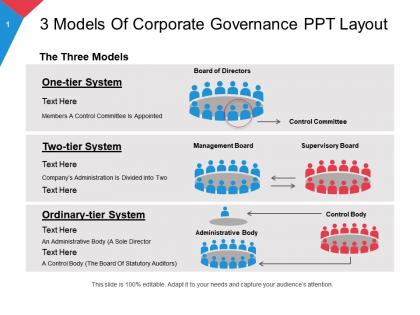
Identify the most effective governance model for your structure with our 3 models of corporate governance PPT layout. It will help your management to select the model which is best in their interest. Whereas you can define its importance with this business governance PowerPoint layout template for your business administration. Such as, it helps in managing all your business challenges and also helps in resolving your business problems in an efficient manner. It also helps in streamlining all your business functions also. You can also use this corporate governance structure Presentation layout to take better and enhanced investment and financial company decisions which directly results in improving your business worth and value. Explain the topic graphically in detail for the better understanding of your audience with this organizational governance PPT image. Also, use this entity governance model PowerPoint diagram to explain the elements which may affect your business model. Such as any type of human errors, external or internal forces, and more. Thus, click on the download link to start now. Identify external influences with our 3 Models Of Corporate Governance Ppt Layout. Equip folks to cater for the impact.
People who downloaded this PowerPoint presentation also viewed the following :
3 models of corporate governance ppt layout with all 5 slides:
Doubts don't get a chance to emerge due to our 3 Models Of Corporate Governance Ppt Layout. It ensures folks don't interrupt.



FAQs for 3 models of corporate
So basically it's about who you're actually trying to make happy. Shareholder governance? You're focused on investors - stock prices, dividends, all that money stuff. Stakeholder models are way broader though - you're thinking about employees, customers, the community, environment, not just shareholders. Quick way to think about it: one asks "how do we boost profits?" The other's like "how do we help everyone our business touches?" Most American companies are still pretty shareholder-heavy, but European ones tend to be more stakeholder-focused (probably why their work-life balance is better lol). Really depends what your company values long-term.
So basically, US companies are all about keeping shareholders happy - that's pretty much it. European companies? They actually care about employees and the environment too, which honestly makes more sense to me. Board setups are totally different - Americans pack theirs with independent directors obsessed with stock prices, but Europeans put actual employees on boards. Germany's co-determination thing is wild if you look it up. Regulation-wise, the US lets markets sort themselves out while Europe writes tons of specific rules. Just make sure you know what you're dealing with before jumping into international stuff!
So transparency is huge for corporate governance, but every region does it differently. Anglo-American companies go hard on public disclosures and shareholder reports. Europe's more about stakeholder transparency - like employee councils and community stuff. Asian models mix both but add this whole relationship-based element that honestly gets pretty messy to navigate. Without transparent processes though, you can't hold leadership accountable or make good decisions. Check what transparency rules actually apply in your area and for your stakeholders - that's where I'd start.
Track your compliance scores and audit results - that's the obvious stuff. Board attendance matters too, obviously. But honestly? The soft signals tell you way more. How fast do decisions actually happen? Are people speaking up in meetings or just nodding along like zombies? Survey stakeholders about trust levels every quarter. When shit hits the fan, can your board actually pivot or do they freeze up? Mix hard data with gut-check indicators on a scorecard. The real question: do investors genuinely trust your leadership or are they just being polite?
Honestly, the governance structure tells you everything about whether a company's CSR is legit or just BS. When there's actual board oversight - like dedicated committees watching ESG stuff - you get real programs with accountability. Otherwise? It's usually just fancy PR. Board diversity matters a ton too. Companies with varied perspectives actually push for meaningful social responsibility instead of surface-level gestures. My advice - always peek at their governance first before buying into any CSR claims. Saves you from falling for the corporate theater that weak leadership usually produces.
Dude, regulatory stuff totally shapes how companies set up their governance. Banking's probably the craziest - Basel III makes them have specific risk committees and capital oversight. Healthcare companies need specialized audit teams just for FDA compliance, which is honestly a nightmare. Insurance has all these solvency rules too. Your board makeup and committee structure has to match what regulators want for your industry. Oh, and your reporting has to align with their expectations. So yeah, always map out the regulatory landscape first when you're building these frameworks. It's like the foundation everything else sits on.
Honestly, tech makes governance way less painful. Board portals are a game changer - no more giant binders everywhere, just secure digital voting and document sharing. Real-time compliance monitoring with AI beats the usual audit season panic (trust me on this one). Automated reporting cuts out those annoying manual errors too. Your stakeholders get faster access to info, plus you'll have solid audit trails for everything. The best part? Way less time doing boring admin work means more focus on actual strategy stuff that matters.
Here's the thing - diverse boards just make better decisions. You get people challenging each other instead of everyone nodding along. Different backgrounds mean someone's actually going to spot risks others miss. Independent directors are huge too because they'll call out management when needed (no awkward conflicts). Honestly, the best boards don't just think about demographics - they want people who think differently. Skills matter obviously, but cognitive diversity is where the magic happens. You want board members who'll ask the uncomfortable questions. Makes for messier meetings but way better outcomes in the long run.
Look, startups get to build everything fresh but with zero budget or expertise. You're stuck doing bare-bones board meetings while trying to nail product-market fit - governance feels like a distraction, right? But honestly, that's your secret weapon. Big companies are drowning in legacy systems and bureaucratic nonsense when they try updating their governance. They've got competing stakeholders pulling in different directions. You can actually design something lean that grows with you. My advice? Start super simple with just the essentials, then add complexity later when you actually need it.
So boards are finally waking up to cyber risks - they're creating dedicated risk committees and actually requiring directors with cybersecurity backgrounds. At least one board member needs that expertise now, which honestly should've happened years ago. Companies are doing regular cyber assessments that go straight to the top instead of getting buried in IT. Some are bringing in outside cyber advisors too. The big shift? It's not just a tech problem anymore - it's business-critical. Oh, and make sure your whole board gets basic cyber training. Set up clear protocols for when (not if) something goes wrong.
So governance and culture basically feed into each other, right? Your board sets the tone - if they're big on transparency, that becomes the vibe throughout the company. People start acting that way naturally. But culture can flip it around too and actually change how governance works. It's this weird back-and-forth thing. Here's what I'd focus on though: when you're setting up any governance stuff, think about what behaviors you're accidentally encouraging. Because honestly, whatever you incentivize is exactly what you'll get - even if that wasn't the plan.
So basically the OECD, World Bank, and ICGN are like the cool kids setting corporate governance trends. They put out these guidelines - stuff about board independence, shareholder rights, transparency - that become the gold standard everyone copies. Stock exchanges and investors totally buy into it too. Companies desperately want to look legit, especially if they're going international or need global funding. It's honestly just fancy peer pressure, but it works. Your company pretty much has to play along with these frameworks or you'll look sketchy compared to competitors.
So basically these big institutional investors - pension funds, mutual funds, BlackRock and those guys - they've got tons of shares and aren't shy about using them. They vote on who's on the board, how much CEOs get paid, ESG stuff. Gone are the days when they just sat quietly in the background (finally, right?). If a company's governance sucks, they'll threaten to sell or vote against management. Most public companies actually have whole teams now just to keep these investors happy and avoid proxy fights. It's pretty wild how much power they wield.
Okay so basically you gotta shield your long-term planning from all that quarterly earnings drama. Set up board committees that actually focus on strategic stuff with longer timelines - like 3-5 years instead of just this quarter's numbers. Tie exec pay to those longer metrics too, not just annual bonuses. I mean, investors can be pretty shortsighted sometimes, but if you're upfront about your vision and explain the trade-offs you're making, most decent ones will get it. The trick is having systems in place so when things look rough quarterly, you can still defend those bigger decisions without panicking.
Honestly, look at Enron and Wells Fargo - their boards were basically just yes-men who didn't ask hard questions. You need directors who actually know what they're doing and aren't buddies with the CEO. Create real whistleblower protections (not just some HR hotline nobody trusts), do regular risk checks, and build a culture where people can speak up. That last part's huge - most problems get spotted early by employees, but they stay quiet because they're scared of getting fired. Oh, and diverse skills on the board matter way more than people think.
-
Innovative and attractive designs.
-
It saves your time and decrease your efforts in half.