


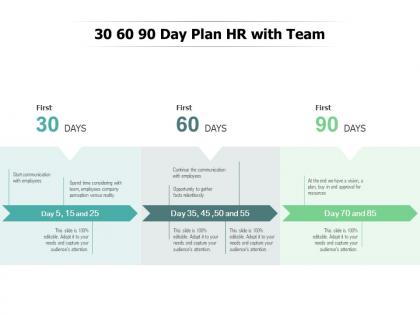
30 60 90 day plan hr with team





Try Before you Buy Download Free Sample Product
 Impress Your
 Audience
 100%
100% Editable
 Save Hours
 of Time


Feed the dose with our 30 60 90 Day Plan HR With Team. Help it go down their gullets.
People who downloaded this PowerPoint presentation also viewed the following :
30 60 90 day plan hr with team with all 5 slides:
No gulf is too great for our 30 60 90 Day Plan HR With Team. They help erase all differences.



FAQs for 30 60 90 day plan
Key objectives in the first 30 days include establishing stakeholder relationships, conducting comprehensive workforce assessments, reviewing existing policies and procedures, implementing immediate compliance updates, and setting up essential communication channels. These foundational activities streamline organizational transitions by building trust, identifying critical gaps, and ensuring regulatory alignment, with many HR teams finding that early relationship-building and policy audits ultimately deliver smoother operations and enhanced employee engagement.
HR teams can effectively assess current processes through comprehensive audits, employee feedback surveys, workflow mapping, stakeholder interviews, and performance metrics analysis. These evaluation methods streamline identification of bottlenecks, compliance gaps, and efficiency opportunities, with many organizations finding that systematic assessment delivers enhanced employee experiences, reduced processing times, and strategic alignment with business objectives.
**INPUT**: What strategies can be employed to build relationships with employees and stakeholders in the first month? **OUTPUT**: Effective first-month relationship strategies include conducting one-on-one meetings with team members, hosting informal coffee sessions with key stakeholders, implementing open-door policies, and organizing cross-departmental introductory sessions. These approaches enable HR leaders to understand organizational dynamics, identify immediate concerns, and establish trust through active listening, while many organizations find that early relationship investment ultimately delivers stronger employee engagement and smoother policy implementation.
At the 60-day mark, HR teams should prioritize initiatives based on foundational systems established in the first 30 days, focusing on process optimization, employee engagement programs, and performance management enhancements. These strategic priorities enable organizations to streamline recruitment workflows, implement feedback mechanisms, and strengthen retention strategies, with many companies finding that this systematic approach ultimately delivers improved employee satisfaction and operational efficiency.
Training and development plans for the first 60 days should include compliance certification updates, HR technology platform training, performance management system workshops, and cross-functional collaboration sessions. These strategic initiatives enhance team capabilities by streamlining administrative processes, improving data analytics skills, and strengthening employee relations expertise, ultimately delivering faster response times and more strategic HR support across departments.
HR teams can measure initiative effectiveness through employee engagement surveys, turnover rates, time-to-hire metrics, training completion percentages, and performance review scores. These measurements enable organizations to identify which programs deliver the strongest ROI, with many companies finding that systematic tracking at the 60-day mark helps optimize resource allocation and enhance overall workforce productivity.
HRIS platforms, applicant tracking systems, payroll automation software, performance management tools, and employee self-service portals can significantly streamline HR operations within 90 days. These technologies enhance efficiency by automating routine tasks, centralizing employee data, and enabling real-time reporting, with many organizations finding that strategic implementation reduces administrative overhead while improving employee experiences and operational transparency.
HR should communicate its vision through multi-channel strategies including town halls, department meetings, executive presentations, internal newsletters, and digital platforms like intranets or collaboration tools. These approaches enable transparent goal-sharing, stakeholder alignment, and feedback collection, while many organizations find that regular communication cadences, visual progress dashboards, and leadership endorsements ultimately deliver stronger employee engagement and organizational buy-in.
HR success metrics include employee engagement scores, time-to-fill positions, retention rates, training completion percentages, and performance review cycle adherence. These measurements enable organizations to track recruitment efficiency, workforce satisfaction, and operational effectiveness across departments, with many companies finding that consistent monitoring delivers improved talent acquisition, reduced turnover costs, and enhanced organizational productivity.
HR teams can foster feedback culture through regular one-on-ones, anonymous feedback systems, pulse surveys, open-door policies, and structured peer review processes. These approaches streamline communication by encouraging transparency, enhancing employee engagement, and establishing trust-building mechanisms, with many organizations finding that consistent feedback loops ultimately deliver improved performance and stronger workplace relationships.
Compliance serves as a foundational element throughout the 30-60-90 day HR plan, ensuring legal adherence, policy implementation, and risk mitigation at each phase. Initially focusing on audit assessments and documentation reviews, HR teams progressively enhance compliance frameworks, streamline reporting processes, and integrate regulatory requirements into daily operations, ultimately delivering organizational protection and operational confidence.
HR teams align 90-day objectives with business strategy by conducting stakeholder meetings with leadership, analyzing workforce gaps against strategic goals, and mapping talent initiatives to revenue targets. Through strategic workforce planning, teams can prioritize hiring for growth areas, develop skills training for emerging needs, and implement retention programs for critical roles, ultimately delivering enhanced organizational capability and competitive advantage.
**INPUT**: What strategies can be used to enhance employee engagement during the 90-day transformation? **OUTPUT**: Employee engagement strategies during 90-day transformations include transparent communication, regular feedback sessions, recognition programs, skill development opportunities, and collaborative goal-setting initiatives. These approaches enhance engagement by building trust, providing growth pathways, and involving employees in the change process, with many organizations finding that consistent recognition and clear communication ultimately deliver higher retention rates and improved productivity.
Stakeholder buy-in is critical for 30-60-90 day HR plan success, ensuring leadership alignment, resource allocation, realistic expectations, and organizational support throughout implementation phases. Without early engagement from executives, department heads, and key personnel, HR teams often face resistance, budget constraints, and competing priorities, while plans with strong stakeholder involvement deliver measurable improvements in employee satisfaction and operational efficiency.
Common pitfalls include setting unrealistic goals, neglecting stakeholder input, focusing solely on administrative tasks, underestimating resource requirements, and failing to establish measurable metrics. These challenges often derail HR transformation initiatives, with many organizations finding that strategic planning, cross-departmental collaboration, and balanced operational-strategic objectives ultimately deliver sustainable team performance and organizational alignment.
No Reviews